


A Free Lane Or Manège
Description
This section is from the book "Training Young Horses To Jump", by Geoffrey Brooke. Also available from Amazon: Training Young Horses To Jump.
A Free Lane Or Manège
A third method is jumping entirely free in a lane. Personally I dislike using the straight lane with fixed jumps, though undoubtedly excellent results have been obtained with a certain percentage of young horses trained in this way.
If a free lane is used, I think an oblong or elliptical manège with no fixed jump, except possibly a ditch, is by far the best. It is advisable not to have any upright jump at all in the manège for the first one or two lessons.
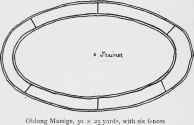
The horse must first understand what is required of him when he is put in the manège. For this purpose the trainer will stand in the centre with a long whip to keep the horse on the move. He must first be taught to go round the manège free at all paces to either hand, by which he will soon learn to take the bends cleverly with either leg leading at a canter. During this time he will also learn to understand the words "walk," "trot" and "canter." The turns at both ends teach the horse to collect himself as he comes round into the straight and will soon prevent him from attempting to rush. If he tries to whip round, and not go on the required circle, he must be instantly checked. About the third day a jump can be put in. By degrees more numerous and larger obstacles can be placed at various distances from the turns so that he obtains practice in judging his distance when suddenly coming on a jump.
It is necessary to commence with a small but solid obstacle so that the horse will not attempt more than once to chance a fence.
For a horse that takes off too close to a fence a guard rail just off the ground will be found useful to correct this fault.
Young horses will sometimes be found, when jumping, to get their noses right down between their knees, at the same time often failing to get their hocks properly under them and to raise their forehand properly. On the other hand, if they jump big and well with their weight very far forward they are apt to overjump themselves. Although, of course, con siderable liberty of rein is essential, this is a bad habit, and this mistaken effort of the horse should be checked by putting on a dumb jockey. On no account must the reins on the dumb jockey be so short as to stop his freedom in jumping, but merely to suggest a higher carriage of the head. They can then be shortened up gradually.
It is a good plan for those horses who appear to bungle their fences, and are unable to judge their distance properly, to place a bar one foot high at seven yards from the obstacle. The horse will then at the canter have to jump the bar, take one stride and jump the obstacle. It also helps to balance a young horse, by putting several bars at seven yards apart and perhaps one at four yards. In the latter space the horse will not take an extra stride, but will have to change his legs and jump. This is, I believe, continually practised in Italy.
In the early stages and, in fact, throughout all the training, all possible excitement should be avoided. This is most important and can only be arrived at by starting with very small obstacles jumped at a very slow pace, even at a walk. As the horse's ability and confidence increase the obstacles can be made correspondingly more difficult. If a young horse is refusing through nervousness the rider must show the greatest patience and, if possible, lower the fence and reward the horse liberally when he eventually jumps it. The idea is to teach the horse to like jumping, and to pop over a fence as quietly and kindly as he would go clown a road.
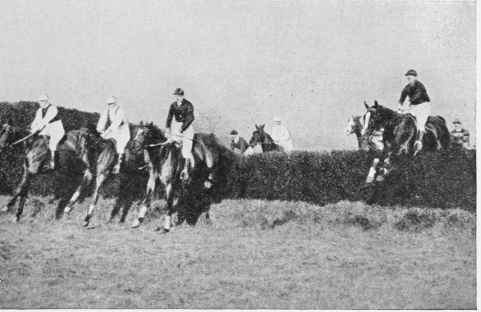
Fig. 4. - Horses Landing Over A Fence - They are jumping well. Both the riders themselves and the horses' heads are in the positions most suited for jumping with ease and galloping on without checking. - W. A. Rouch Copyright
Now, an old horse may often be useful to give a lead to a youngster jumping free, but this is by no means necessary if the schooling has been systematically progressive-in fact, it may even be harmful. The old horse will generally want to go faster than the youngster should at the commencement of his training, in which case the services of the former should be dispensed with.
The length of time that a young horse should be kept jumping free depends upon the following points:
1. His condition and state of his legs.
2. The state of the ground, good or otherwise.
3. His age and the weight of the rider who is training him.
4. Whether he has shown himself pro ficient, jumping free or not.
Generally, if the horse is fresh on his legs and fit to carry his rider, there is no object in continuing to jump him free.
Personally, I would not jump some horses free at all, but one must make allowances for the above conditions.
If the youngster has been schooled free on the lines suggested, he should not have contracted bad habits, such as rushing at his fences, jumping out of his stride, getting his head lower than is required to balance himself properly over the fences.
The horse eventually has to jump with a man on his back, so he must necessarily learn to balance himself differently under these new conditions.
For this reason it is not advisable to continue free jumping longer than may be required by any special circumstances.
Continue to:


My Books

