


Bits And Their Fitting On The Horse
Description
This section is from the book "Training Young Horses To Jump", by Geoffrey Brooke. Also available from Amazon: Training Young Horses To Jump.
Bits And Their Fitting On The Horse
The different actions of the snaffle and bit from a training point of view are often misunderstood.

Fig. 20 - The bit and bridoon reins are divided by the width of the hand. The head is here shown raised on the bridoon or snaffle. To exemplify this, the action of the hands is exaggerated.
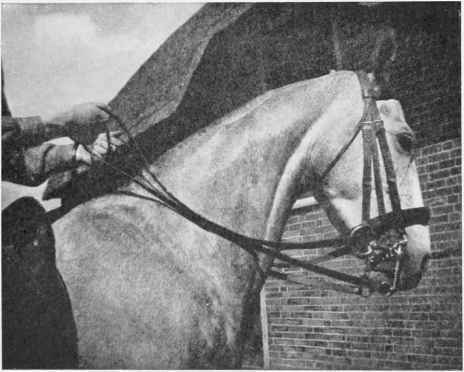
Fig. 21 - The back of the hands are turned downwards and the bit reins are felt and the head is bent at the poll and the jaw relaxed. The action of the bit should be conveyed to the horse by degrees. He should not be suddenly forced into it and be compelled to obey by the severity of the bit. If this part of the training is hurried the mouth will be spoilt.
Snaffle
For training purposes the snaffle should be used to place and keep the horse's head up, and by being played in the corners of the mouth it will prevent a horse from hanging his head on the rider's hands. Some horses will bend to a snaffle, but they are comparatively few.
Curb Bit
The bit acting on the bars of the mouth induces the horse to bend at the poll, and the lever action of the mouthpiece and the curb chain causes the jaw to be relaxed. This bending and relaxation of the jaw acts as a buffer between the impetus of the horse and the rider's hand. Much patience is often required to obtain this required flexion. Young horses should be ridden with their curb chains quite loose at first or they will develop the tiresome habit of getting their tongues over their bits.
Young horses should be occasionally allowed to feed with their bits on in their stables. It teaches them to keep their tongues under their bits and also to mouth themselves freely. A horse that does not froth at the mouth will have a dead mouth, and instead of giving flexion to the riders hand will pull and set his jaw.
From time to time there has been considerable discussion as to the relative length of the upper and lower branches of the curb bit. It is generally considered for the average hunter the upper branch should be if in. from the bearing of the curb chain to the mouthpiece with the normal cheek or lower branch of in. To increase severity the lower branch is lengthened. The important point about the upper branch is that it should be of such a length that when the bit is correctly placed in the horse's mouth the curb chain will rest and remain in the chin groove.
Continue to:


My Books

