


Direct-Indirect Heating
Description
This section is from the book "Cyclopedia Of Architecture, Carpentry, And Building", by James C. et al. Also available from Amazon: Cyclopedia Of Architecture, Carpentry And Building.
Direct-Indirect Heating
The general form of a direct-indirect radiator has been shown in Fig.. 10 and 11 of Part I. Another form where the air is admitted to the radiator through the wall instead of the floor is shown in Fig. 23. Fig. 24 shows the wall box with louvre slats, and netting, through which the air is drawn. A damper door is placed at either end of the radiator base, and if desired, when the cold air supply is shut off by means of the register in the air duct, the radiator can be converted into the ordinary type by opening both damper doors, thus taking the air from the room instead of from the outside. It is customary to increase the size of a direct-indirect radiator 30 per cent. above that called for in the case of direct heating.
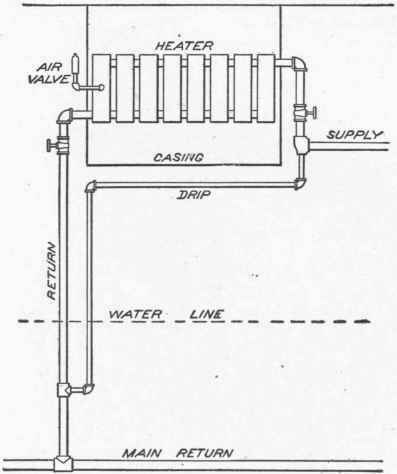
Fig. 22.
Size of Pipe. | Square Feet of Indirect Radiation which will be Supplied with | ||
1/4 Pound Drop in 200 Feet. | 1/4 Pound Drop in 100 Feet. | 1/2 Pound Drop in 100 Feet. | |
1 | 28 | 40 | 57 |
1 1/4 | 51 . | 72 | 105 |
1 1/2 | 67 | 95 | 170 |
2 | 185 | 262 | 375 |
2 1/2 | 335 | 475 | 675 |
3 | 540 | 775 | 1105 |
3 1/2 | 812 | 1160 | 1645 |
4 | 1140 | 1625 | 2310 |
5 | 2030 | 2900 | 4110 |
6 | 3260 | 4660 | 6600 |
7 | 4830 | 6900 | 9810 |
8 | 6800 | 9720 | 13860 |
Continue to:


My Books

