


Chalk, Pastel, Pen And Ink, Pencil And Crayon. Continued
Description
This section is from the book "Arts And Crafts In The Elementary School", by Joan Dean. Also available from Amazon: Arts And Crafts In The Elementary School.
Chalk, Pastel, Pen And Ink, Pencil And Crayon. Continued
The other use of shading is one which is well within the understanding of Juniors and one which I feel will do much to improve the use of pencil. This is the use of shading to show texture. Actually this can hardly be called shading—it is really a way of representing different surfaces on paper. Children can be encouraged to notice, for example, that a wooden table or floor has a kind of pattern on it because it is made of wood, that we know that grass is grass and stone is stone and so on, because of the surface texture that we can see. All these textures can be represented in one way or another in any medium. This is one of the things one has to discover how to do and a great deal of exploration is necessary. Some suggestions for this kind of work will be found in Chapter Eighteen. This particular use of pencil seems to me to be a profitable one and it is to this that I would direct the work of any child who is keen to put "shading" into his drawing.
5. Pen and ink. This is an excellent medium for children at the top of the Primary school. It is usually at hand, and it offers opportunity and incentive to draw with observation. Just as paint forces a child to commit himself in colour, so ink forces him to commit himself in line and tone. It is, once again, the medium which provides a discipline in its nature. Pen drawing, in general, is best done on a small scale, because it takes time to do. I have found that many children are rather frightened of a medium in which they feel they can neither cover up nor rub out. This is actually not altogether true. In a certain kind of pen drawing one can re-draw many times without spoiling the picture. In other kinds of drawing an accurate first attempt is required. The medium does, in fact, demand a certain amount of clear thinking and forethought, which is also an excellent discipline. In any case, this worry about the finality of pen drawing lessens as children gain experience. The possibility also of using a number of different-coloured inks should not be forgotten.
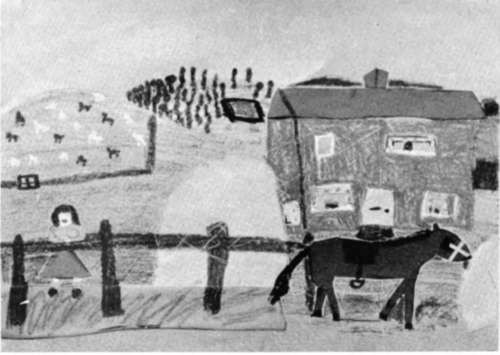
9-year-old. Picture using more than one medium—collage and crayon (Chapter 6)

10-year-old. Collage figure—one of the Kings for a Nativity scene
(Chapter 7)

7-year-old. Applique embroidery, made partly by sticking and partly by sewing (Chapter 7)
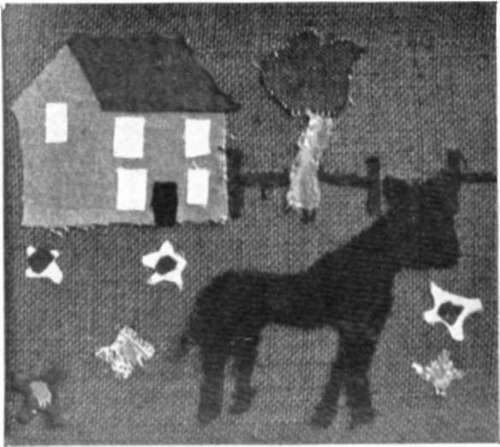
7-year-old. Applique embroidery, made by sticking only
(Chapter 7)

7-ycar-old. Applique embroidery, made by sewing and sticking
(Chapter 7)

10-year-old. Needlework box
The boxes were planned to encourage exploration of stitches with applique (Chapter 7)
It seems to me a pity that so many schools have taken a very conservative attitude towards the use of ball-point pens for writing. However carefully we instruct children in the use of the ordinary sort of pen, at least 90 per cent of them will use ball-point pens when they grow up, unless they have been superseded by something else, so why not teach them to write with these pens. Certainly their use in drawing should be explored. They have not the flexibility of line that is found in pen work, but the line is stronger and clearer than that produced by a pencil. In my own work I long since abandoned pencil in favour of a ball-pen for all rough and sketch-book work, and I find that there are some children for whom this is a good medium.
Just as with paint we tried to discover all the different ways in which paint could be laid on paper, so also with these media we must explore the kinds of marks they make, and the ways in which they can be combined and contrasted with each other, and with other media.
Each of these media can be explored in similar ways to those suggested for paint, through pattern work. It is, perhaps, particularly necessary to explore the relations of each to the others and to notice the special qualities of each. Children can easily see, for example, that pen and ink produce a sharp clear line and pastel, chalk and crayon rather less definite ones. Ink or paint produces a clearly defined plain surface if used to make a solid shape. Chalk, pastel and crayon produce a shape with an indefinite edge and a textured surface. These differences make a pleasant contrast, and patterns using two or more of the media, and including all the textures that can be thought of, give good opportunity for exploration.
Another kind of pattern which gives good opportunity to explore these media is a repeating pattern in which the same or a similar shape is repeated in a different medium each time. Take a sheet of paper and fold it so that there are sixteen rectangles marked by the folds. In the first, using crayon, perhaps, draw a shape. Make it an interesting one, but not so complicated that it cannot be more or less repeated. It should be large enough almost to fill the rectangle. Colour some of it plain and fill some of it with texture. In the next rectangle draw another shape as like it as you can, but this time using pencil or ink. Draw similar shapes in the next two rectangles, using other media. In the next line, start again with another shape, repeating it in the four adjoining squares in other media. This not only introduces the idea of a repeating pattern without demanding too many repeats, but it actively contrasts the media concerned. It becomes very clear that the shape which is easy to draw in ink is quite difficult to draw in chalk.
This sort of contrast in media, encouraging the choice of a suitable one for each job, can also be observed in pictorial work by making pictures in which more than one of these media is used. If we make, for example, a picture in which there are figures in the foreground and a town or country scene in the background, it is evident that we want our clearest definition and detail in the foreground, and less in the background. So we could well use ink in the foreground and pastel or crayon in the background. This will also help a composition problem which children will meet later: that of how to place emphasis in a particular part of the picture.
Any of these media can be used to make a textured background for other work, possibly collage. They can be used singly, or together, or with paint. This kind of work, provided it is purposeful, offers very wide opportunities for exploration, since there are few limitations.
Continue to:


My Books

