


Lightning Bug Box
Description
This section is from the book "How To Build Games And Toys", by B. W. Pelton. Also available from Amazon: How To Build Games And Toys.
Lightning Bug Box
Whether or not lightning bugs are available for incarceration, the folding of this little box will culminate in a satisfyingly spectacular manner if the directions are followed faithfully and all creases made sharp.
Step 1. A square of paper which is not too stiff is folded into the Wing described in the previous section, as indicated in 1 of Figure 6.6. With its open base up, the two upper corners are labeled a and b for future reference.
Step 2. Fold corners a and b down to meet at the bottom corner; turn the paper over and make the same folds on the back.
Step 3. Fold corners c and d to the center and make identical folds on the back.
Step 4. Fold corners a and b outward as indicated, and repeat on the other side.
Step 5. Fold a and b inward as indicated, on both sides of the paper.
Step 6. This is the crucial step. Open E and D slightly and with a pencil poke open the fold in E and tuck in the folded triangle a. Do the same for D and repeat the operation on the opposite side of the paper figure. Press all creases hat.
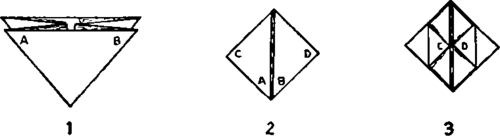
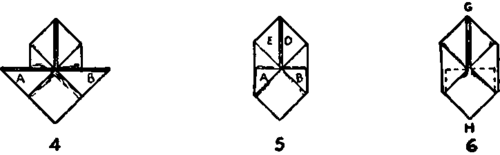
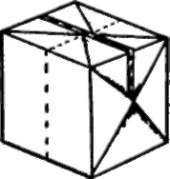
Fig. 6.6. How to fold a paper box.
Step 7. Holding the figure with the thumb at G and the fingers at H, squeeze it gently to insure that all creases will open. Then blow gustily through the opening at G to open out the box shown in 7 of the drawing.
Do not be downhearted at first failures; it took the writer five attempts and two changes of paper to make a satisfactory box. Early failures, moreover, will make the young patient more jubilant over final success, and more insistent upon displaying his or her mysterious ability to visitors or successive waves of family.
Catamaran. More properly described as a double boat, this is an interesting little figure to fold.
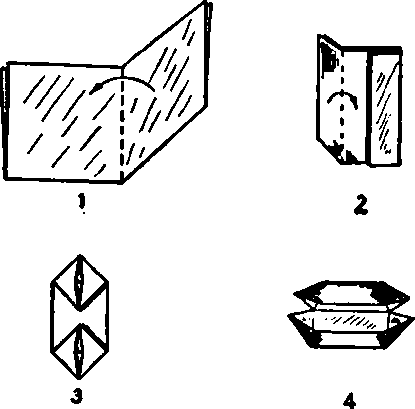
Fig. 6.7. Catamaran.
Step 1. Fold a square of paper upward across the center and then fold the long side across the center to form a still smaller square, as in 1 of Figure 6.7.
Step 2. The sides are now folded inward against the center line as in 2 of the drawing.
Step 3. Turn the paper over, plain side up. To understand the next movement study 3 of the drawing, which is the end result. It is obtained by folding down the front two layers, simultaneously pushing the corners out to form the triangular creases shown in the drawing. Repeat this operation at the bottom, then fold the whole figure inward the long way, and crease sharply along YZ.
Step 4. Open out the sides to form the double boat, which will last longer on the waves if it was folded from a waxed paper or bread wrapper. Meanwhile it can be pressed into service to hold crayon stubs, hairpins, toothpicks, colored shoe buttons, and other small oddments.
Chains of figures. As old as time but quite often forgotten is the method of making a dozen or so identical, united figures from a single strip of folded paper with a minimum of scissor cuts. The paper is folded as in cutting out the Indian feathers in Figure 6.15, and the half-outline of a dancer, policeman, Boy Scout, or Indian is drawn, then cut out. When unfolded, the young craftsman will be delighted to exhibit a pony ballet, a cordon of police, a Boy Scout jamboree, or an Indian war dance.
Continue to:


My Books

