


Shadow Plays
Description
This section is from the book "How To Build Games And Toys", by B. W. Pelton. Also available from Amazon: How To Build Games And Toys.
Shadow Plays
Simple shadow plays conceived, directed, and produced by children, offer rich possibilities as creative outlets. Inasmuch as the puppet figures and sketchy scenery are one-dimensional silhouettes, the greater part of the technical details are reduced to the care required in cutting out tracings on various grades of cardboard or other opaque materials.
Although the initial productions of youthful impresarios may lean heavily toward unjointed figures from fairyland, Wizard of Oz, or perhaps comic book backgrounds, continuing interest and different age groups will experiment with jointed silhouettes having knotted thread or split paper fastener joints like the jumping jack in Figure 2.11. The transitional stage is speedily hurdled when articulated toys such as the three-dimensional bucking bronco in Figure 4.19 are at hand. Horses of this type, interspersed between unjoined silhouettes, can be hooked up to the cook wagon or a cardboard replica, to symbolize the stubborn, plodding advance of the pioneers along the Oregon or Santa Fe Trails, for example. Once past, the same horses may have cardboard Indian riders astride them, followed, in turn, by the United States Cavalry. Or the riders may be knights in armor jousting at one another with long lances in King Arthur's lists. Other three-dimensional, articulated toys may be pressed into service to depict the adventures of the farmer's daughter, or of a whaling fleet, or of some military campaign, with appropriate cardboard or beaverboard trees or suggested portions of buildings or battlements at the edges of the screen.
The Screen
Before discussing the size and nature of the shadow screen, it will be well to examine into the normal possibilities for a "stage" which can be suitably draped to exclude all light other than that which illuminates the screen from behind. The problem will be simplified when a pair of tall folding screens are available to shut out the glare from the sides, while providing a backstage working space. Broom, mops, or other long sticks laid across the tops of the screens will serve as rafters over which a heavy cloth can be draped to cut off the upward rays from behind the stage. The latter may be a table of any length located directly in front of the screens, and covered with cloth to the floor.
In the absence of two tall screens, the average doorway will accommodate a bridge table 30 in. square. If the doorway is suitably located, all that will be necessary is to drape the table and hang another cloth drape from the top of the door casing to the top of the white screen, as in Figure 4.25. This leaves the young puppeteers plenty of room to manipulate their silhouette actors from below the table top, in front of a bridge lamp having a 150 to 200-watt lamp. If a photo flood reflector is available, so much the better. Doors which are inconveniently located can sometimes be teamed up with a single screen to provide a usable backstage area.
Since there is no telling how continuous will be the children's enthusiasm for this form of entertainment, the screen might as well be constructed so that it can be easily disassembled for storage. The overall dimensions of the frame will be more or less determined by the available working area. However, when it is proposed to use a series of existing toys, the general rule is that the screen should be about one and a half times the height of the figures. As for the frame supporting the screen, ordinary furring strips, either half-lapped at the corners or butt jointed with corrugated fasteners, will prove satisfactory.
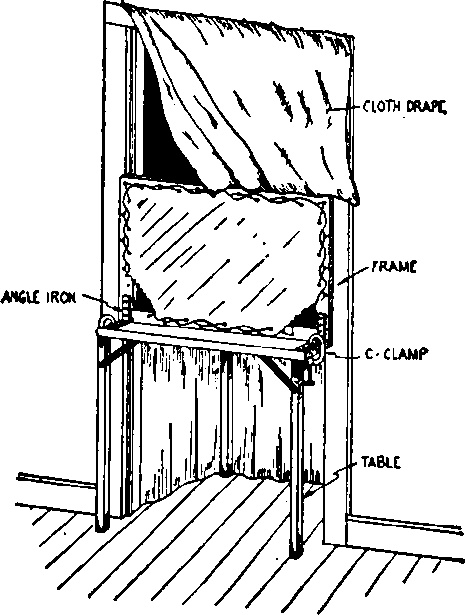
Fig. 4.25. Backstage in shadowland.
A primary requisite of the material for the screen is that it be translucent enough to give a sharp outline to the silhouetted puppets, yet substantial enough to stretch without wrinkles. A section of old bedsheet or a piece of unbleached muslin will fill the bill perfectly. As shown in the drawing, long life and quick adjustment can be built into the screen cloth by outfitting it with small eyelets and stringing a strong light cord through them. When preparing for a play, the cord can be looped in a zigzag fashion over shingle nails driven well into the frame, so that the screen fabric stretches smoothly in all directions. During one night stands only, white shelf paper can be tacked over the frame.
For the more advanced types of puppets which are supported by a rod or umbrella rib and perform on a narrow rear ledge, the screen can be set up near the table edge, as indicated in Figure 4.25. Large angle irons with their bottom legs hacked off to the desired width of the ledge, when screwed to the rear of the screen can be fastened to the table top with C-clamps. When no ledge is desired, the angle irons are attached to the front of the frame.
Continue to:


My Books

