


Miniature Housekeeping Fixtures
Description
This section is from the book "How To Build Games And Toys", by B. W. Pelton. Also available from Amazon: How To Build Games And Toys.
Miniature Housekeeping Fixtures
Doll housekeeping is an engrossing occupation for years at a stretch, yet there comes a time when the urge to imitate will unerringly propel the young housekeeper into the kitchen or laundry of her home, where she is apt to become somewhat of an obstacle to orderly procedure. By providing her with small-scale models of some of the basic domestic fixtures and accessories, she can be allotted space in the corner of a room removed from preoccupied areas.
Stove
Probably Number One on the parade of Junior Housekeepers' intense desires is a realistic cookstove. As will be noted in Figure 4.26, an electric stove has been chosen because it is a simple matter to hook up a red light which will flash on when any of the switches or the oven are snapped, indicating that the dolls' dinner is on the way.
The dimensions illustrated in Figure 4.26 B of the drawing were chosen to accommodate cooks from five years of age and up, and can of course be modified to fit the individual user. The framework shown is made up from straight lengths of furring strips, f in. thick and 15/8 in. wide. The four identical frames indicated in C are made up first, with the horizontal top members indented f in. to take the long (18 in.) top and bottom members of the front and back. Corrugated fasteners hammered diagonally across the butt joints on both sides will hold the frames together until the wallboard panels firm them up; long finishing nails driven in at a slight angle will add strength.
After all four sections have been assembled and trued up is the time to apply the wallboard covering. The outer wallboard panels extend far enough to the rear to cover the thickness of the rear panel. Any type of wallboard capable of withstanding plenty of moving and careless handling will prove satisfactory, with plywood a first choice. The two inner rectangular sections, however, may be covered on the inside with thin beaverboard or cardboard to form the oven. Horizontal cleats K are nailed in place after the lining has been tacked on, to support the oven bottom and shelf; the upper (shelf) cleats are butted against and nailed firmly to vertical cleats set flush with the oven opening, as supports for the sides of the oven door. It is a good idea to paint the sides of the oven black before final assembly is made by nailing the upper and lower horizontal rails in place on both front and back.
Lumber List
Pieces | Thickness, in Inches | Width, in Inches | Length, in Inches | Description |
4 | 3/4 | 15/8 | 18 | Front and back rails |
8 | 3/4 | 15/8 | 123/4 | Vertical spacers |
8 | 3/4 | 15/8 | 61/2 | Horizontal spacers |
1 | 1/2-1/4 | 91/2 | 16 | Stove top |
2 | 1/4 | 91/4 | 16 | End panels |
2 | 1/4 | 5 | 16 | Front panels |
1 | 1/2 | 8 | 123/4 | Oven door |
1 | 1/4 | 16 | 18 | Back panel |
1 | 3/6 | 43/4 | 181/4 | Back piece (clock) |
As shown in A, the oven door is an 8-in. by 123/4-in. piece of 1/2-in. plywood hinged at the bottom to a 15/8-in. by 8-in. piece of material also 1/2 in. thick, which is nailed directly to the bottom rail of the stove frame; a similar piece is fastened above the door. A pair of small spring hinges are ideal for keeping the oven door off the floor. If these are not available, ordinary butt hinges will do, with a long screen door spring fastened by one end to the top rail of an oven separator, and the other end attached to a screweye on the inside corner of the oven door. The latter is held closed by a cupboard (spring) turn catch.
A sheet of hardboard or plywood makes a sturdy stove top which overhangs the sides and front by 1/4 in. The three hot plates may have a diameter of 3 in. and be cut from hardboard or even tin, and painted black. Three friction top can covers will present a finished appearance, and need not be the same size. The plates are held in place with an all-purpose adhesive and have large, flat-headed screws or bolts through their centers, passing into or through small scraps of wood under the stove top. If a broken traveling clock is on hand, it can be mounted through a hole in a curved back piece as shown; otherwise the latter can be a straight strip of wood or hardboard nailed to the back of the rear upper stove rail. Needless to say, neither the hot plates nor the clock should be set into position before the stove receives its final coat of enamel.
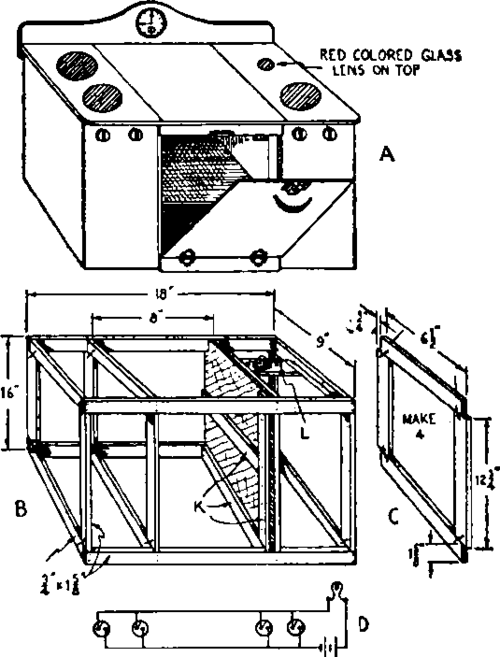
Fig. 4.26. Electric play stove.
As indicated in B, a narrow shelf nailed to the undersides of two upper side rails, will hold a miniature porcelain electric lamp socket under a hole cut in the right rear corner of the stove top. An old flashlight lens with its screw top, makes an excellent signal lamp cover which can be screwed down through a tightly fitting hole. A piece of red cellophane under the lens will furnish the color. Failing this, a glass mason jar top can be glued in place or a percolator top similar to the one in Figure 4.22 (over red cellophane). Four radio toggle or rotary switches are mounted in pairs at the front to control the red signal light. The hook-up diagramed in Figure 4.26 D will insure that the red light will glow when any switch is on. Before attaching the one-piece back panel, a lower shelf similar to L is nailed in place on top of two lower separators. To this a dry battery or a pair of flashlight cells are clipped. Since only the oven has a bottom, the batteries can be replaced easily from underneath. If preferred, shelf L can be hung low enough to accommodate a standard 15- or 25-watt lamp, with a wire and plug leading from the rear of the stove to the nearest base plug. This will require standard switches and boxes, however, and BX cable.
Paint the oven and its plywood or hardboard shelf black, and give the stove a good undercoater before applying the final coat of white enamel. A super de luxe job will result if the stove top is cut from material which is thick enough to support chrome around its outside edges. The curved radio carrying handle on the oven door is optional, since the nickeled cupboard catch handle must be turned to open the oven door.
For very young cooks, or when time is of the essence, a cardboard carton of suitable size can be pressed into service. After all openings are glued shut, and cracks covered with gummed paper, the box is given a thorough enamel job (white). The four hot plates are enameled black and the oven door outlined in black. Four small radio toggle switches cemented in place will add reality.
Continue to:


My Books

