


Treasure Chest
Description
This section is from the book "How To Build Games And Toys", by B. W. Pelton. Also available from Amazon: How To Build Games And Toys.
Treasure Chest
Younger hoarders will welcome private storage space in the form of the pirate's treasure chest pictured in Figure 4.32 (page 138). Their appreciation will wax enthusiastic once they are initiated into the mysteries of the two secret compartments, where they can safely deposit their priceless coupons, stamp or coin collections, maps of buried treasure, or fraternal compacts signed with blood.
A strong chest can be assembled from f-in. plywood or solid stock and, for the ambitious craftsman, is an ideal project for large dovetail joints along the edges. However, when screwed together, the simple butt and mitered joints shown in the drawing will insure a sturdy chest which will withstand much rough handling.
If it is constructed of boards, the front, back, and end pieces will have to be edge glued from two or more pieces, preferably with 1/4-in. dowel reinforcements. In the interests of simplicity, the cutting of the lumber list (page 137), is based upon the assumption that f-in. plywood will be used to make the chest. This will require a 4-ft. by 6-ft. sheet of the f-in. material, and a piece only a trifle over 21/2 ft. square for the false top and bottom.
The construction of the chest lid can be simplified by using rounded end pieces and center braces over which thin plywood can be steamed and screwed to form a curved lid. It is doubtful, however, whether this type of lid would hold up when used as a seat or a platform.
As will be noted in A and B, both the false lid X and the false bottom Y rest on cleats (K and K2) which are attached to the inside of the ends of the lid and chest respectively; both are bradded to long "hinge" dowels HD and HD2, which rotate easily in four holes, H and H2. Two additional 30-in. dowels, LD and LD2, fitting loosely in the four holes L and L2, serve to lock the false top and bottom when closed. They should be loose enough so that they can be pushed out with a nail, nail file, or pencil. A piece of fiat spring or a section of old hacksaw blade is fastened under the hinge side of the false bottom, so that it will pop up when released. The success of these secret compartments is entirely dependent upon the accurate location of their dowel "hinges" and "locks."
Lumber List
Pieces | Thickness, in Inches | Width, in Inches | Length, in Inches | Description |
Chest | ||||
2 | 3/4 | 171/2 | 30 | Front and back |
2 | 3/4 | 171/2 | 181/2 | Ends |
1 | 3/4 | 101/2 | 30 | Bottom |
(K2) 2 | 1/2 | 21/2 | 111/4 | Cleats, bottom compartment |
(HD2 & L2) 1 | 1/4 | 12 | 281/2 | False bottom |
2 | 3/8 | ... | 30 | Dowels |
Lid | ||||
1 | 3/4 | 91/2 | 30 | Center panel |
2 | 3/4 | 51/2 | 30 | Sloping panels |
2 | 3/4 | 21/2 | 30 | Vertical edges |
2 | 3/4 | 51/2 | 181/2 | Ends |
(K) 2 | 1/2 | 11/2 | 181/2 | Cleats, top compartment |
1 | 1/4 | 181/2 | 30 | False top |
(HD & L) 2 | 3/8 | ... | 30 | Dowels |
The lid is attached to the chest at the rear with strap hinges, and is equipped in front with a hinged hasp, slightly bent at its upper end. This poses the question of padlocks. For a chest which is in constant use, a young owner can usually be satisfied with a massive appearing yet deceptively easy-to-open imitation padlock, such as is diagramed in C.
In this example the basic requirement is a metal ring which can be forced open or sawed so that it can be lifted free of the hasp on the front of the lid.
A scrap of wood of the same, or slightly greater, thickness as the metal ring is sawed into the outline of a large padlock, then the shaded section Z is cut out to provide a loose channel in which the ring can be turned. These two filler sections are then glued and bradded to a back section cut from thin veneer, or nailed to a back-plate cut from tin. The ring is then laid in position and checked for clearance, and an identical front-plate added. After the padlock is painted black and the ring turned in the hasp so that its open joint is concealed by the front- and back-plates, there is every likelihood that it will foil the prying fingers of the uninitiated.
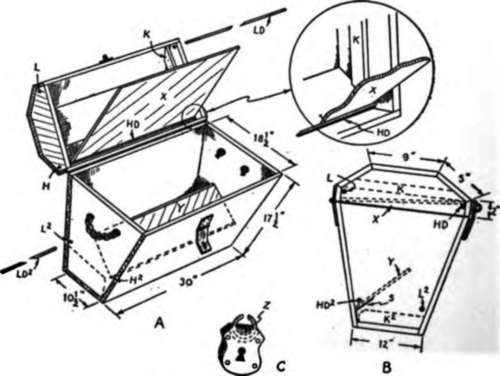
Fig. 4.32. Pirate's secret cache.
Rope handles are fastened through holes in the ends, which must be bored high enough to avoid the possibility of interference with manipulation of the false bottom. The chest can then be painted maroon, medium green, or blue, with massive appearing black metal bands and hardware.
These bands, and the corners, if not dovetailed, may be made from smooth-edged tin strips or even thick cardboard, painted black, and studded with massive appearing upholsterer's tacks. A skull and crossbones painted on the top panel may give pause to an inquisitive younger brother or sister.
Continue to:


My Books

