


XI. Polygons. Continued
Description
This section is from the book "Geometric Exercises In Paper Folding", by Tandalam Sundara Row . Also available from Amazon: T. Sundara Row's Geometric Exercises in Paper Folding (Large Print Edition).
XI. Polygons. Continued
Let AB be a side of the first polygon, 0 its center, OA the radius of the circumscribed circle, and OD the apothem. On OD produced take OC= OA or OB. Draw AC, BC. Fold OA' and OB' perpendicular to AC and BC respectively, thus fixing the points A', B. Draw A'B' cutting OC in D. Then the chord A'B' is half of AB, and the angle B'OA' is half of BOA. OA' and OD' are respectively the radius R' and apothem r' of the second polygon.
Now OD' is the arithmetic mean between OC and OD, and OA' is the mean proportional between OC and OD'.
... r' = ½ (R + r), and R' = √Rr'.
137. Now, take on OC, OE=OA' and draw A'E. Then A'D' being less than A'C, and L D'A'C being bisected by A'E,
ED' is less than ½CD', i. e., less than ¼CD ... R1 - r1 is less than ¼(R - r). As the number of sides is increased, the polygon approaches the circle of the same perimeter, and R and r approach the radius of the circle. That is,
R + r + R1 - r1 + R2 - r2 +....
= the diameter of the circle = p / π.
Also,
R12 = Rr1 or R. r1 / R1 = R1 and r2 / R2 = R2 / R1, and so on.
Multiplying both sides,
R. r1 / R1 . r2 / R2 . r3 / R3 .......= the radius of the circle = p / 2π.
138. The radius of the circle lies between Rn and rn, the sides of the polygon being 4.2n in number; and π lies between 2 / rn and 2 / Rn. The numerical value of π can therefore be calculated to any required degree of accuracy by taking a sufficiently large number of sides.
The following are the values of the radii and apothems of the regular polygons of 4, 8, 16....2048 sides.
4.gon, r = 0.500000 R = r√2=0.707107 8.gon, r1 = 0.603553 R1 = 0.653281
2048-gon, r9 = 0.636620 R9 = 0.636620.
... π = 2 /0.636620 = 3.14159.....
139. If R" be the radius of a regular isoperimetric polygon of 4n sides
R"2 = R'2(R+R') / 2 R, or in general
Rk+1 / Rk =
140. The radii R1, R2.....successively diminish, and the ratio R2 / R1 is less than unity and equal to the cosine of a certain angle α.
R3 / R2 = = cosα / 2.
... Rk + 1 / Rk = cos α / 2k -1 multiplying together the different ratios, we get
Rk+1 =R1.cosα.cos α / 2. cos α / 22 .. .. cos α / 2k-1
The limit of cos α .cos α/22 .. .. cos α / 2k-1, when k =∞, is sin 2α / 2α, a result known as Enter's Formula.
141. It was demonstrated by Karl Friedrich Gauss* (1777-1855) that besides the regular polygons of 2n, 3.2n, 5.2n, 15.2n sides, the only regular polygons which can be constructed by elementary geometry are those the number of whose sides is represented by the product of 2n and one or more different numbers of the form 2m + 1. We shall show here how polygons of 5 and 17 sides can be described.
The following theorems are required : †
(1) If C and D are two points on a semi-circumference ACDB, and if C be symmetric to C with respect to the diameter AB, and R the radius of the circle,
AC.BD = R.(C'D - CD).......i.
AD.BC = R.(C'D + CD)......ii.
AC.BC=R.CC'.............iii.
(2) Let the circumference of a circle be divided into an odd number of equal parts, and let AO be the diameter through one of the points of section A and the mid-point 0 of the opposite arc. Let the points of section on each side of the diameter be named A\,
*Beman and Smith's translation of Fink's History of Mathematics,P. 245; see also their translation of Klein's Famous Problems of Elementary Geometry, pp. 16, 24, and their New Plane and Solid Geometry, p. 212.
† These theorems may be found demonstrated in Catalan's Theoremes et Problemes de Giomitrie Elimentaire.
A2, A3-----An, and A'1, A'2, A'3-----A'„ beginning next to A.
Then OA1.OA2OA3..............OAn = Rn......iv. and OA1.OA2.OA4....OAn = R n/2.
142. It is evident that if the chord OAn is determined, the angle A„OA is found and it has only to be divided into 2" equal parts, to obtain the other chords.

Fig. 50
143. Let us first take the pentagon. By theorem iv,
OA1.OA2 = R2. By theorem i,
R(OA1 - OA2) = OA1.OA2=R2.
... OA1 - OA2 = R.
... OA1 = R / 2(√5 + 1), and OA2 = R / 2 (√5 - l).
Hence the following construction.
Take the diameter A CO, and draw the tangent AF. Take D the mid-point of the radius OC and
On OC as diameter describe the circle AE'CE. Join ED cutting the inner circle in E and E'. Then FE' = OA, and FE= OA2.
144. Let us now consider the polygon of seventeen sides. Here* OA1 . OA.2 . OA3 . OA4 . OA5 . OA6 . OA7 • OA8 = R8.
OA1 . OA2 . OA4 . OA8 = R4. and OA3 . OA5 . OA6 . OA7 = R4. By theorems i. and ii.
OA1 . OA4 = R(OA3 + OA5) OA2 . OA8 = R ( OA6 - OA7) OA3 . OA5 = R ( OA2 + OA8) OA6 .OA7 = R(OA1 - OA4 ) Suppose
OA3 + OA5 = M, OA6 - OA7 = N, OA2+ OA8 = P, OA1 - OA4 = Q.
*The principal steps are given. For a full exposition see Catalan's Theo-remes et Problemes de Geometrie Elementaire. The treatment is given in full in Beman and Smith's translation of Klein's Famous Problems of Elementary Geometry, chap. iv.
Then MN=R2 and PQ = R2. Again by substituting the values of M, N, P and Q in the formulas
MN=R2, PQ=R2 and applying theorems i. and ii. we get (M - N) - (P - Q) = R.
Also by substituting the values of M, N, P and Q in the above formula and applying theorems i. and ii. we get
(M - N) (P - Q) =4R2
Hence M - N, P - Q, M, N, P and Q are determined.
Again
OA2 + OA8 = P,
OA2.OA8 = RN. Hence OA8 is determined.
145. By solving the equations we get
M - N=½ R(1+√17). P - Q = ½ R(-1 + √17).
P = ¼ R (- 1 + √17 +
N = ¼ R( - 1 - √17+
OA8 = 1/8 R [- 1 +√17 +
- 2
= 1/8 R [ - 1 + √17 +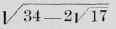
- 2
146. The geometric construction is as follows:
Let BA be the diameter of the given circle; O its center. Bisect OA in C. Draw AD at right angles to
OA and take AD = AB. Draw CD. Take E and E' in CD and on each side of C so that CE = CE' = CA.

Fig. 51.
Bisect ED in G and E'D in G'. Draw DF perpendicular to CD and take DF= OA. Draw FG and FG'.
Take ZT in EG and H in FG' produced so that GH=EG and G'H'=G'D. Then it is evident that
DE = M - N, DE'=P - Q; also
FH= N, ... (DE + FH)EH= DF2 = R2; FH' = P, ... (FH' - DE') FH= DF2 = R2.
Again in DF take K such that FK=FH. Draw KL perpendicular to DE and take L in KL such that FL is perpendicular to DL. Then FL2 = DE. FK= FN.
Again draw H'N perpendicular to FH' and take H'N=FL. Draw NM perpendicular to NH'. Find M in NM such that H'M is perpendicular to FM. Draw MF' perpendicular to FH'. Then
F'H' . FE' = F'M2 = FL2
= RN. But FF' + F'H'=P.
... F'F=OA8.
Continue to:


My Books

