


XIV. Miscellaneous Curves
Description
This section is from the book "Geometric Exercises In Paper Folding", by Tandalam Sundara Row . Also available from Amazon: T. Sundara Row's Geometric Exercises in Paper Folding (Large Print Edition).
XIV. Miscellaneous Curves
262. I propose in this, the last chapter, to give hints for tracing certain well-known curves.
The Cissoid
263. This word means ivy-shaped curve. It is defined as follows: Let OQA (Fig. 76) be a semicircle on the fixed diameter OA, and let QM, RN be two ordinates of the semicircle equidistant from the center. Draw OR cutting QM in P. Then the locus of P is the cissoid.
If OA=2a, the equation to the curve is y2 (2a - x) =x3.
Now, let PR cut the perpendicular from C in D and draw AP cutting CD in E.
RN:CD = ON: OC=AM:AC=PM:EC, ... RN:PM=CD:CE.
But RN: PM=ON: OM=ON: AN=ON2: NR2
= OC2:CD2, ... CD : CE = OC2:CD2.
If CF be the geometric mean between CD and CE,
* See Beman and Smith's translation of Klein's Famous Problems of Elementary Geometry, p. 44.
CD:CF=OC: CD ... OC:CD = CD:CF=CF:CE
... CD and CF are the two geometric means be-tween OC and CE.
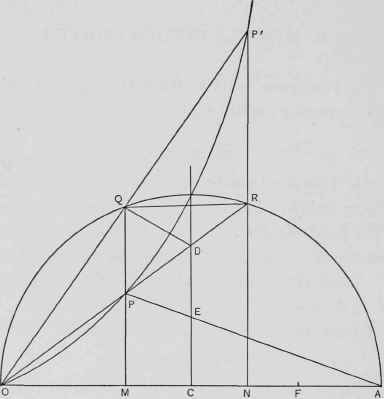
Fig. 76.
264. The cissoid was invented by Diocles (second century B. C.) to find two geometric means between two lines in the manner described above. OC and CE being given, the point P was determined by the aid of the curve, and hence the point D.
265. If PD and DR are each equal to OQ, then the angle AOQ is trisected by OP.
Draw QR. Then QR is parallel to OA, and
DQ = DP = DR = OQ ... ROQ=
ROQ= QD0 = 2
 QRO = 2
 AOR.
AOR.
The Conchoid Or Mussel-Shaped Curve
266. This curve was invented by Nicomedes (c. 150 B. C). Let O be a fixed point, a its distance from a fixed line, DM, and let a pencil of rays through O cut DM. On each of these rays lay off, each way from its intersection with DM, a segment b. The locus of the points thus determined is the conchoid. According as b >, =, or <a, the origin is a node, a cusp, or a conjugate point. The fig-ure† represents the case when b> a.
267. This curve also was employed for finding two geometric means, and for the trisection of an angle.

Fig. 77.
*See Beman and Smith's translation of Klein's Famous Problems of Elementary Geometry, p. 40.
†From Beman and Smith's translation of Klein's Famous Problems of Elementary Geometry, p. 46.
Let OA be the longer of the two lines of which two geometric means are required.
Bisect OA in B; with O as a. center and OB as a radius describe a circle. Place a chord BC in the circle equal to the shorter of the given lines. Draw AC and produce AC and BC to D and E, two points collinear with O and such that DE = OB, or BA.
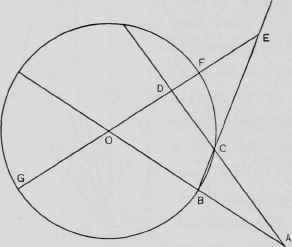
Fig. 78.
Then ED and CE are the two mean proportionals required.
Let OE cut the circles in F and G.
By Menelaus's Theorem,*
BC.ED.OA=CE. OD .BA
... BC.OA=CE.OD or BC / CE = OD / OA
... BE / CE = OD + OA /OA = GE/OA.
*See Beman and Smith's New Plane and Solid Geometry, p. 240.
But GE.EE=BE.EC.
... GE .OD = BE. EC. ... OA .OD = EC2. ... OA :CE = CE:OD = OD:BC.
The position of E is found by the aid of the conchoid of which AD is the asymptote, 0 the focus, and DE the constant intercept.
268. The trisection of the angle is thus effected. In Fig. 77, let φ= MOY, the angle to be trisected. On OM lay off OM=b, any arbitrary length. With M as a center and a radius b describe a circle, and through M perpendicular to the axis of X with origin 0 draw a vertical line representing the asymptote of the conchoid to be constructed. Construct the conchoid. Connect O with A, the intersection of the circle and the conchoid. Then is
 AOY one third of φ.*
The Witch
269. If OQA (Fig. 79) be a semicircle and NQ an ordinate of it, and NP be taken a fourth proportional to ON, OA and QN, then the locus of P is the witch.
Fold AM at right angles to OA. Fold through O, Q, and M. Complete the rectangle NAMP.
PN: QN=OM:OQ = 0A : ON.
*Beman and Smith's translation of Klein's Famous Problems of Elementary Geometry, p. 46.
Therefore P is a point on the curve. Its equation is, xy2 = a2 (a - x).

Fig. 79.
This curve was proposed by a lady, Maria Gaetana Agnesi, Professor of Mathematics at Bologna.
The Cubical Parabola
270. The equation to this curve is a2y = x3.
Let OX and O Y be the rectangular axes, OA=a, and OX=x.
In the axis O Y take OB = x.
Draw BA and draw AC at right angles to AB cutting the axis OY in C.
Draw CX, and draw XY at right angles to CX. Complete the rectangle XOY. P is a point on the curve.
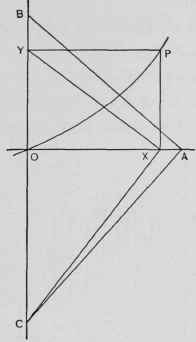
Fig. 80.
y = XP = OY= x2 / OC = x2. x /a2 = x3 / a2
... a2y = x3.
The Harmonic Curve Or Curve Of Sines
271. This is the curve in which a musical string vibrates when sounded. The ordinates are proportional to the sines of angles which are the same fractions of four right angles that the corresponding abscissas are of some given length.
Let AB (Fig. 81) be the given length. Produce BA to C and fold AD perpendicular to AB. Divide the right angle DAC into a number of equal parts, say, four. Mark on each radius a length equal to the amplitude of the vibration, AC=AP=AQ = AR = AD.
From points P, Q, R fold perpendiculars to AC; then PP', QQ', PR', and DA are proportional to the sines of the angles PAC, QAC, RAC, DAC.
Now, bisect AB in E and divide AE and EB into twice the number of equal parts chosen for the right angle. Draw the successive ordinates SS', TT', UU', VV, etc., equal to PP, QQ', RR', DA, etc. Then S, T, U, V are points on the curve, and V is the highest point on it. By folding on VV and pricking through S, T, U, V, we get corresponding points on the portion of the curve VE. The portion of the curve corresponding to EB is equal to A VE but lies on the opposite side of AB. The length from A to E is half a wave length, which will be repeated from E to B on the other side of AB. E is a point of inflection on the curve, the radius of curvature there becoming infinite.
Continue to:


My Books

