


How To Make A Parisian Phaeton
Description
This section is from the book "Cassell's Cyclopaedia Of Mechanics", by Paul N. Hasluck. Also available from Amazon: Cassell's Cyclopaedia Of Mechanics.
How To Make A Parisian Phaeton
The accompanying sketch shows an outline elevation of a double seat Parisian phaeton. In making the body the following parts will be required. For the rockers A six pieces of birch, 3in. wide by-Jin. thick when finished; two sham doors or pillars B, got out to pattern by ljin. thick; two front and two hind pump handles C, 1.; in. deep by l 1/4 in. thick; and four rocker pieces D, l 1/4 in. by 1 1/4 in.; all these parts should be of clean, close-grained English ash, dressed up square and true. The rockers are halved together at the bottom to form the well of the body; the joint at the bottom must be made as shown, and fixed with tour screws in each half-check from the inside. Be careful to get the correct bevel, and both sides alike. Before fixing together for good, box out 5/8 in. for the bottom board and 1/2 in. back: and front for the heel panels. The hind pump handle C is halved into the sham door B from the inside to the same bevel as the rocker, with which it has to line, and the front pump handle is put into the front rocker piece D in a similar manner. The ends should be carved, and a chamfer made on the outer edge of the rocker pieces and the sham doors, and in some cases a quarter bead is run along the bottom edge of the pump handle.
If the phaeton is to be painted, give all the joints a good coat of white-lead mixed with linseed oil only; if it is to be finished in the natural wood, put it together with gold size or a thick varnish. The rocker pieces and sham doors are now secured to the well with No. II screws, with the heads inside, keeping them flush with the inner edge of the rockers,and when in place the pump handles should line with one another and be just a trifle out of the straight line on the top; this is to allow for a little rise. Lay the side down flat, outside uppermost, and mitre in the bottom rocker piece D; this is also fixed from the inside, and a fine screw is inserted through each mitre into the side pieces. Two filling-up pieces a re required on the pump handles inside, bevelled from the rocker to the pump handle to carry the edge plate; these may either be of steel round the well, or iron. Along the pump handles as far as the curved ends it is half round, 1 3/8n. wide, feather-edge; and if a rumble has to be placed at the back, lugs should be welded into the plate to take an iron stay to support the rumble. Four 5/16in. holes are drilled along the bottom part of the plate to which the body steps are bolted.
The plates are now screwed on, No. 14 screws being used around the well, and No. 12 screws along the pump handles. The two sides are next fixed together, a stretcher being placed across back and. front to keep it the proper width; the bottom is first put in, then the front and back panels. Next place two strap iron plates across the bottom, and turn up each panel 3 in. The hind seat E, 1 ft. 6 in. wide, is now got out and fitted on temporarily; it comes flush with the outside of the sham door at the front, and is swept in towards the back about l 1/4 in. each side; the elbows are got out to the same sweep as the end of the seat, are l 1/4in. wide by liin. deep when finished, and should line with the sail out of the sham door; they are half-ehecked on to the sham door, and are supported at the back by a square iron stay shaped as Fig. 2. The bolt end at the top passes through the raised back G, which is of 1-in. birch, swept edgeways in its length, 5in. wide, and notched on to the elbows so that it is level at the bottom, being fixed in place by the bolt end on the corner iron and a small corner plate on top of the elbow and inside the raised back. The spaces for the sticks or iron rods should now be marked off. Measure the lengths required, and mark the direction of each one on the outside with a short straightedge; take apart, bore the holes for the pins 8 in. deep, carve the ends ou the elbows, put in the pins, and fix down the elbows and raised backs for good. The front seat H is made of 1-in. birch, 1ft. 2 in. wide, and sufficiently long to overhang the pump handle l 1/4in.on each side, to which it is fixed by screws. The dash-board I is made of 1/2-in. birch, fixed to the front edge of the seat, which is bevelled to the pitch, and by two half-round irons on the front, with a strong foot at the bottom. The side seat rail is made of 1/2-in. round iron, and has a 6-in. half-round flap to fix it to the seat, and a round boss to take a j-in. bolt through the dash at the front.
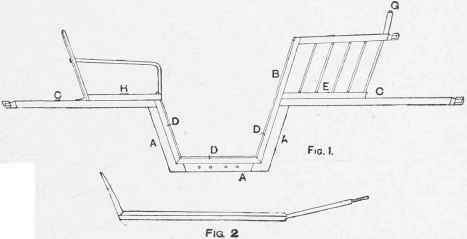
Mating a Parisian Pnaeton.
Continue to:


My Books

