


Thermo-Electric Piles
Description
This section is from the book "Cassell's Cyclopaedia Of Mechanics", by Paul N. Hasluck. Also available from Amazon: Cassell's Cyclopaedia Of Mechanics.
Thermo-Electric Piles
The simplest form is shown in Fig. 1. It consists of a number of strip-, say of bismuth and antimony. These are joined, and alternate junctions, as 1,3, and 5, heated as shown, while the other junctions are cooled. The action is very weak; for instance, for a single pair of these metals the electromotive force is only about 120 microvolts (120/1000000 volt) per degree centigrade difference of temperature between the junctions. Even this electro-motive force is lowered by the "Peltier" effect, and the piles are racked by stresses due to expansion and contraction. The following table gives particulars of the thermo-electric properties of some metals, the electro-motive forces given being those obtained by junctions of the particular metal with lead, the difference of temperature being 1 C.
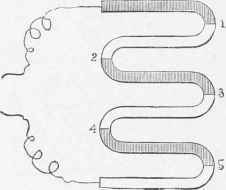
Fig. 1.
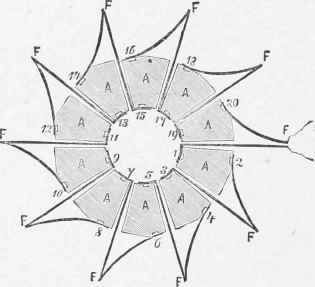
Fig. 2.
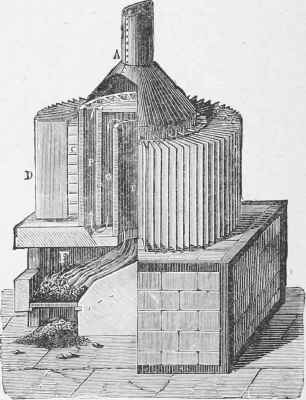
Fig. 3. Thermoelectric Piles.
Metals. | Electro-motive Force |
Bismuth ... | + .000068 volts |
+ .000024 „ | |
German | + .000015 „ |
+ .00000015 „ | |
Tin | + .000001 „ |
Metals. | Electro-motive Force. |
Lead | |
Copper . . | - 0000017 volts |
Silver | - .0000029 „ |
- .0000035 „ | |
- .000015 „ | |
Antimony | - .000046 „ |
The current flows from the metal that is higher on the list; thus, comparing bismuth and antimony, from the first to the second. The value of the electro-motive force for any pair of metals is the algebraic difference of the numbers given in the table; thus, of bismuth and antimony it is the difference between + .000068 and - -000046 = .000068 + .000046 = .000114 volt, and between antimony and lead the potential difference is the difference between .000088 and 0, or .000058 volts. The physical conditions of the metals have much effect on the voltage; thus, hard platinum is thermo-electrically negative to soft platinum. A section of Clamond's thermopile is shown in Fig. 2. The elements consist of block A, of an alloy (two parts tin and one part?inc), and arms of sheet iron F. The latter project and offer considerable surface to the air, so that the joints numbered 2, 4, 6, etc., to 20 are cooled. The inner junctions 1,3,5, etc., to 19 are heated, an earthenware cylinder with holes across it allowing- coal-gas jets to play on the joints. Five such layers were used. Another form of Clamond pile is shown by Fig. 3. In this the hot gases from a coke furnace F pass up through the flues T, O, and P, and out at the chimney at A. The elements are shown at C, while copper radiators Dattached to the outer junctions, but insulated from them, serve to increase the difference of temperature. It is said that from a battery with 3,000 couples the total electro-motive force obtained was 109 volts, the internal resistance being 15.5 ohms. The temperatures of the junctions were not stated, but 11 lb. of coke was burned per hour.
Continue to:


My Books

