


Alcohol. Part 4
Description
This section is from the book "The Engineer's And Mechanic's Encyclopaedia", by Luke Hebert. Also available from Amazon: Engineer's And Mechanic's Encyclopaedia.
Alcohol. Part 4
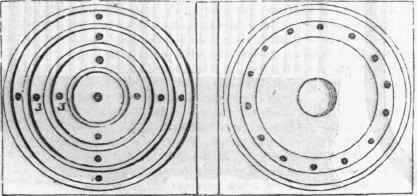
A number of bent tubes, as at H, are fixed in the annular plate, which covers the receiver at B with their upper ends, a little above the surface, which serve to carry off the condensed liquid back into the receiver B. The vapour improved in its spirituosity, is then collected in the chamber F, and passes from thence by the tube I into the second receiver K. The top plate of this receiver K, as well as the bottom plate of the third receiver N, have a number of openings or apertures forming concentric circles, as at L L, Fig. 2, in the plan of the apparatus, which we also annex. Into each of these annular apertures L L are fixed two copper cylinders, one within the other, and only a quarter of an inch apart; and as there are four such apertures, there are consequently eight cylinders, or four pairs in the apparatus, which are exhibited in section in the annexed Fig. 1. at M M. CO are tubes which pass through the receiver at K, to convey water between the cylinders; similar tubes are passed through the receiver N, by which means the water is diffused over every part of the extended surface of the apparatus, effecting thereby almost as rapid a condensation of the aqueous portion of the vapour, as if the water were in actual contact with it. ,The vapours from the lower receiver K ascend, as before mentioned, through the narrow spaces between the cylinders into the upper receiver N, in a high state of purity and strength.
From this last hold it proceeds into the worm by the tube P, where it is instantly condensed by the refrigerating effect of the cold water, by which this part of a distillatory apparatus is always surrounded. The water contained in the second bath T, shewn in section, is heated to 140° (or less, as the strength of the spirit may require,) that being a temperature at which the vapour of water, as well as that from the empyreumatic oils, cannot exist. This apparatus is stated to be so effective, that in an experiment made at an eminent distillery in London, in the presence of several experienced distillers, "feints 80 per cent, under proof were put into the still, and came out at one operation at 55 per cent, over proof." Grimble's Patent Distilling Apparatus consists of a series of very small tubes, fitted to the mouth of an ordinary still, the upper ends being received into a close box, from whence the uncondensed vapour passes on to the worm whilst the condensed portion is returned to the still.
It is shewn in the accompanying engraving, where A is the still; B the bottom box of the apparatus.
Fig. 1.
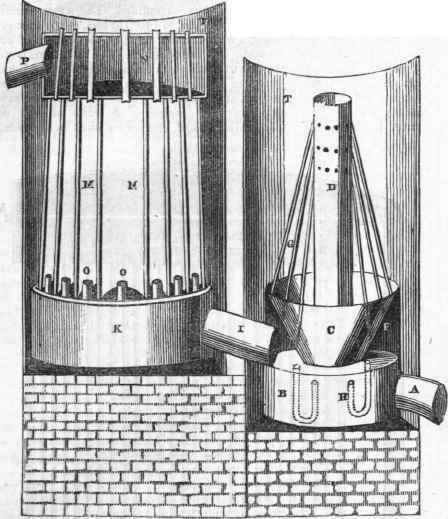
Fig. 2.
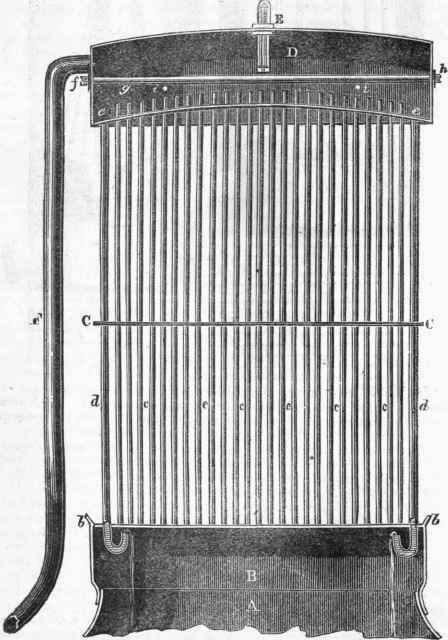
fitting on the still; b b a plate of copper, fitting on the box B; c c c are open tubes, through which the vapour ascends into the top box D, where the sepa-ration of the aqueous vapour takes place from the spirits; the tubes cc c project through the bottom plate of the box D, so that the oily and aqueous matters are not allowed to return by the small tube, which would impede the vapour issuing from the still, but run back into the still by the larger corner tubes d d, which are on a level with the bottom plate at e e. The lower ends of these times are turned up syphon-wise, to prevent the ascent of the vapour from the still, c c is a stay plate for the tubes; in the box B is a range of tubes g g g, through which a current of cold water is maintained when the spirit is required very strong, (but not generally used) having its egress and exit at f h. F is the pipe that conveys the spirituous vapour into the worm, and a thermometer at E serves to regulate the operations. We understand that an apparatus of this description is or was in use at Messrs.
Booth and Co.'s distillery, but di not know how far it answered the proposed end.
Evans's Patent Distilling Apparatus. The object of this invention is to effect a more equal and uniform distribution of heat to the liquid under distillation, than is obtained in stills as hitherto constructed, as well as obtaining spirits of great strength at a single operation. As the plan is totally different from any of the preceding ones, and as some of the arrangements evince great ingenuity on the part of the inventor, we lay it before the reader, without, however, expressing an opinion as to its applicability in practice. The engraving represents the whole operation at one view, a is a pipe which conveys the wash or fermented liquor into a reservoir b, where it is maintained at a certain level by the ball valve c. d is the still, which is a revolving copper cylinder, with ledges fixed in horizontal lines against the inner surface, to increase the agitation of the wash as it turns upon its hollow axis f g; its motion is derived from the spur-wheel h acting upon the pinion i fixed upon its hollow axis; j is the rectifier; this is formed of a large pipe of uniform bore, coiled up into the spiral figure exhibited, with the ends bent, so as to form axes for rotation, on one of which a pinion k (corresponding to that at i) is fixed; and this pinion is acted upon by another spur-wheel I on the same shaft as the other; m is the common distiller's refrigeratory; and n a receiver for the distilled spirit.
The figure represented in dotted lines, is intended to show the position in which the still is drawn up when it is necessary to cleanse it. For this purpose there is at o a universal joint, of a peculiar construction, which enables it to be easily done, after having separated the connecting tubes at the union joint, represented contiguous thereto. The rectifier j communicates with the still through the hollow axle g, and with the refrigeratory through a stuffing-box; and the still communicates with the reservoir by means of a syphon passing through the hollow axis f. The outward part of the syphon has two unequal limbs; the short one is inserted in the reservoir for the purpose of charging the still with wash, and the long limb for discharging the spent liquor. In order to charge the still, the ball of the valve is pressed downward, so as to raise the liquid above the top of the syphon; this sets the syphon in action, and causes it to fill the still to the same level as the liquid in the reservoir. Thus prepared the fire is lighted, and a slow rotatory motion is given to the still by hand or any other convenient first mover, applied to the shaft upon which the spur-wheels h and I are fixed.
Continue to:


My Books

