


Chapman's Furnace
Description
This section is from the book "The Engineer's And Mechanic's Encyclopaedia", by Luke Hebert. Also available from Amazon: Engineer's And Mechanic's Encyclopaedia.
Chapman's Furnace
In 1824 Mr. Chapman received a reward from the Society of Arts for a different mode of introducing air into the furnace. He casts the grate bars hollow from end to end, so that they form a series of parallel tubes, which open into two boxes, one placed in front, and the other behind the grate. In the front box, directly underneath the fire door, there is a register to open and shut to any extent, at pleasure; the other end is connected with the brickwork, directly under the fire bridge, which fire bridge is made double, with a small interval between, about one inch, the interval to go across the furnace from side to side, and rather to incline forward, or towards the fire door, so as to meet and reverberate the smoke on to the ignited fuel in the grate, which causes it to inflame and become a sheet of bright fire under the bottom of the boiler. By this arrangement it will be perceived, that if the front register is open, or partially so, there will be a great draft of air through it, along the interior of the grate bars, thence into the flue of the fire bridge, and out of the orifice at top, which air will be heated in its passage through the bars before it comes in contact with the smoke, when it will give out its oxygen, and cause it to inflame.
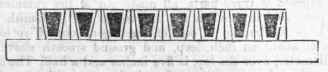
Mr. Chapman's mode of supplying the coals to the furnace is also simple and excellent, which will be explained with reference to the subjoined engraving. Fig- 1 is a section of the furnace, with a boiler fixed therein; and Fig. 2 a view of the hollow bars as they open into the box i. a is the boiler; b the fire-place; c the feeding hopper, with a cover d, and its type or turning bottom, having a lever or counterpoise e, by means of which the coals are delivered into the fire-place; f is a rake, by means of which the half-burnt coals are pushed forward previously to letting in a fresh charge; g a slit below the furnace door, through which the state of the fire is seen; i t is an air-tight box, into the back of which the bars open, and in front of which is a register for the admission of air; k one of the hollow bars, the whole of which are shown in Fig. 2 as they open into the box i above mentioned; f a flue in the fire bridge, through which the air having passed into the box i, and thence through the hollow bars k, enters into the furnace, and consumes the smoke.
Hollow bars are said to be more durable than solid.
Fig. 1.

Fig. 2.
Continue to:


My Books

