


Horology. Part 2
Description
This section is from the book "The Engineer's And Mechanic's Encyclopaedia", by Luke Hebert. Also available from Amazon: Engineer's And Mechanic's Encyclopaedia.
Horology. Part 2
The catgut goes round 16 times, so that the clock will go eight days. The hour-hand of the clock is turned by the wheel work shown upon the front frameplate; on the end of the arbor of the centre wheel 64 a tube is fitted, so as to go round with it by friction; this carries the minute hand, but if the clock should require correction, the hand may be slipped round without moving the wheels: this tube has a pinion of 40 teeth on its lower end, indicated by a dotted circle; this turns another wheel 40, of 40 teeth, which has a pinion of 6 teeth on its arbor, turning a wheel 72, of 72 teeth; the two wheels 40 will both turn in an hour, and 72 in 12 hours; the arbor of this wheel has the hour-hand, and is a tube going over the minute-hand, so that the two hands are concentric. The barrel a is fitted to an arbor coming through the plate of the clock, and is filed square to put on a key to wind up the weight; the great wheel 96 is not fixed fast to the arbor, but has a click on it, which takes the teeth of a ratchet wheel cut upon the barrel; so that the barrel may be turned in the direction to wind up the weight without the wheel; but by the descent of the weight, the wheels will be turned by the click.
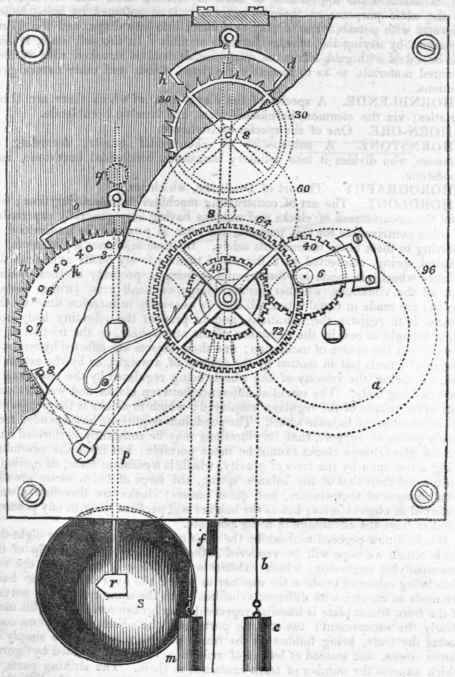
In commencing our description of the striking parts, we should observe, that Mr. Prior not having exhibited their connexion with the going parts of a clock, we have chosen the mode of unlocking the detent which appeared the simplest, and admitted the easiest explanation; but various other and perhaps better modes might be contrived for effecting this: the dotted circle k has a weight m suspended from it by a catgut passing round it like that which passes round the going barrel a; n is a scape-wheel of 78 teeth, connected with the barrel by a ratchet and click, and having 12 pins projecting from its face, a portion of which are seen, marked 2, 3, 4, 5, 6, 7, 8; these pins are ranged in a circle at unequal distances, corresponding to the number of strokes to be struck at each successive hour; o is the scapement similar to that previously described; on its arbor is fixed a pendulum p, of about nine inches in length, and which will therefore vibrate half seconds nearly; but in order to regulate the fate of vibration at pleasure, the rod of the pendulum is prolonged beyond the point of suspension, and carries a small ball q moving stiffly upon it, and by raising or lowering this ball the vibrations become retarded or accelerated.
To the lower end of the pendulum rod is attached a hammer r, which strikes upon a bell s at every second vibration; this effect is obtained by placing the bell sufficiently oblique to allow the hammer to swing past it at one vibration, and to impinge upon it at the returning one. The barrel k and escape-wheel n are retained at rest by the locking detent t, which engages each of the pins in succession on the face of the escape-wheel; this detent is fixed on to the arbor of the arm or lever v, which is pressed by the spring w against a snail or cam a fixed upon the hollow arbor which carries the minute-hand. The snail is consequently carried round once in an hour, during which time the lever v is gradually elevated, and moves the detent in like manner until the lever arrives at the highest part of the snail, when the pin on the escape-wheel is released from the detent, and the wheel immediately begins to revolve and imparts motion to the pendulum, which, as before said, strikes upon the bell at each second vibration.
The rotation of the snail having carried its highest point past the end of the lever, the latter (pressed by the spring w) falls past the straight side of the snail to the foot of the same, and brings the detent into its locking position; and when, by the revolution of the escape-wheel, the next pin comes in contact with the detent, the motion of the wheel is arrested. Clocks are sometimes impelled by springs instead of weights, as in the one just described, and are very convenient for placing in chambers on account of their occupying less room than weight-moved clocks. The construction of these spring clocks resembles that of the other, with the exception that for the barrel and weight are substituted a fusee and spring barrel, resembling the same pieces in a pocket-watch, to the description of which we shall now proceed.
The essential difference, as we have before observed, between a clock and a watch, consists in the former being regulated by a pendulum, and the latter by a balance; for as to the maintaining power, it is sometimes the same in both, since although watches are not impelled by weights, clocks (as just mentioned) are sometimes kept in motion by springs like watches. The balance is a small wheel fixed on an arbor or axis called the verge, and moving freely upon pivots at the ends of the arbor. To the axis of the balance the inner end of a very elastic helical spring called the pendulum is attached, and the outer end is made fast to some fixture. In this state the balance will remain at rest when the spring is in that position which it would assume if detached from the balance, and at perfect liberty; but if the balance be turned on its pivots in either direction, so as either to wind up or unwind the spring, the latter will, upon the external force being removed, tend to resume its natural position; but the momentum which is thus imparted to the balance will carry it past the position of rest, which will again alter the spring, and the balance will again be returned past the position of rest, and will thus continue to vibrate until the friction of the pivots and the resistance of the air destroy the original impulse.
The vibrations of such a balance, which passes through equal spaces, will be performed in equal times; these vibrations, therefore, form the real measure of time, and the remaining apparatus in a watch is for the purpose of registering the vibrations, and of maintaining the motion of the balance; and this is accomplished in watches by means of a train impelled by a spring and fusee. The spring employed for this purpose consists of a long flat plate of steel, coiled up in a helical form; it is inclosed in a cylindrical box called the spring barrel, to which its external extremity is attached, whilst its internal end is connected to a fixed axis, round which the barrel revolves. As the strength of the spring is greater the more it is coiled up by turning the box, its action would be unequal in impelling the work of the clock; and to remedy this inconvenience, the fusee has been contrived. The fusee consists of a conical barrel, round which a spiral groove is cut, which receives a chain previously wound round the barrel, by which, as it is turned round, it coils up the spring; the groove receives the chain first near the base of the cone, and as the barrel revolves, gradually brings it nearer the axis; by this means the stronger the spring is coiled up, the shorter is the lever by which it acts upon the work; and as it gradually uncoils and becomes weaker, on the contrary the lever of action becomes longer.
Continue to:


My Books

