


367. Bolts, Nuts And Machine Screws
Description
This section is from the book "An Elementary Outline Of Mechanical Processes", by G. W. Danforth. Also available from Amazon: An elementary outline of mechanical processes.
367. Bolts, Nuts And Machine Screws
These articles are products of the re-manufacture of metals. Those for general use are made according to adopted standards of shape and size.
A machine screw is a small bolt with a slot in the head to be turned by a screw driver. Machine screws are made in diameters designated by gage numbers, and varying over a range from about 1/16 to 1/2 inches in diameter. Machine screws with nuts are called stove bolts.

Fig. 217. - Pipe-Fitting Tools.
Bolts are standardized in the following items, viz.:
(1) Length.
(2) Diameter.
(3) Threads per inch for a given diameter.
(4) Shape and dimensions of head.
Nuts are standardized in shape and dimensions. A nut is usually larger than the head of its bolts as it is essential that the side of the nut through its smallest part should be large enough to give it the strength needed.
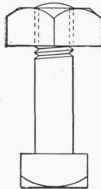
A
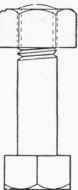
B
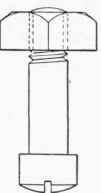
C
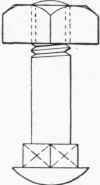
D
E
F
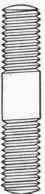
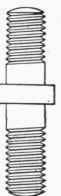
Fig. 218. - Standard Bolts.
Fig. 218 shows the usual types of standard machine bolts. These are designated as follows, viz.:
A. Machine bolt, square head and nut.
B. Machine bolt, hexagon head and nut.
C. Machine bolt, round or fillister head.
D. Carriage bolt.
E. Stud bolt.
F. Stud bolt with collar.
G. Tap bolt or cap screw (the same as A, B, or C), without nut and with longer thread.
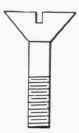
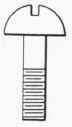
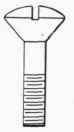
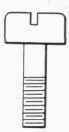
Fig. 219. - Forms of Machine-Screw Heads.
Fig. 219 shows the usual forms of machine-screw heads. They are designated as follows:
1. Flat or countersunk.
2. Round or button.
3. Oval countersunk.
4. Fillister.
Among the special forms of bolts may be mentioned the following, viz.:
(1) The body-bound bolt, also called the tight-fitting bolt, is one which is turned in a lathe to fit closely a bored hole. Bolts of this kind are much used in holding together parts of machinery to prevent the slightest change of position of one part on another.
(2) The set screw is used to screw through the hub of a wheel and press against the shaft to hold the wheel in place. It has many other similar uses. It resembles a tap bolt, and is either pointed or cupped at the end to take good hold against the shaft.
(3) The expansion bolt is used for bolting brackets and fixtures to a stone, brick or cement wall. The bolt has an expanding nut which is placed in a hole dug in the wall. When the bolt is screwed in tightly, it expands the nut and makes it press tightly in the hole.
The length of a bolt does not include the head, except in the case of bolts with countersunk heads. It is generally understood that bolts have standard right-hand threads, and if bolts with left-hand, double or other than standard threads are desired they must be specified.
To prevent nuts jarring loose and unscrewing, various nut locking devices are used.
Continue to:


My Books

