


Insulite Battery
Description
This section is from the book "American Library Edition Of Workshop Receipts", by Ernest Spon. Also available from Amazon: American Library Edition Of Workshop Receipts.
Insulite Battery
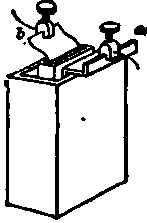
The British Insulite Co. have brought out a sealed cell suitable for domestic use, as shown in Fig. 37. It is an oblong vessel on plan, with a diaphragm of porous material securely cemented to opposite corners, thus dividing the cell into 2 equal compartments. In one is a carbon rod surrounded by fragments of carbon about pea size, and in the other, the familiar zinc rod, with a special excitant, non-corrosive and non-poisonous. The lid is perforated with 3 holes, into 2 of which the electrodes fit water- and air-tight, by the. aid of collars formed of pieces of rubber tubing; while the third is closed by a stopper and capsule, forming a release-valve to provide for the slight variations in the pressure of the contained air. When the capsule is screwed home, the cell may be shaken about or inverted without injury or escape of the liquid; and one turn of the capsule is sufficient to leave the cell in a permanently working condition. The lid, having been fitted to the electrodes, is pressed down on the diaphragm, and auto-genously soldered in position, the zinc rod lasting about 2 years with the average amount of usage of the bell, and being readily replaced when worn out.
The connections are made by nickel-plated caps, split and held by pinching screws to the carbon and zinc rods, and as the latter are tightly surrounded by rubber, there • is little risk of defective connections from corrosion or other effects.
Fig. 36.
Continue to:


My Books

