


Lead. Part 13
Description
This section is from the book "American Library Edition Of Workshop Receipts", by Ernest Spon. Also available from Amazon: American Library Edition Of Workshop Receipts.
Lead. Part 13
To sum up, the advantages of the steam process, as compared with the old 6 - ton Pattinson pots formerly used, are: - (1) saving of § amount of fuel used; (2) saving of cost of calcination of the lead to the extent of at least $ of all that is used; (3) above all, havmg in labour to the extent of 2/3. The process has its disadvantages, and these are a larger original outlay for plant, and a constant expense in renewals and repairs. This is principally caused by the breakage of pots; but with increased experience, this item has been very much reduced during the last 2 or 3 years.
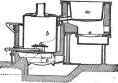
The arrangement of the steam apparatus is shown in Fig. 143: a is a melting - pot of 9 or 10 tone capacity, where the crude lead is melted; b, a pot of 15 tons capacity, where the lead is subjected to the action of the steam; c, pipe introducing the steam; d, cast - iron plate for distributing the steam through the mass; e, fireplaces.
Fig. 143.
Parkes' or the "zinc process depends upon the affinity which zinc has for silver. The lead is melted in a Pattinson pot, and skimmed; then molten zinc is added to it, and stirred up with it; finally, the lire being damped, the metal is left to cool gradually. The zinc containing the silver now rises to the top, and la skimmed off with a perforated ladle; if necessary, the pro - being used than is requisite to combine with the silver known to be present. the zinc is then distilled off the alloy in an appropriate retort, and condensed, when it can be used in subsequent operations. As worked in this country by Locke, Blackett & Co., the process is as follows:- A charge of silver - lead, usually about 15 tons, is heated to a point considerably above that which is used in either the pattinson or the steam process, The quantity of zinc added. is regulated by the amount of silver contained in the lead: but for lead containing 50 oz. to the ton, the quantity of zinc used is in moat cases about 1 1/2 cent. of the charge of lead. The lead being malted as described, a portion of this zinc, usually about 1/2 the total quantity required for the charge, is added to the melted lead, and thoroughly mixed with it by continued stirring.
The lead is now allowed to cool, when the zinc is seen gradually to rise to the top, having incorporated with it a large proportion of the silver. The setting - point of zinc being above that of lead, a zinc crust is gradually formed, and this is broken Up and carefully lifted Off into a small pot conveniently placed, care being taken to let as much lead drain off as possible. The fire is again applied strongly to the pot, and when the lead is sufficiently heated, a further quantity of zinc, about 1/3 of the whole amount used, is added, when the same process of cooling and removing the zinc crust is repeated. This operation is gone through a third time, with the remaining portion (1/2 per cent.) of zinc; and if each of these operations has been carefully carried out, the lead will be found to be completely desilverized, and will only show a very small trace of zinc. In some works, this trace of zinc is allowed to remain in the market lead, but at Locke, Blackett & Co.'s works it is removed by subjecting the lead to a high heat in a calcining furnace.
The zinc crusts, rich in silver, are freed as far as possible from the lead by allowing this to sweat out in the small pot, after which the crusts are placed in a covered crucible, where the zinc is distilled off, and a portion of it is recovered. The lead remaining, which is extremely rich in silver, is then taken to the refinery and treated in the usual manner. The quantity of zine recovered la as high as 50 to 60 Per cent. of the total used.
This process has much to recommend it, in the low original coat of plant, the small amount of labour, and the extreme quickness with which the lead can be treated. The stock of working lead required is also (mall as compared with either the Pat - tinson or the steam process. Against this, however, is to be set the cost of the zinc which is lost.
The combination of the lead with the zinc is effected In several ways, e.g., by mechanical agitation, by introducing the lead in a kind of rain through an iron sieve into the molten zinc, and by dispersing the zinc drop by drop among the molten lead by putting it (the zinc) Into an iron colander, which is plunged into the lead.
Similarly, a plurality of methods have been proposed for separating the silver and zinc compound produced by the desilvernation of the lead. At Pisa, distillation is adopted: after a portion of the lead has been liquated from the material, the latter is placed in a crucible and heated to redness; the zinc distils over, and the residua of silver - lead left is cupelled. At Fried - richshiitte, near Tarnovitz, the silver - zinc scums are liquated only to such a point as will leave lead enough to ensure that the proportion of zinc does not exceed 12 percent.; they are then distilled In zinc muffle furnaces with coke powder. In the works on the Rhine, chlorination is preferred; it con - sists in mixing, at a low - red heat, lead chloride with the zinc crusts, and the result is a zinc chloride which separates, and a silver - lead which is cupelled. At Rothschild's works, in Havre, oxidation by steam, has given very satisfactory results. The apparatus used is shown In Fig. 144. The lead is first melted in the upper pot a, and then the zinc Is introduced by means of an iron box. pierced with holes; after stirring, settling, and skimming, the lead - zinc mass is run into the lower pot 6, into which a current of superheated steam is conducted by the pipe c; there is thus produced zinc oxide and a rich silver - lead.
The latter is cupelled, while the zinc oxide Is washed to remove grits, and then affords pure zinc oxide, which is sold as zinc - white, and an impure lead oxide, which is reduced in a rever - beratory furnace, or treated with hydrochloric acid to dissolve the zinc and liberate the lead; d, the fireplaces.
Continue to:


My Books

