


Angle Connections. Continued
Description
This section is from the book "Do It Yourself With Aluminum. 125 Projects For The Home Craftsman", by G. W. Birdsall. Also available from Amazon: Do It Yourself With Aluminum.
Angle Connections. Continued
Angle-To-Ancle Joint
The best way to connect one angle to another in either a T-joint or an X-joint is to bolt or rivet the two adjacent legs as in Fig. 4—46. To brace and stiffen the joint, cut a small piece of the same type angle section and rivet or bolt it to the other members as shown.
Attaching Angle Legs
It is easy to attach the end of an angle to the bottom surface of a table top by cutting off a section of one face of the angle and bending the other down alongside it as in Fig. 4-47. Then drill a hole through this, and drive a screw through it into the underside of the table top. While such a connection itself will not keep the leg from tilting, table designs using this leg connection have ample strength designed into the accompanying framework structure.

Fig. 4-49.
Closing Angle Bends
When angles are used as legs on tables and various items, it is desirable to close the open ends in some way to increase the area contacting the floor and thus reduce any tendency to dig into floors or rugs. Figure 4—48 shows how to attach a rubber bumper by cutting a pair of 45° miters on both legs of the angle and bending inward. Then drill to pass the screw attaching the bumper.
The method of Fig. 4-49 is still easier. Simply cut off one face of the angle as shown, and bend the opposite piece of leg to overlap it.
Inlaying 1" Angle
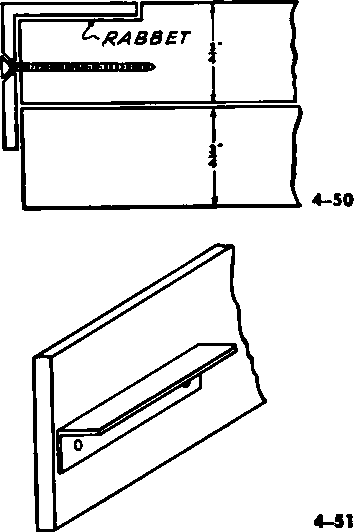
Any table top can be enhanced greatly by inlaying the edge with 1" angle as shown in Fig. 4-50. Before starting to inlay, be sure table edge is absolutely straight lengthwise and square with the table top. The best way is to run edge through a jointer-planer. Then rabbet out a section 1/16" deep and 15/16" in from the corner to make the angle come flush with the table top.
Most tables will require two lengths of angle. Make the joints in the angle come in the center of table ends. Thus one piece goes along the front edge of table and half the length of each end. The second piece then goes along the back edge of table and remainder of distance at each end. It is easier to line up joints along a straight edge than at corners. Measure length required, and cut angle stock 1/8" longer for good measure. Drill, notch, and bend corners per Fig. 4-37. Adjust length between bends for precise fit if necessary. Secure angle to table edge with finishing nails.
To make nailheads invisible, file off top of nailheads to cut head thickness in half. Drill a hole in angle the exact size of nail body. Then countersink slightly with a drill same size as nailhead. But remember that the table trim stock is only 1/16" thick, so countersink must be very shallow, just a little less than the depth of the filed nailhead. Now position trim accurately, insert nail, and drive into table top. Use a small hammer, and drive nail-head flush with surface of the angle trim. Try one or two with scrap pieces of angle to get the hang of it.
Drawer Slides From Angles
Figure 4-51 shows an easy way to make slides for drawers inside cupboards or storage units, using1/8" x x 34" angle with one of the flat faces up. Where a drawer is to work between table legs of angle stock,

Fig. 4-52 shows how to mount the drawer slides to the legs to avoid interference. The vertical leg of the angle stock forming the drawer slide is cut %" longer than the horizontal leg and then bent around back of the table leg, to which it is then riveted.
Recessing Angle
In the vanity table shown in Fig. 9-7 and in many other plywood structures such as bookcases and desks, it often is desirable to sink one face of angle stock used for framing. Most designs using angle framework look best with the flat faces of the angle legs outward .... thus in Fig. 4-53, angles used at corners for legs face front and left at "A"; back and left at "C."
But suppose you wish to set the angle in from the corner .... as at UB.M Note from Fig. 4-54 that the end piece of the cabinet is slotted to take the front face of the angle. Using this type of construction, back legs can also be moved in from the corner as at "D," Fig. 4-53.
Recessing the angle in this manner adds novelty and a modern touch and makes the item actually stronger because the panels help hold the angle rigid.
Continue to:


My Books

