


Triangles
Description
This section is from the book "A Practical Workshop Companion For Tin, Sheet Iron, And Copper Plate Workers", by Leroy J. Blinn. Also available from Amazon: A Practical Workshop Companion For Tin, Sheet Iron, And Copper Plate Workers.
Triangles
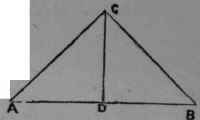
To Find The Area Of A Triangle When The Base And Perpendicular Are Given, Fig. 3
Rule. - Multiply the base by the perpendicular height, and half the product is the area.
The base of the triangle, fig. 4, ADB is 3 feet 6 inches in length, and the height, DC, 1 foot 9 inches required the area.
6 inches = .5, and 9 inches = 75;
3.5X1.75 hence------------=3.0625 Square feet the area.
Fig. 4.
Any two sides of a Right Angled Triangle being given to find the third.
When the base and perpendiculars are given, to find the hypothenuse.
Add the square of the base to the square of the perpendicular, and the square root of the sum will be the hypothenuse.
The base of the triangle, fig. 5, AB is 4 feet, and the perpendicular BC 3 feet, then
42 + 32 = 25, √ 25 = 5 feet the hypothenuse.
When the Hypothenuse and Base are given, to find the Perpendicular.
From the Square of the hypothenuse, subtract the Square of the base, and the Square of the remainder will be the perpendicular.
Fig. 5.
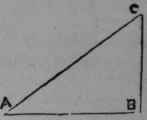
The hypothenuse of the triangle, fig. 5, AC, is 5 feet, and the base, AB, 4 feet; then 52 - 42 = 9, and √ 9 - 3 the perpendicular.
When the Hypothenuse and the Perpendicular are given to find the base.
From the Square of the hypothenuse subtract the square of the perpendicular and the square root of the remainder will be the base.
Continue to:


My Books

