


Electrolysis Of Water
Description
This section is from the book "Welding Theory, Practice, Apparatus And Tests Electric, Thermit And Hot-Flame Processes", by Richard N. Hart. Also available from Amazon: Welding: Theory, Practice, Apparatus And Tests, Electric, Thermit And Hot-Flame Processes.
Electrolysis Of Water
When water is decomposed by electrolysis, it gives 2 volumes hydrogen, 1 volume oxygen.
The electrolyte is a dilute solution of sodium or potassium hy-droxid; oxygen rises from the positive and hydrogen from the negative. If the gases are collected as mixed oxygen and hydrogen in the gasometer, it is called detonating gas. This is the gas that was first used in the oxy-hydrogen blowpipe (see page 117). Detonating gas is handy for blowpipe work, but it is dangerous. It is the most readily combustible mixture of the two gases, and if the torch backfires there will be an explosion. To prevent this a safety water-seal was introduced in the leading tube, or the blowpipe handle contained a chamber packed with fine rods or gauze or asbestos wool to imitate the idea of the Davy safety lamp.
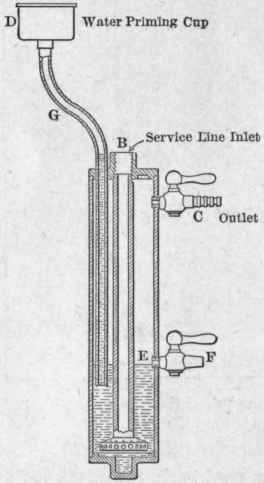
Fig. 37. - Diagram of safety water seal, to protect the acetylene supply (the Linde air products company).
The railroads will not handle detonating gas, and it is not manufactured except privately. In the electrolysis of water nowadays a diaphragm placed between kathode and anode separates the gases. Of these gases the oxygen is of the greater commercial importance.

Fig. 38. - Oxygen constant-pressure regulator.
Oxygen is colorless, odorless, non-poisonous, and supports combustion with hydrogen, acetylene, producer gas, etc.
Since 1880 rapid progress has been made in the manufacture of nearly pure oxygen and hydrogen by the electrolysis of water. Abroad, it is the main source of these two gases, especially since 1900. In America there is but one electrolytic industrial plant. The Linde oxygen practically controls the market.
Among the successful commercial processes in Europe are those using the patents of Schmidt, Schuckert, Garuti, Schoop, and Hazard-Flamand. The Schuckert apparatus is as follows:
"It consists of a cast-iron tank, containing a number of cast-iron electrodes in various chambers separated by diaphragms, extending from the top downward about three-fourths the depth of the cell, the. gases being conveyed through a pipe system to separators, whence the wash-water is returned to the electrolytic cells.
"The electrolyte is a 20 per cent, solution of caustic potash. The cells are embedded in a sand layer about 2 or 3 inches in thickness, arranged to protect the apparatus from heat radiation, the temperature of the electrolyte being maintained at about 75 deg. Cent. This is said to be the most satisfactory temperature, as the lowest voltage is required at this temperature for decomposing the electrolyte. The pressure is from 2 to 3 volts, and the various cells are connected in series very much the same as a battery of accumulators. The hydrogen and oxygen gases when generated at the electrodes are conducted through pipes to separate gasometers or tanks for storage." 1
From 97 to 99 per cent, oxygen is claimed for this plant, which is that of the Schuckert Co., Niirnberg, Germany.
Another process, the Hazard-Flamand is also described in detail in the Electro-Chemist and Metallurgist2 of the British Faraday Society. The table of relative outputs at different current values is given below.
The Hazard-Flamand Cell
Volts applied at voltameter terminals | Current in amps. | Yield of 02 grams per hr. | Yield of 02 grams per kw.-hr. | Per cent, of theoretical energy efficiency (213.07 grams per kw.-hr.) |
2.1 | 243 | 72.0 | 141.7 | 66.5 |
2.3 | 265 | 79.0 | 129.6 | 60.7 |
2.8 | 323 | 96.2 | 106.3 | 50-5 |
1 Electrochemical and Metallurgical Industry, F. C. Perkins, May, 1906.
2 Electro-chemist and Metallurgist, June, 1904.
"In considering the fourth and fifth columns, it must be born in mind that hydrogen is also liberated, of double the volume, but of 1/8 the weight. In other words, with an e. m. f. of 2.1 volts, each voltameter produces 1.8 cu. ft. of oxygen per hour and 3.6 cu. ft. of hydrogen, of the respective approximate weights of 72.0 and 9.0 grams."1 The article goes on to state that while 2.1 volts is theoretically most efficient, 2.4 gives best practice. The oxygen is 99 per cent, pure and the hydrogen in proportion.
Manufacturers of electrolytic gases claim that their oxygen is much purer than that of other processes. Oxygen by the chlorate process is contaminated with carbon dioxid, often over 10 per cent. Liquid-air oxygen contains from one to five per cent, nitrogen. The impurities of electrolytic oxygen are a few per cents, of hydrogen, a little chlorin, and water vapor. In laboratory determinations these impurities sometimes determine which kind of oxygen shall be used. For welding and soldering, the gases should be pure for the sake of keeping harmful impurities from burning into the metal.
The first cost of installation of an electrolysis plant is very great and may reach as high as $25,000, exclusive of maintenance cost. For this reason very few industries would find it worth while to install such a plant for welding purposes. In Europe these installations are most often separate concerns for the manufacture and sale of stored oxygen and hydrogen.
For further information about electrolysis of water the reader is referred to "The Electrolysis of Water," by Engelhardt, translated by Richards, 1904.
Continue to:


My Books

