


A Power Dory V. The Engine and Fittings
Description
This section is from the book "Amateur Work Magazine Vol3". Also available from Amazon: Amateur Work.
A Power Dory V. The Engine and Fittings
Carl H. Clark.
The engine is now to be obtained and installed. The question of the best make will be largely a matter of personal preference and also of price. Almost all of the engines on the market are capable of satisfactory running if properly adjusted and taken care of. A large part of the trouble experienced by amateurs in running gasoline engines is caused by lack of proper adjustment. Good care should be taken not to change the adjustment of the engine as obtained from the makers until after it has had a thorough trial in the boat and the owner is familiar with its action under all circumstances.
When ordering the engine, the distance from the after side of the deadwood to the flat part of the bed should be given to the engine dealer, to be sure of getting the shaft long enough. In the matter of spark coil and batteries, it is to be urged that only the best be purchased, as use on salt water is very severe, and cheap materials very soon go to pieces, and cheap bat. teries very soon run out. It is advised that a magneto be used for ignition, using the batteries for starting only.
The first step will of course be to bolt the engine in place. It should be placed upon the bed, with the shaft in place in the hole in the deadwood. This hole is of course larger than the shaft, and the engine is now to be adjusted, either by cutting the bed slightly, or in any other way, until the shaft is directly in the centre of the hole. It may perhaps be necessary to trim the inside end of the hole with a gouge to get the proper clearance. At the same time the brace between the engine beds may be fitted to the round of the under side of the base, and then fastened in place by lag screws.
To get clearance for the fly-wheel, the beds will need to be notched out, this should be done until the fly-wheel has about 1-4" clearance. A clearance must also be allowed for the crank in starting. When everything has baen brought to a good bearing, holes may be bored for the lag screws which hold down the engine. These screws will probably be 4 or 5 inches long, and the hole is bored to fit the size at the bottom of the thread. It will be rather a nice piece of work to fasten the engine into place without cramping tbe shaft and causing it to bind in the bole.
The stern bearing may now be slipped on over the shaft, and brought up against the deadwood, to which it is to be carefully fitted and bolted, with a layer of lead between. This piece, also, must be carefully fitted, or it will otherwise bind the shaft and cause friction and wear. When all is secure, the engine should turn over freely by hand; this point is very important and must be carefully observed.
In describing the installation of the engine it will be hardly possible to give an exact description of all the work, as no two engines are piped up in exactly the same manner. When ordering the engine, detailed directions for fitting up should be asked for. In many localities the engine maker can refer the buyer to one or more of his engines already in use. Seeing an engine already in place will be of great help to the amateur builder, and together with tne somewhat general directions here contained will enable him to fit up his engine with little trouble.
It will be best to have the several lengths of pipe cut and threaded by a pipe fitter from the measurements, as this work requires special pipe tools too expensive for the amateur to buy. The heavy piping for the exhaust should be fitted first, together with the muffler. Some makers furnish two small mufflers instead of one large one. The mufflers are placed under the deck aft, and the exhaust is carried out through the stern-board. The exhaust pipe runs directly from the engine to the muffler, which is so placed that there will be space between it and the sternboard to easily accommodate an elbow horizontally, from the muffler the pipe extends horizontally a few inches, then with another elbow it extends up the sternboard .and out through it, with another elbow and short pipe just above the rudder stock. In case two smaller mufflers are used, or for any reason, the arrangement outlined cannot be used, it should be kept in mind that the arrangement shouldbe as simple and direct as possible.
It will be noticed that there is a union between the muffler and the engine; this is necessary to allow it to be fitted into place. In fitting up this piping, the part beyond the union is made up first to fit into place; the short pipe which extends through the stern-board is a threaded close nipple, and is to have a locknut screwed on outside when it is in place; the straight pipe in the forward end of the muffler is fitted with one part of the union. This portion is then held in place while measurements are taken for the pipe between the engine and the union ; the latter piece is screwed into the exhaust hole in the engine and the connection made with the union. The necessity for the union will now be seen. A locknut is screwed over the short nipple on the outside of the sternboard to secure water tightness and hold the pipe in place. A cleat is fastened under the after end of the muffler to take the weight and hold it in place. Whenever the pipe comes in contact with any of the woodwork a piece of asbestos should be tacked between to prevent the woodwork being charred by the heat.
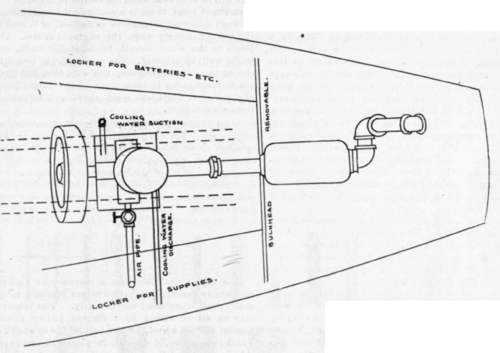
Fig. 11
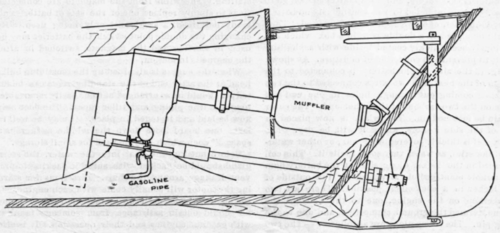
The cooling water should be piped up next. As wilf be seen, this water is circulated by a small pump, which draws water from the outside, and discharges it around the cylinder and overboard. The suction pipe leads either through the side or bottom, as is most convenient. When the engine is received it will propably have a stem in the suction pipe ready to connect. The connection with the bottom or side must, of course, be water tight and is connected to the part already in place with a piece of flexible tube, so that the vibration of the engine will not disturb the connection with the plank. If it passes out through a plank, a piece of oak should be fastened on the inside to reenforce the plank.
Continue to:


My Books

