


Elementary Mechanics III. The Inclined Plane
Description
This section is from the book "Amateur Work Magazine Vol3". Also available from Amazon: Amateur Work.
Elementary Mechanics III. The Inclined Plane
J. A. Coolidge
We will next study the construction, uses, and advantages of the inclined plane. Next to the lever this is the simplest of the mechanical powers, and a machine that we can hardly fail to see in walking five minutes about the business portion of a large city.
The board used in our experiments in friction can be used once more. It should be a piece of clear pine board, 3' long, 6" wide, and 3/4" thick. We must cut a piece 3/4" wide and 2 1/2' long out of the middle of the board. See Fig. 6. Next we must have two strips of wood, 5/8" thick, 24" long, and 3" wide, with a slot 3/8" wide cut out of the middle to within 1 1/2" of each end. See Fig. 7. These will serve as supports for the upper end of our board A, and should be fastened by two screw-eyes S, that fit into A and are prevented from pulling through the slots by tightly fitting washers. See Fig. 8. The lower end of the strips may be kept in place at b, by nailing them to a strip of wood 6" long and 3" wide.


Fig. 7

Fig. 9
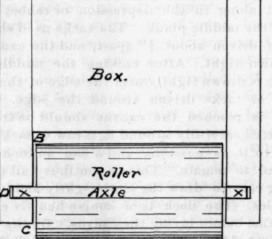
Now we must make a little car which shall run with very little friction, a well made toy railway car will answer. With these appliances our experiments ought to be accurate enough to teach us the laws of the inclined plane. A small wooden box 5" x 3" and 2"/ deep should be made of 3/8" stock and mounted on two rollers as wheels. Cut two pieces of curtain pole or other round stick at least 1 1/2" in diameter, 2 7/8" long, and polish as smooth as possible. Through the length of these pieces, exactly in the centre, bore a hole 1/4" in diameter. Or large spools may be used by carefully cutting off the bevel ends, only they must be smoothly rounded. Two pieces of 1/4" brass rod, which can be got with the curtain pole of any furniture dealer, must be cut 3 5/8" long. These may be made to serve as axles for the rollers by dropping a little shellac into the holes of the wooden rollers and then pushing the rods through. See Fig. 9. Two narrow pieces 5/8" thick, 5" long and 3 1/2" wide will next be needed; 3/4" from each end, and 1/2" from one edge, bore holes 5/16" diameter and 3/8" deep. See D, Fig. 9. These holes must be made as smooth as possible and lubricated with powdered graphite. Our axles, X X, Fig. 9, will fit easily in these holes and should turn with but little friction. After fitting these in the holes, tack or glue the strips to the sides of the box and we have a car which, though crude, will serve our purpose very nearly as well as a more expensive one.
Before studying the laws of the inclined plane, one or two experiments in friction must be performed, and in all experiments allowance should be made for the force lost in overcoming the
a b 12 in. | Total Wt. | Total Force | Friction | F less Friction | PxL | Wt. xH |
" | 2 lbs. | " | " | " | " | " |
" | 3 lbs. | " | " | " | " | " |
" | 4 lbs. | " | " | " | " | " |
a b 18 in. | 2 lbs. | " | " | " | " | " |
" | 3 lbs. | " . | " | " | " | " |
" | 4 lbs. | " | " | " | " | " |
a b 24 in. | 2 lbs. | " | ' | " | " | " |
" | 3 lbs. | " | " | " | " | " |
" | 4 lbs. | " | " | " | " | " |
friction, and not directly available in moving the weight we wish to raise.
Experiment XI. Take the block used in the experiments in friction, draw it along the board five or six times. Divide the force used to move the block by the weight of the block. This, as you know, is the co-efficient of friction. Raise the end of the board A (7, Fig. 8; place the block on the board and adjust the height a, until the block will just slide down with uniform speed. Great care must be taken that the block does not move with increasing speed. Measure carefully the height a b and call it h; also the base a c and call it b. Divide h by b and the quotient, h divided by b, is the coefficient of friction and should be the same as that found before, although Found in a different way. Let us suppose this is about 2/10 Whatever it is, that fractional part of the force used should be deducted on all experiments with the block, on account of friction, the remainder is available in moving the body.
Experiment XII.
Place upon the block weights enough to make the entire weight 30 ounces, and pull it up the board a c several times until we have determined accurately the average force employed in moving it. Deduct the force used in overcoming friction, and we have W, the weight, and F, the force. Measure the height a b and the slant a c. See Fig. 8. Multiply F by length a c. Multiply W by height a b. Do they agree? They should. By the law of the inclined place, "Power x Length - Weight x Height." Make the height a b less than before and try the experiment again. Experiment XIII.
With the board horizontal find the friction in pulling the little car with a total load, car and weights, of 2 lbs. Raise the end of the board a 12" above b and try again. Increase a b to 18" and then as high as possible, in each case determining the force, after deductiug the friction. It is very easy to see in a general way that the steeper the slant the greater the force. We will now try the experiment more systematically, and arrange our results so that we can see what the experiment teaches.
Does the law PxL=W xH hold true ?
Can you not, as you compare the force and weight, see how barrels are rolled up inclined planes? Think of the skids and planks on all the trucks. Every large team carrying barrels and bales of merchandise has one hanging on one side or underneath. But why is this possible? After taking out friction, which must be overcome in moving the car even over a horizontal surface, we find 1 lb. force moving 3 lbs. weight. In considering the object to be attained we find that it is to lift a weight the distance a b, or a barrel of sugar into a wagon, let us say. The weight has to be slid or rolled the length a c, or up an incline three or four times as long.
The weight lifted may be considered as a force acting against the moving force, and it may be separated into two forces, or two results. One effect of the weight is to bend the inclined plane, as can be seen when a very heavy weight is resting on a plank. This effect, or force, is overcome or met by the stiffness of the plane. The other effect of the weight is to roll or slide down the plane. The force that is used in moving the weight up the plane overcomes this force. The nearer horizontal the plane is, the nearer the the force necessary to move the weight is to zero. The force is always as many times less than the weight as the height is times less than the length.
Experiment XIV.
It now remains to move the car with a force parallel to the base b c. Fasten the car to the hook of the balance by a long thread, pass the thread through the slot in the board and pull the loaded car up the incline a c, keeping the string and balance always horizontal. At first this will be awkward, but after a few trials we can obtain a satisfactory result. Measure a b and b c. Try F X b c and W X a b. How do these products agree ? We should find the results correspond as before, but the reason is not so easily seen. Perhaps it will be enough to know that it is true. Questions of horces pulling wagons up a hill, or loaded cars up a track can now be answered. In all cases the gain in moving a large weight with a small force is offset by the necessity of making the force act through a correspondingly greater distance.
Continue to:


My Books

