


Elementary Mechanics. VI. The Screw-Rivalling
Description
This section is from the book "Amateur Work Magazine Vol3". Also available from Amazon: Amateur Work.
Elementary Mechanics. VI. The Screw-Rivalling
J. A. COOLIDGE. VI. The Screw-Rivalling the lever both in frequency of use and in value is the Screw, a machine consisting of a cylinder or cone (See Fig. 16 and 17) with a "thread" or narrow inclined plane wound in spiral form along its length like a spiral staircase on a small scale. Unless it is a common screw of conical shape it is fitted into a nut or receptacle of some shape in which has been made a counter thread or hollow spiral to receive its thread.
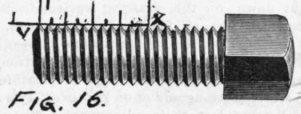
We shall confine our attention to cylindrical screws, although what we shall say will apply in general to the common screw. In machines, such as the jack screw, the power is applied at the end of a lever and causes the screw to pass through its nut, pushing before it the weight to be lifted or the resistance to be over, come. The common law of machines:-"Power, multiplied by the space through which the power acts, equals the weight multiplied by the space through which the weight moves," will apply, of course, to the screw, although friction will make it seem false. Experiment 13.

Take a cylindrical ssrew (see Fig. 16) of rather coarse thread; rub a piece of graphite or soft pencil along one side and then lay it upon a piece of unglazed paper. Press it hard upon the paper and the thread will make a series of short marks corresponding to the ridges in the figure. Measure from one of these marks a space an inch long. (See XV Fig. 16.) Count the number of spaces in this line and you will have the number of threads to the inch. Do the same with several screws of differeni sizes, including one or two tapering screws.
For every complete turn of the screw it moves through the nut the space between two threads. If, therefore, there are 12 spaces to the inch the space the weight moves for one turn of the screw is 1-12". Now, if the screw be that of a carpenter's vise and we apply a force on the handles 14" from the centre of the screw, the power space will be a circle whose radius is 14", i. e., 14x2x3 1-7, or 88". If, in the law of machines, P.
xP. space = wt. x wt. space, we supply the distance 1-12" and 88" and consider one force equal to 30 pounds, we shall have 30 x 88=wt. x 1-12. This will give us 1-12 of the wt., 2640 or a total value of 31,680 pound, an almost incredible amount. But, as is often the.case, 3/4 or more of the force is lost by friction. Even with this los6 we have an actual result of 7920 pounds resulting from a force of only 30 pounds.
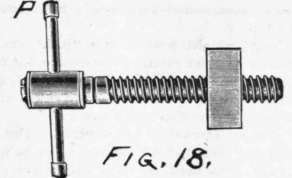
Experiment 14. Take the wooden screw and nut from a carpenter's bench (See Fig 18), [half of a carpenter's clamp or even a large iron bolt and nut may be used if the first is not available], find the number of threads to the inch for wt. space, and measure the length of this handle from the centre of ihe screw to the point P. At P. attach the spring balance used in former experiments. Bore a small hole in the lower end of the screw and turn in a screw eye. On the screw eye hang a weight W. Fasten the nut firmly so that as the power is applied at P. the weight shall be raised.
Using the law P. x P. space=wt. x wt. space, supply all the values except the power. Wt. space equals the distance between two threads of the screw. P. space equals 2x3 1-7x the length of the handle, i. e., if the length, AP, in Fig. 16, is 14" it will be 2 x 3 1-7 x 14, or 88". With a known weight W, say eight pounds or more, calculate what the power should be. Now pull on the balance and make a number of trials until you have obtained a constant value for P. Should it be four times as large as the value calculatad, do not be surprised, as this shows the exceedingly large amount of friction. You may say, of what use is the 6crew when 3/4 of the force is lost? If you will recall our study on friction you will remember that friction is a great help as well as a hindrance, and here we can see the need of this friction. Suppose we are clamping a piece of elastic wood in a vise and that, as soon as this weod is pressed between the jaws of the vise the elastic wood pushes back and the jaws are pushed as far open as before. As it is now, the friction of the screw in its nut prevents the vise from opening, but if that did not hold, some other contrivance would be necsssary to prevent slipping.
If the heavy weight resting on a "jack" exerted a downward force great enough to overcome the friction of the screw, the screw would turn backward and the weight fall slowly. We can see the value of what really hinders the motion of the power.
Of the many screws in use, especially the larger ones, perhaps those that will impress us as being most valuable are those used in vises, carpenters, clamps, letter presses, presses used for various purposes, wagon jacks and, most of all, the large jacks put under a house to raise it. These, with the many screws and bolts used for various purposes, will convince us of the great value of the screw.
The Wedge.
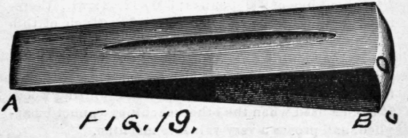
Although a machine less used than any of the others, a series of articles would be incomplete without a brief mention of the wedge. It is really an inclined plane, or a double inclined plane with the bases joined so that both long surfaces are oblique to the edge of the height. See Fig. 19. The power, instead of pushing the weight steadily up the plane, by quick, successive blows drives the wedge under the weight, or, as in splitting wood, between the portions to be moved or separated. Because of the method of applying the force, i. e., by quick, repeated blows, as well as on account of the great friction, any simple experiments with the wedge are out of the question. The law of the wedge is, as in all machines, P. xP. space=wt. x wt. space, and, as seen in Fig.19., if AB is 12" and DC 2" with a force of 200 pounds; 300x12=2xwt., therefore the weight equals 1,800 pounds. Much of this will be lost by friction, however, but notwithstanding the loss, much is gained. The wedge is used in lauch-ing ships, in raising buildings or parts of buildings for short distances, in laying floors and splitting wood. It can be used when the other machines cannot be applied, and proves a very valuable machine.
Continue to:


My Books

