


Chapter V. How To Do Outside Woodwork
Description
This section is from the book "How To Make Common Things. For Boys", by John A. Bower. Also available from Amazon: How to Make Common Things.
Chapter V. How To Do Outside Woodwork
We will first suppose that you have a garden. The edging of the garden-beds is frequently a matter that has to be decided on. Tiles are heavy, brittle, and expensive; box-edging always requires clipping to keep neat, but a good wooden border put down carefully looks well, and lasts for years. This is one of the things you can do. Get some lengths of wood; if you have to buy them for the purpose, they will cost ½d. per foot, in lengths of 12 feet, width 6 inches, and 1 inch thick.
If you have to make them out of lengths from egg-boxes, you have nothing to do but cut them off in the lengths required; the width is determined by the stuff as it comes to your hand. In order to increase the length of time such wood will last, it may be charred. Some persons, to prevent the early decay of the wood when put into ground, tar its surface. This we do not advise if you want to paint it afterwards; if you do not, you can tar each length of wood before it is put into the ground - it is a sure preservative against early decay. If you determine to do this, be careful, and only put the tar where it is required; you can probably borrow tar-brush and bucket where you get the tar. After tarring, the wood must get thoroughly dry before being used. In the other plan, the wood may be lightly smeared with petroleum; then set fire to it; the flame will quickly go out. It requires careful management. Do not perform operations near to any objects that will readily catch fire. This will slightly char the wood, so that it will be as well preserved when put into the ground as if it had been tarred. The other advantage is, the wood can be painted afterwards. While the wood is being got ready to put down, make some stakes of 2 inch stuff, and about 8 inches long. They must be shaved off so as to have one thin end, as in Fig. 46, a; this is to allow it to be driven into the ground easily. Having prepared sufficient so as to have one for about every 6 feet, take a line attached to a stake, and put it in the ground at the starting-point. Stretch it out along the line you want to put in your edging; draw it tight, and put in the stake at the other end. Now with a garden spade, make a slight hollow trench all along the line. Put in the lengths of wood; make them secure by driving in the prepared stakes at proper distances; to give strength and stability to the wood, nail them together by some 2 inch nails. In driving in the nails you must either have some one hold a stone or brick at the back of the stake, or hold one there yourself with your foot, or each blow instead of knocking in the nail will knock out the stake. Having done this to the extent needed, get a coarse hempen rope, and nail all along the upper edge of the wood. When complete you can paint it a terracotta red, or you can paint it green. If properly done it makes one of the neatest and most durable garden-edges we know of. In Fig. 46, b and c, we show the section and elevation of the edging.
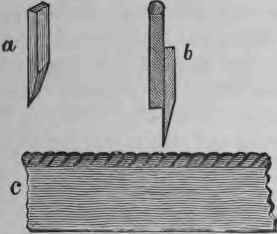
Fig. 46. - Garden edging.
Continue to:


My Books

