


How To Make A Swing
Description
This section is from the book "How To Make Common Things. For Boys", by John A. Bower. Also available from Amazon: How to Make Common Things.
How To Make A Swing
You may like to add a swing to your garden amusements. To put one up is rather heavy work, but with the help of a companion you may be able to manage it without a great outlay, and it will give a good amount of honest work to both of you.
First, you must have the uprights, then the cross-piece from which to suspend the swing, then hooks and rings, then the seat and ropes for the swing.
For the uprights, the best way is to go to a timber-yard, and select two lengths 10 or 12 feet of squared timber, or ends of scaffold-poles from 4 inches to 6 inches across. You may sometimes meet with such pieces cheap, but you must have good sound stuff, such as will bear a good strain. Then you must have a "jamb" for each of the uprights to be sunk into to make for it a foot, and two struts for each upright. Fit them together, as shown in Fig. 47, a, making use of any suitable joint among those given in the last chapter. In Fig. 47, a shows how each foot must be fitted. The uprights must not be cut in any way so as to be weakened. The foot had better be about 3 feet long and 6 inches wide, with the bottom end of the upright let in, as shown in Fig. 48, with the struts let into the foot, and lono-enough to grasp the upright 3 feet above the foot. This must be put together with 3 inch nails. Bore the holes with a gimlet before putting them in, so there is no fear of splitting the wood. They must be sunk into the ground to the depth of 3feet or more in the case of a 12 foot length; tar them before putting them in; take care and fix them upright. Let the soil round these be well rammed in, so that they stand very firmly with a distance of about 3 feet 6 inches between each. The cross-piece at the top had better be fitted with a pair of strong hooks at a distance of 14 inches apart; measure the distance so that the swing hangs exactly in the centre of the beam. The hooks can either be screwed in, or they can pass through the wood and be fixed into a nut on the other side; whichever you can manage strongest and best. In putting the cross-piece into position, yon can use the halving joint, Fig. 19, or cut nothing away, but put the ends across the uprights, and secure them by an angle of sheet-iron (b, Fig. 47), which a blacksmith will make for you for a few pence, and which will bind round the cross-piece and uprights; nailed at the face and back; and will make the whole very firm and secure, and very strong. Then to improve appearances it will be better to give it two coats of paint, and while this is drying you can make the swing. Get a good board of hard wood, 14 inches by 8 inches; plane it up so that the upper side is quite smooth. At each end on the under side screw a cross-piece to keep it from warping or splitting.
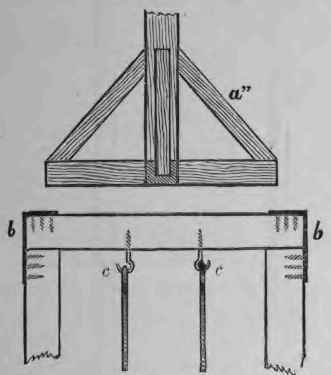
Fig. 47 - The Swing.

Fig. 48.
Get a carpenter to put through the corners, not too near the edge, four holes for the rope to pass through. We say "get a carpenter," because these holes will have to be made with a brace and bit - a tool which we have not mentioned, or which will not probably be among the set you possess.
Now you want the rope. Get a good stout piece, long enough to suspend the seat about 2 feet from the ground. Arrange the rope as shown in Fig. 47, c. When the ends are spliced let them be bound over with some good waxed cord, so that there is no fear of slipping. In the upper end two grooved rings must be bound into the rope, so that by these the swing is suspended on the hooks. Under such an arrangement there will be little friction, and the durability is almost never ending. The complete swing is represented in Fig. 48.
A serviceable swing may be made with somewhat less outlay, perhaps, by getting four fairly straight bits of rough tree branches and letting them into the ground with a strong iron bar held firmly in the two forks at the top. In this bar the two hooks must be fixed to suspend the swing from, as shown in former diagram. Be sure the whole structure is secure and strong; there are more ways of securing this than we can possibly mention in our general instructions. Frequently swings are fixed to the projecting arm of a growing tree, in which case it is very easily and cheaply contrived.
Continue to:


My Books

