


How To Make Fencing
Description
This section is from the book "How To Make Common Things. For Boys", by John A. Bower. Also available from Amazon: How to Make Common Things.
How To Make Fencing
An easy method of making a light fence is by open lattice-work nailed to rails supported on posts at intervals, the length of which must be determined by the height and weight of the fence. The posts must be sunk into the ground. This portion should be thicker, and need not be planed up as carefully as the part that is above ground. The lattice or open portion should be done with smooth laths, as shown in Fig. 66. Take care that the posts are upright, and that the earth is well rammed round the sunken portion. A very neat and substantial fence may be made by strips of cleft oak, one strip of which laps over another. These palings require substantial posts into which rails are tenoned. To these rails the palings arc fixed, while a board runs along the bottom giving a finish and strength to the whole. The open paling is another favourite method of fencing. It consists of rails tenoned into posts, to which neatly cut and planed palings are nailed at regular intervals, as shown in Fig. 67. A gate can be made to suit any style of fencing. First make a strong frame, which must be mortised together, and strengthened by a diagonal rail. The post to which the gate has to be hung must be equally strong, and the latch and hinges must be strong enough to carry the gate, but plain or ornamental as a matter of taste. If the gate is very heavy, the post to which it is hung must have a foot similar to that attached to the upright for the swing; for the post must be upright, or no gate will swing well.
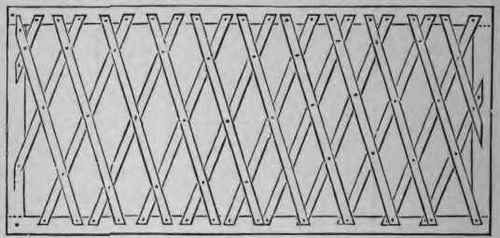
Fig. 60.

Fig. 67.
Following the directions we have given for making the various items, we think you will have gained sufficient skill in handicraft to accomplish most things you will be called on as an amateur to do, and at the same time have gained a good knowledge of the use of tools, which can afterwards be extended should you put yourself under a good teacher, or even become an apprentice to some handicraft business.
In regard to the prices of wood used in making the various articles mentioned, we have quoted it as received from a deal-yard, where you can get it of any description, and in any length, width, or thickness, and rough or planed.
You, into whose hands this book may fall, will have different methods of supplying yourselves with wood. Much good wood, except for the heaviest posts and uprights, may frequently be bought up in the form of disused packing-frames, and boxes of various descriptions. Take care in every case to remove every nail or screw that would prevent you from using a plane or cutting tools about them, and do not buy wood planed if you can do the planing and smoothing for yourself. We have given no very special directions about nails or screws. These you had better select from a good ironmonger's, where you can see every kind you are likely to want, and where you can have any directions you need for using them. In buying locks and hinges, the prices given includes the necessary screws.
The various stains or varnishes we have mentioned are kept by most oilmen. If, however, you like to make them for yourself, you can do so. We think that our directions in one of the early chapters arc clear enough to enable you to do so.
In our next chapter we shall give directions for making things of lighter structure, in the form of ornamental work and model-making.
Continue to:


My Books

