


Ship Model Makers' Club. Part 6
Description
This section is from the book "Things To Make In Your Home Workshop", by Arthur Wakeling. Also available from Amazon: Things to Make in Your Home Workshop.
Ship Model Makers' Club. Part 6
The sails are the next thing to be considered. Any thin "canvassy" looking material, linen for preference, will do. Their size and shape can be seen in Fig. 34. Note that the mainsail proper has a bonnet, which is a primitive provision for reefing, laced to it.
The canvas looks best if it is stitched in rows about ¼ in. apart to represent seams. The edges should have a narrow hem and may have a cord sewn to that.
As the rest of the model is being antiqued, the sails also should be treated. Strong tea makes a good base color, with other browns streaked in while the sails are wet, and a restrained touch of green and perhaps red.
Fasten the sails to the yards with heavy brown thread or thin cord. Use a marline hitch, which is the same as a buttonhole stitch. To the leeches of the main- and foresails are fastened thin cord and bead crow's-feet. Those leading abaft are called martinets and those forward bowlines. At the bottom corners of all make loops in the cord or sew on little rings.
The yards are held to the masts by parrels (Fig. 37). A turn of cord will serve for this, but the correct method is to use rollers (beads) and battens (four rows of five beads and five little battens) to keep them apart, with thin cords through both beads and battens.
Halyards are used to suspend the yards. There should be two of heavy cord at the main, hitched to the yard near the middle and leading through blocks lashed to the mast, over the shrouds, then down to double blocks, which are connected by thin cords to other double blocks fastened to staples in the deck.
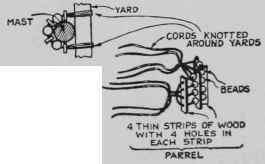
Fig. 37. - How the parrel is made and knotted to the mast.
The yards are kept horizontal with topping lifts, two to a side at the main and one at the fore. The cords are tied to the yard, pass through single blocks and back to the yard; from the blocks other cords lead through blocks at the masthead and to the deck.
From the martinets other thin cords lead through masthead blocks to the deck and cords lead from the clews through blocks lashed under the yards to the deck.
To the clews heavy cords are hitched, one part leading aft to a large single block to form a sheet and the other forward for the tack. The tack goes through a hole in the forward bulwark and back through another hole beneath and then forward to form the fall of the fore sheet, its end being fastened to a staple beneath the two holes. A strengthening piece may be glued to the bulwark where these holes come, called a chestree. The fall of the main sheet starts from a bolt in the hull, abaft and below the chain-wale, and passes back to a hole in the after bulwark. There will also be a single heavy cord from the clew of the bonnet leading aft. .
The main brace pennant is from the yardarm to a large block and its fall comes from a staple in the hull to a hole in the after bulwark.
The fore brace pennant is similar but shorter, and its fall leads from a bolt in the forechains to the post upholding the cow bridge on the opposite side of the deck.
The lateensail at the mizzen has a similar but smaller parrel; a single halyard; an elaborate crow's-foot leading to the mainmast head; a single or double sheet to a short boom extending over the stern, and a tack made fast to the main rigging.
The main topsail is but a small sail. A cord parrel and a single halyard making fast to a staple in the top will hold it. The sheets also lead to other staples in the top, and light braces lead through single blocks lashed to the mizzenmast head. There should also be preventer backstays from the masthead to blocks abaft the mizzen rigging.
Models most frequently have their yards directly across the ship, but it is preferable in a case like this to have them slightly diagonal, or braced in as if for a quarterly breeze, and for this model they were stiffened and bellied out. This was accomplished by coating the after sides with thin, tinted casein glue, blowing them out with an electric fan while drying.
The anchor cables are three parts of the thick cord laid together, or other heavy cord; they are hitched to the anchor rings, the ends being glued and nailed inside the hawse pipes, forward and aft.
The flukes of the forward anchors are lashed to staples in the cow bridge and their stocks to the fore rigging. The after anchors are lashed to the chainwales, the cables leading from the cat-holes.
The flags are best made from thin white silk, and painted with artists' water colors. A little gum may be used with the water. Photo stamp colors serve well. The flag at the fore is green on white, and represents the badge of the Band of Discoverers. At the main is the royal standard of Castile and Aragon in red and yellow; at the mizzen the escutcheon of their Catholic Monarchs with the eagle of St. John; and at the mizzen peak, the streamer of the Castile Armadas.
A line of thin white shellac around the edges of the flags will prevent their fraying when cut. The staffs can be of wood or wire; reed chair spline is the best because it bends when accidentally knocked.
Other gay touches may be shields hung on the pavisades. These are easiest made from thin wood. A flat staple in the back of each, representing the arm hold, serves to hang it on a pin driven into the pavi-sade guardrail. The shields should also be tied in position. The designs given are more or less arbitrary, supposedly the arms of Columbus' companions.
To the mainmast there should be hung a slightly larger shield painted with the arms of Castile and Aragon, perhaps centered with those of Leon. This is to be carried ashore when new lands are taken possession of. Similarly, a cross on a long staff may be placed by the mizzenmast.
Everything is done now but the base on which to stand the model. Any kind may be used, but the simplest form is advisable. That for the original model consists of two pieces of 3/8-in. oak, cut to fit on the bottom of the hull 6 in. apart, with the edges just curved out a little and joined with a square stick of the same wood, projecting through and fastened with wooden pegs.
Continue to:


My Books

