


How To Build Windmill
Description
This section is from the book "Wrinkles And Recipes, Compiled From The Scientific American", by Park Benjamin. Also available from Amazon: Wrinkles and Recipes, Compiled From The Scientific American.
How To Build Windmill
Windmills can be either horizontal or vertical, but the latter are almost exclusively employed. In the vertical windmill, the shaft is inclined to the horizon at an angle of from 5° to 15 when the wheel is placed at the top of a tower; so that the wheel will clear the sides of the building, and allow space for the action of the wind. If the wheel is supported by a post, the shaft may be horizontal. The connection of the shaft with the pump or other mechanism maybe made either with gearing or by means of a crank and connecting rod. The shaft must be free to swing around in any direction, so that the wheel can always face the wind. It is moved, in the case of small windmills, by the use of a weather-vane on the end of the shaft opposite to the wheel. With large windmills supported on towers, the top of the tower is generally arranged so that it can he rotated, and a small auxiliary wind-wheel, con nected by gearing, moves it into the proper position as the direction of the wind changes. The wheel of a windmill May be covered with cloth, or with slats of wood or metal, the cover in either case being technically known as the sail.
Make the sail of a series of joined slats, that present a close surface to wind of the ordinary velocity, and open, thereby decreasing the surface, as the velocity of the wind increases. The best velocity for a windmill is such that its periphery moves about 2-3/5 times as fast as the wind. Thus, if the wind is moving at the rate of 20 feet a second, the tips of the sails should move at the rate of 52 feet a second, so that, if the wheel were 12 feet, in diameter, it should make about 83 revolutions a minute. Of course, if the velocity of the wind varies greatly, it will be impossible to keep the speed constant, so that windmills are not ordinarily well suited for work requiring steady motion; although they answer very well for moving pumps, if an intermittent supply of power is not a serious obstacle, In some sections, however, the prevailing winds are quite steady, and in such cases windmills can be applied with advantage to grist-mills and other useful work. The force and Velocity of the wind can only be determined by experiment, but the results of previous experimenters May be useful:
Velocity of wind. | |||
In feet per second. | In miles per hour. | Perpendicular force, in pounds per square foot. | Common expressions of the force of the wind. |
10 | 6.82 | 0.33 | Gentle pleasant wind. |
20 | 13.64 | 0.91 | Brisk gale. |
30 | 20.56 | 2.04 | Very brisk. |
40 | 27.27 | 3.92 | High wind. |
50 | 34.09 | 6.25 | Very high. |
60 | 40.91 | 9.25 | Very high. |
70 | 47.73 | 12.75 | A storm. |
80 | 54.55 | 16.34 | A storm. |
90 | 61.36 | 20.74 | A great storm. |
100 | 68.18 | 25.28 | |
110 | 75.02 | 30.89 | |
120 | 81.84 | 36.75 | A hurricane. |
130 | 88.65 | 43.26 | A hurricane. |
140 | 95.47 | 50.32 | A violent hurricane. |
150 | 102.29 | 57.56 | A violent hurricane. |
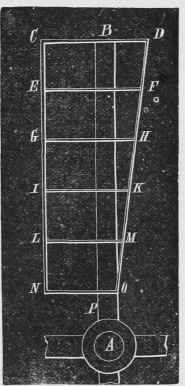
In the accompanying figure is shown one of the four sails of a windmill, it having been found that four sails of proper proportion produce the best effect. The piece P B is called the whip of the sail ; C D, E F, G H, etc., the bars of the sail. The bars are inclined to the plane of revolution at different angles, the angle made by any part of the sail with this plane being called the weather of the sail. Making the distances A O, N L, LI, etc., each equal to 1/12 of the diame-ter of the wheel, the best values for the angle of weather are as follows:
For N 0- | 18° |
For L M- | 19° |
For J K- | 18° |
For G H- | 16° |
For E F- | 12 1/2° |
For C D- | 7° |
The sail stretched over these bars will be a warped surface, somewhat resembling the blade of a screw-propeller. The part B DO, called the leading sail, is triangular, and B D is 1/15 of the diameter of the wheel, B C being 1/10 and C N 5/12 of the diameter. The main body of the sail, B C N O, is commonly rectangular. A windmill of the best proportions, running under the most favorable circumstances, utilizes about 29/100 of the energy of the wind that acts on an area equal to a circle having the same diameter as the wheel. It would not be advisable to count on realizing more than half this power in general practice ; and on this assumption, we have the following empirical rule for determining the diameter of a wheel to give a certain amount of power with an assumed velocity of the wind:
Divide the required horse-power by the cube of the velocity of the wind in feet per second; take the square root of the quotient and multiply it by the number 2024.8. The product will be the required diameter in feet. Example: A windmill is to be erected in a locality where the general velocity of the wind is about 20 feet per second. It is to be attached to a pump, the work required of it being to raise 1000 gallons of water per hour through a height of 20 feet 1000 United States gallons of water weigh about 8320 pounds, and, taking into effect the resistance of the pump, the power required will be about 1/6 of a horse-power, or 0.167 horse-power. Dividing this by 8000, the cube of the velocity of the wind, extracting the square root, and multiplying by 2024.8, we obtain 9-1/4 ft. as the required diameter of the wheel, referring to the figure, we find that, in this case, C N is 3 feet 10 -1/4 inches, B D, 7-3/8 inches, and B C 11-3/32 inches. The velocity of the tips of the sales should be 52 feet per second, or the wheel should make about 108 revolutions a minute.
Building A Windmill
Continue to:


My Books

