


Lining Shafting
Description
This section is from the book "Wrinkles And Recipes, Compiled From The Scientific American", by Park Benjamin. Also available from Amazon: Wrinkles and Recipes, Compiled From The Scientific American.
Lining Shafting
Every one operating long lines of shafting should provide- an adjusting rod, as shown in the engraving. A may be a rod or a piece of gas pipe, of sufficient Length to reach from the shaft, (), to within about 4 feet, of the floor; an offset piece, B, is fixed to the top of this rod, which carries a right and left hand screw, C; two jaws, D, travel upon this screw, one upon the right and the other upon the left hand thread, as shown. The screw may be worked by a 1/4-in. wire, E, with a crank, F, at its lower end; if a gas-pipe is used, the wire may pass through the pipe, and the lower end of the screw, C, enter the top of the pipe as a bearing. If the rod, A, is of wood, three or four wire staples will suffice as guides for the wire, as indicated. A target, G, with a clamp-screw, slides upon the rod, for the purpose of easy adjustment to the sights of the leveling instrument.
Now it will of course be apparent to every one that, whenever several sizes of shafting occur in the same line, this ad justing-rod will always give the exact central distance, O, of the shaft from the target; hence we have only to plant the leveling instrument in a position to command a view of the target when suspended from each of the several bearings of a line of shafting, in order to adjust the level of a line with the utmost expedition and accuracy. An engineer's tripod and level is, of course, the best instrument for this purpose, but, when this is not at hand, an ordinary builder's level may be used: the longer it is, the better. Fix a temporary sight at one end of the level; a piece of tin (with a small pin-hole) next the eye, and a piece of tin or thin wood with a large hole at the farther end, with a vertical and a horizontal thread stretched across the hole, with their point of intersection the same distance above the level as the hole in the eye-piece. The level may be used upon a level stand or table, some five feet from the floor.
To adjust a line of shafting laterally, an adjusting-rod must of course be used horizontally in connection with a strong line, stretched as taut as possible, at such distance from the shafting as to need nearly the full length of the rod to reach it. The reason for placing the line at such a distance from the shaft is to prevent the difference in level between the line and the shaft from materially impairing the truth of the result. If the line is very long, it will sag so much that a plumb-line suspended from the measuring point of the target or rod may be necessary for perfect accuracy.
The jaws, D, should be so formed that they may be applied to the inside of boxes. Pivot-boxes are now so generally used, however, that this application of the rod is not so common.
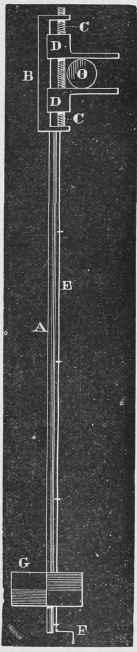
Device For Lining Shafting
Continue to:


My Books

