


Testing The Strength Of Materials
Description
This section is from the book "Wrinkles And Recipes, Compiled From The Scientific American", by Park Benjamin. Also available from Amazon: Wrinkles and Recipes, Compiled From The Scientific American.
Testing The Strength Of Materials
The engraving which accompanies this article illustrates a very convenient, yet quite accurate, method of determining the strength of materials, which has been devised by the writer. The test-piece is made by cutting, from the piece of metal of which the strength is to be determined, a piece about 3 in. long and 1 in. square. At the middle of its length, a part is turned cylindrical in form and 1 in. long, with a diameter of 1/2 in. if of iron, or 3/8 in. if the metal is steel. The test-piece thus made is fastened in the vise, as shown in the engraving, and a long handled wrench is attached to the projecting head. A springbalance is secured to the end of this wrench, and the experimenter twists off the head by pulling on this spring-balance, as seen in the illustration. The balance should be capable of indicating weights of fifty pounds or more. By simply painting the scale of the balance with white-lead, or smearing it with tallow, and by springing the pointer so that it will touch the surface, a recording apparatus may be improvised which will indicate the maximum strain reached during the test.
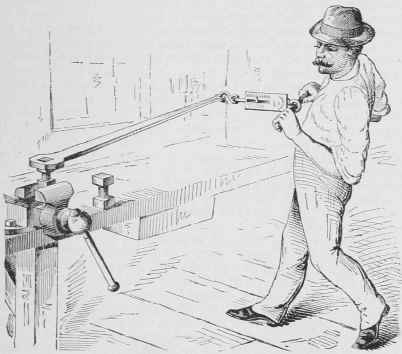
Testing Metals
In testing, the experimenter pulls steadily on the balance, gradually increasing the force exerted, and watching carefully, and noting the action of, the test-piece and the balance, until fracture occurs. A resistance, which is apparently quite unyielding, is felt at first; this is suddenly observed to be succeeded by a gradually increasing distortion of the test-piece, accompanied by an increasing resistance, up to the point of the commencement of rupture. From the latter point, the resistance becomes less and less, finally ceasing when the test-piece falls apart. By conducting the operation very carefully, and noting resistances very accurately, all of the following important points may be determined:
The limit of elasticity is the point at which the yielding first commences. Note the reading of the balance at this point and the angle of distortion. The last quantity is the measure of the stiffness of the metal. The most rigid pieces are, of course, those which yield the least with a given amount of force. After the piece has been twisted so far as to have taken a set, the pull may be relaxed, and the distance which the piece springs back is to be noted. The elasticity of the metal is measured by this recoil. The ductility of the metal is measured by the extent of yielding which occurs before fracture takes place. The resilience of the metal-which is the name given its power of resisting shock-is very closely proportioned to its strength multiplied by its ductility. Therefore, to ascertain what blow would be resisted by it without its taking a set, it is simply necessary to multiply the resistance at the limit of elasticity by the amount of distortion observed within the elastic limit. The homoge neity of the material is indicated by the smoothness and regularity with which the metal changes in its power of resistance as the deformation progresses.
In making such a series of experiments, it is usually found best to first select a well-known and good brand of the kind of metal which it is proposed to test, and, by a set of experiments on test-pieces cut from it, to determine what, with the particular arrangement of apparatus chosen, is the resistance registered by the balance, and what are the characteristics of the metal as shown by the method here described. By a careful comparison of the behavior of the metal of which the quality is desired to be learned with this standard set of samples, the operator soon learns to judge quickly and accurately of the value of his material for any specified purpose.
As the tensile strength of a metal is usually very closely proportional to the resistance to torsion, this also enables a very satisfactory determination of the value of the metal for resisting tension to be obtained. In the autographic recording machine, built by the Mechanical Laboratory of the Stevens Institute of Technology, these results are permanently inscribed upon a sheet of profile-paper, the pencil of the apparatus writing a diagram or curve which is a record of all the circumstances modifying the resisting power of the metal while under test. The rule being applied, the torsional, and approximately the tensile, resistance is read off at a glance, and the position of the elastic limit, the homogeneousness, the elasticity, the stiffness, the ductility, the resilience, are all found fully indicated by the diagram, and can be, at any subsequent period, shown by means of this automati cally produced record. On these records, the tensile resistance is found to be about 25, 000 pounds per square inch for each inch in height of the diagram.
The peculiar method of fracture here adopted is well adapted to exhibit in the surfaces of the break any peculiarity of the metal. If homogeneous, it will show a uniform and characteristic fracture; if seamy, it will be found to have cracks extending spirally around it; if of cast-iron, the character of the ruptured surfaces will at once reveal to the experienced eye whether the metal is fine or coarse grained, a dark foundry or a light forge iron, and whether of close or open texture. If of steel, it will be readily seen whether it is "high" or "low, " whether tool steel or of the machinery grade. Whatever the character of the material, the eye, experienced in such kinds of observation, will at once detect it, while the record of the experiment, or the "strain-diagram, " will give the exact data of resistances, and will be a check upon the judgment thus formed.
Continue to:


My Books

