


Telegraphic Communication Between Great Britain, Europe, America, And The East. Part 2
Description
This section is from "Scientific American Supplement". Also available from Amazon: Scientific American Reference Book.
Telegraphic Communication Between Great Britain, Europe, America, And The East. Part 2
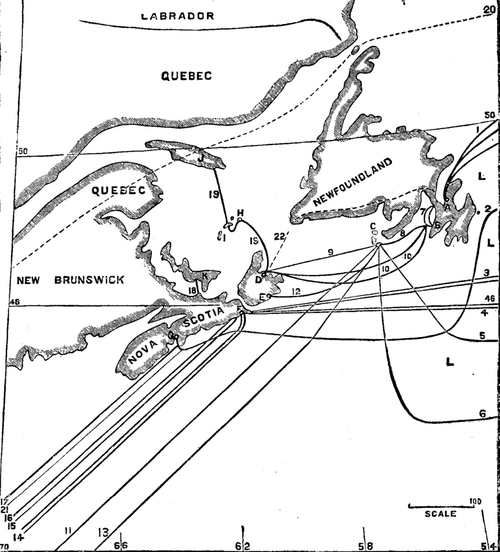
MAP SHOWING MAIN CABLES FROM EUROPE AND THEIR CONNECTIONS WITH CANADA AND THE UNITED STATES.
Reference to places - A, Heart's Content; B, Placentia; C, St. Peter Miquelon; D, North Sydney, Cape Breton Island; E, Louisbourg; F Canso, Nova Scotia; G, Halifax; H, Bird Rock; I, Madeline Isles; J, Anticosti; K, Charlotte Town, Prince Edward's Island; LLL, Banks of Newfoundland.
The three cables of this company presently in use and connecting Valentia in Ireland with Heart's Content in Newfoundland, were laid in 1873, 1874, and 1880; and (1) are respectively 1886, 1846, and 1890 nautical miles in length. This company also owns the longest cable in the world, that namely from Brest in France to St. Pierre Miquelon, one of a small group of islands off the south coast of Newfoundland and which, strange to say, still belongs to France (6).
The length of this cable is 2,685 nautical miles, or 3,092 statute miles. It was laid in 1869. There are seven cables of a total length of 1773 miles, connecting Heart's Content, Placentia Bay and St. Pierre, with North Sydney, Nova Scotia, and Duxbury, near Boston, belonging to the American company. Communication is maintained with Germany and the rest of the Continent by means of a cable from Valentia to Emden 846 miles long (7); and a cable from Brest to Salcombe, Devon, connects the St. Pierre and Brest cable with the London office of the company (10).1
The station of the Direct United States Cable Company is situated at Ballinskelligs Bay, Ireland (2). Its cable was laid in 1874-5, and is 2,565 miles in length. The terminal point on the other side of the Atlantic is at Halifax, Nova Scotia, from whence the cable is continued to Rye Beach, New Hampshire, a distance of 536 miles, and thence by a land line of 500 miles to New York (17).
The Commercial Cable Company's station in Ireland is at Waterville, a short distance from Ballinskelligs (3). It owns two cables laid in 1885; the northern cable being 2,350, and the southern 2,388 miles long. They terminate in America at Canso, Nova Scotia. From Canso a cable is laid to Rockfort, about thirty miles south of Boston, Mass., a distance of 518 miles (16), and another is laid to New York, 840 miles in length (15). This company has direct communication with the Continent by means of a cable from Waterville to Havre of 510 miles (9), and with England by a cable to Weston-super-Mare, near Bristol, of 328 miles (8).
The Western Union Telegraph Company (the lessees of the lines of the American Telegraph and Cable Company) has two cables from Sennen Cove, Land's End, to Canso, Nova Scotia (4). The cable of 1881 is 2,531 and that of 1882 is 2,576 miles in length. Two cables were laid November, 1889, between Canso and New York (14).
The Compagnie Française du Telegraphe de Paris à New York has a cable from Brest to St. Pierre Miquelon of 2,242 miles in length (5), from thence a cable is laid to Louisbourg, Cape Breton (12), and another to Cape Cod (13). It has also a cable from Brest to Porcella Cove, Cornwall (11).
Those ten cables owned by the six companies named, of the total milage of 22,959, not counting connections, represent the entire direct communication between the continents of Europe and North America.
A new company, not included in the preceding statistics, proposes to lay a cable from Westport, Ireland, to some point in the Straits of Belle Isle on the Labrador coast (Map A32, Map B20).
The station of the Eastern Telegraph Company is at Porthcurno Cove, Penzance, from whence it has two cables to Lisbon, one laid in 1880, 850 miles long, the other laid in 1887, 892 miles long (12), and one cable to Vigo, Spain, laid in 1873, 622 miles long (13). From Lisbon the cable is continued to Gibraltar and the East, whither we need not follow it, our intention being to confine ourselves entirely to a brief account of those cables communicating directly with Europe and America. As already stated, this company has altogether seventy cables, of a total length of nearly 22,000 miles.
The Direct Spanish Telegraph Company has a cable, laid in 1884, from Kennach Cove, Cornwall, to Bilbao, Spain, 486 miles in length (14).
Coming now to shorter cables connecting Britain with the Continent, we have those of the Great Northern Telegraph Company, namely, Peterhead to Ekersund, Norway, 267 miles (15). Newbiggin, near Newcastle, to Arendal, Norway, 424 miles, and thence to Marstrand, Sweden, 98 miles.
Two cables from the same place in England to Denmark (Hirstals and Sondervig) of 420 and 337 miles respectively (17 and 18).
The great Northern Company has altogether twenty-two cables, of a total length of 6,110 miles. The line from Newcastle, is worked direct to Nylstud, in Russia - a distance of 890 miles - by means of a "relay" or "repeater," at Gothenburg. The relay is the apparatus at which the Newcastle current terminates, but in ending there it itself starts a fresh current on to Russia.
The other continental connections belong to the government, and are as follows: two cables to Germany, Lowestoft to Norderney, 232 miles, and to Emden, 226 miles (19 and 20).
Two cables to Holland: Lowestoft to Zandvoort, laid in 1858 (21), and from Benacre, Kessingland, to Zandvoort (22).
Two cables to Belgium: Ramsgate to Ostend (23), and Dover to Furness (24).
Four cables to France: Dover to Calais, laid in 1851 (25), and to Boulogne (26), laid in 1859; Beachy Head to Dieppe (27), and to Havre (28).
There is a cable from the Dorset coast to Alderney and Guernsey, and from the Devon coast to Guernsey, Jersey, and Coutances, France (29 and 30).
A word now as to the instruments used for the transmission of messages. Those for cables are of two kinds, the mirror galvanometer and the siphon recorder, both the product of Sir Wm. Thomson's great inventive genius.
Continue to:


My Books

