


Commercial Drafts
Description
This section is from the book "Banking, Credits And Finance", by Thomas Herbert Russell. Also available from Amazon: Banking, credit and finance (Standard business).
Commercial Drafts
A commercial draft is really a letter from one person to another requesting that a certain sum of money be paid to the person who calls, or to the bank or firm for whom he is acting. Commercial usages recognize a particular form in which this letter is written and the address of the person for whom it is intended is usually written at the lower left-hand corner instead of on an envelope.
Commercial drafts are sent through the banks instead of directly through the mail. For instance, if A of Boston owes B of New York $100,B may draw on A for the amount. He may deposit the draft in a New York bank to be forwarded or he may mail it himself to a Boston bank for collection. When the draft reaches the Boston bank, a messenger will carry it to A. If it is a sight draft, that is, if B wants the money paid at sight, immediately, A may give the money to the messenger and take the draft as his receipt. If it is a time draft, that is, if B gives A time, a certain number of days in which to pay the draft, A accepts it. He does this by writing the word accepted with the date and his signature across the face of the draft. He then returns the draft to the messenger and it is returned to B. An accepted draft is really a promissory note, though it is often called an acceptance. When a man pays or accepts a draft he is said to honor it. In this instance A is not obliged either to pay or to accept the draft. It is not binding on him any more than a letter would be. But, if he refuses to honor legitimate drafts, it may injure his credit with the banks and other business houses.
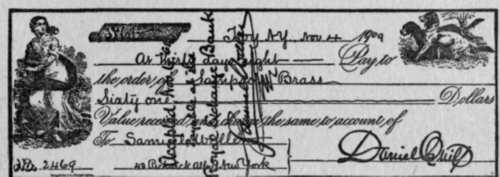
An Accepted Draft.
Continue to:


My Books

