


Agricultural And Rural Population. Part 2
Description
This section is from the "Economics In Two Volumes: Volume II. Modern Economic Problems" book, by Frank A. Fetter. Also available from Amazon: Economic
Agricultural And Rural Population. Part 2
§ 5. Period of decaying agricultural prosperity. Despite the fact that frequently in economic legislation the farmer has been the victim, every compaign orator admits that there is no other occupational class that is of greater importance to the nation than are the farmers, or more deserving of prosperity. Every other part of the industrial organization of a nation is interrelated with its agriculture. Great changes, in respect to growth of population, immigration, exhaustion of natural resources, mechanical inventions, scientific discovery, and many things more, have been occurring, which have altered, and in some communities destroyed, the very foundations of agricultural enterprise in America since the close of the Civil War in 1865. But the farmers have been left to struggle individually with their individual difficulties, though the outcome was of the gravest portent to the whole social economy. Such was the case in the period of agricultural depression from 1873 to about 1896.2 Multitudes of ancestral homesteads were then left behind by the last farmer-descendant of the old line. No longer able to make a living on the soil, he took up an urban occupation.
§ 6. Sociological effects of agricultural decay. Such changes hastened, no doubt, the decline in the birth-rate of the old American stock. The places of many of these long-settled families remained unfilled, as thousands of abandoned farmhouses testified. The places of others were taken by a tenantry, white or black, lacking the thrift of ownership; the lands of others passed to new owners, of alien races. The populations of many rural neighborhoods thus became heterogeneous, with results calamitous to the social life. Once prosperous schools declined, once thronging country churches were deserted, and much of the old neighborhood democracy disappeared. When, about the year 1900, prosperity began slowly to return to the American countrysides in the form of rising prices of farm produce, it was in large part too late to remedy the evil, except as it may be done by generations of effort under more favoring conditions. There are merely suggested here some of the complex sociological effects of past economic changes in American agriculture. It is certain that in the future, also, the economic changes in this field will be related closely to social and political changes of a fundamental character.
2 See Vol. I, p. 347.
§ 7. Fewer, relatively, occupied in agriculture; use of machinery. Probably ever since the first census in 1790, the relative number of agriculturists in this country has been decreasing. Beginning in 1880, the numbers of those occupied in agriculture for gain have been reported at the census in a form that makes them fairly comparable.3
The explanation of this decrease in the proportion of the population that is engaged in agriculture is twofold. The first is the real increase in the productive output per person in agricultural industry. In larger part this is due to the increasing use of machinery in place of simple hand tools, and the substitution of horse-, hydraulic-, windmill-, steam-, and gasoline-power for human labor. This change has been made readily in the regions of level fields, but of late has been made possible to a greater extent in hilly country by rearranging and combining the old irregular fields into regular, fairly level rectangular fields easily tillable, while turning the rougher lands and hillsides into wood-lots and pastures.4 One man, thus, driving three or four horses or a tractor, can do the work formerly done by two or more men and do it just as well. The farmers' incomes in different parts of the country vary pretty nearly with the amount of horse-power used per man. Economies equally great are made in the work done in the barnyards and barns. In most parts of the country only a beginning has been made in these ways, and in future the census will continue to reflect the progress in these directions.
3 It must be observed, in studying these figures, that farmers' wives and children, working at home, are not reported as gainfully occupied. But a widow or a spinster owner, if herself acting as the enterpriser, is reported as "occupied" in agriculture. The increasing number of such cases in the past generation in part explains the growing number and percentage of females in agriculture.
Number occupied in agriculture | Per cent of all persons occupied | |||||
Males | Females | Both sexes | Males | Females | Both sexes | |
1880.. 1890.. 1900.. 1910.. | . 7,068,658. 7,787,539. 9,272,315. 10,582,039 | 594,385 678,824 977,336 1,806,584 | 7,663,043 8,466,363 10,249,651 12,388,623 | 47.9 41.4 39.0 35.2 | 22.5 17.3 18.4 22.4 | 44.1 37.2 35.3 32.5 |
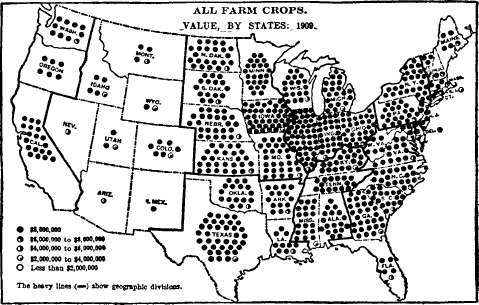
Fig. 2, All farm crops.
Note: This does not include value of live-stock products, the total of which is fully half as great.
§ 8. Transfer of work from farm to factory. The other part of the explanation of the decrease in the proportion of the population that is engaged in agriculture is that many-operations are, step by step, being transferred from the farm to the factory. "Agriculture," we have observed, is a great complex of industries, in which many different products are taken from the first simplest extractive stage, and then put through successive processes to make them more nearly fitted for their final uses. Not so long ago grain cut in the field was threshed, winnowed, shelled, made into flour, and baked on the farm, as it still is in many places. Logs were cut into boards, planed, and made into houses or furniture by the farmer. The old-time farmer made by hand a large number of his farm implements - rakes, ax-handles, pumps, carts, and even wagons. Until a generation ago all butter, cheese, and other dairy products were made on the farm. Now these things are being done in steadily increasing proportion by workers classified as in the manufacturing industries, and agriculture contains fewer separate industries and processes. Of course, there is economy of labor in nearly all of these changes, but the number occupied in agriculture is greatly reduced. Many farmers and more farmers' sons are moving from agriculture into occupations of manufacturing, trade, transportation, and the professions, and are becoming more narrow specialists.
4 See further, ch. 27, § 1 and § 2, on the size of farms as an economic factor.
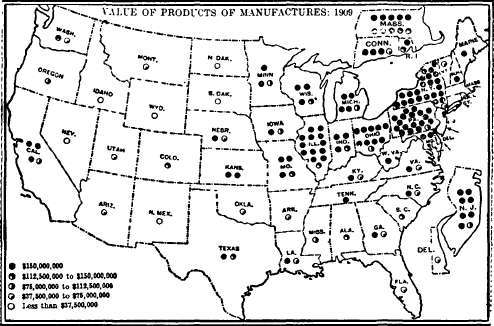
Fig. 3, Chapter 26.—Manufactures. Note: The scale of valuation is not the same as in Fig. 2. Observe how in the northeast manufactures and farming are combined.
Continue to:


My Books

