


Agricultural And Rural Population. Part 3
Description
This section is from the "Economics In Two Volumes: Volume II. Modern Economic Problems" book, by Frank A. Fetter. Also available from Amazon: Economic
Agricultural And Rural Population. Part 3
§ 9. The rural exodus. The percentage of persons in the rural population changes at about the same rate as does that of persons occupied in agriculture. In 1890 it was 64, in 1900 it was 60, in 1910 it was 54, and in 1920 it was 48 per cent. The percentage of the population in cities of 8000 or more has steadily increased. This phenomenon has been marked in all of the countries that have been developing along industrial lines. It has been variously described as the "rural exodus," the "abandonment-of-the-farm movement," and the " cityward drift." It is only in part explained by the change from agriculture to other occupations; perhaps even as much it is due to the decline and disappearance in many rural places of small manufacturing and mercantile businesses before the competition of large business in the cities. In much of the long-settled area of the country every hillside stream once turned a little mill to saw timber, grind corn, forge iron, or weave cloth. Most of these mills are now deserted. In countless villages the old blacksmith shop, once a center of business, is abandoned. Here and there a patriarchal smith still serves a dwindling group of customers, and speaks with mingled pride and pathos of his sons, now in the automobile business in the city. The movement away from the countryside has been but little counteracted as yet, but may be more in future, by the growing enjoyment of rural life, by the back-to-the-land movement, by interurban railways, by improved roads, by telephones, and by automobiles.
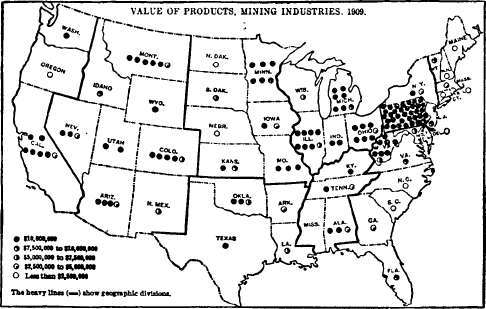
Fig. 4, Products of mines. Compare with distribution of farm crops and manufactures.
The great growth of education (in the sense of schooling) and rise of educational standards has put the country child at a disadvantage as compared with the child in the city. For this reason, great numbers of farmers' families move to villages and cities, to enable the children to attend high school, even when the move involves a sacrifice. Better roads and the consolidated country school, with free transportation for the pupils, replacing the one-room, one-teacher schoolhouse, have done much to meet this need. Still, as competent observers have pointed out, the normal farming life of the country is an education in the manual arts and in other ways, so that even with briefer school terms the country child may be better educated for life than is the city child.
The public was startled to learn that the army tests showed that country youth, on the average, were not as healthy as city youth. Here, again, the progress of the cities in sanitation, medical inspection in schools, care of teeth and of the eyes of school children, gymnasia, organized and directed physical recreation, etc., has left the country homes and the country children at a relative disadvantage. The natural advantages of country life (sunshine, healthy exercise in the open, freedom from noise and strain) cannot always compensate for the poorer water supply, defective sanitation, and lack of medical and surgical care for the growing child. Here is a field for future reform.
§ 10. The farmer's income in monetary terms. Census figures and some additional investigations led to the estimate of the average real income of the farmers of the United States in 1909, expressed in monetary terms, as $724. This was after some twelve years of slowly rising agricultural prices and improving conditions. The estimated value of all products, whether sold or used by the farmer, plus the value of his house rent and fuel consumed by family, was $1236, from which expenditures of $512 are deducted for outside labor and for materials used for operating and maintaining the farm. Of the $724 the sum of $402 is estimated to be the labor income of the family and $322 is estimated to be the wealth income (at 5 per cent of the capitalization of the farm). This was in a period of rising values in farmlands, averaging about $323 per farm annually, and this to most farmers was equivalent to so much monetary savings.
Main items of net income, Of the total $402 is a labor income, and 645 is a funded income.5
Rent | $125 |
Food from the farm | 261 |
Fuel | 35 |
Cash | 303 |
Total | $724 |
Increase in value of farm | 323 |
Total estimated monetary income | $1047 |
Labor income | $402 |
Wealth income | 322 |
Capital income | 323 |
$1047 |
5 see Vol. 1, p. 225. and note 11.
It would be difficult, even if the available statistics were much more exact than they are, to compare exactly the farmer's income with those of urban classes. Averages of such large numbers and over such a wide area have a limited significance in the specific case; and living conditions and the purchasing power of money are very different in country and city and in different parts of the country.6
Continue to:


My Books

