


2. Pachýstima Raf. Am. Month. Mag. 2: 176. 1818
Description
This section is from the book "An Illustrated Flora Of The Northern United States, Canada And The British Possessions Vol2", by Nathaniel Lord Britton, Addison Brown. Also available from Amazon: An Illustrated Flora of the Northern United States, Canada and the British Possessions. 3 Volume Set..
2. Pachýstima Raf. Am. Month. Mag. 2: 176. 1818
Low branching glabrous shrubs, with corky branches, opposite coriaceous evergreen leaves, and small axillary, solitary or clustered, perfect brownish flowers. Calyx-lobes 4, broad. Petals 4, spreading. Stamens 4, inserted beneath the disk; filaments longer than the anthers. Ovary immersed in the disk, 2-celled; ovules 2 in each cell, erect; style very short; stigma slightly 2-lobed. Capsule oblong, compressed, 2-celled, at length loculicidally dehiscent, 1-2-seeded. Seeds oblong with a white many-lobed aril at the base. [Greek, thick stigma.]
Two species, natives of North America. The typical P. Myrsinites (Pursh) Raf. occurs in the Rocky Mountains.
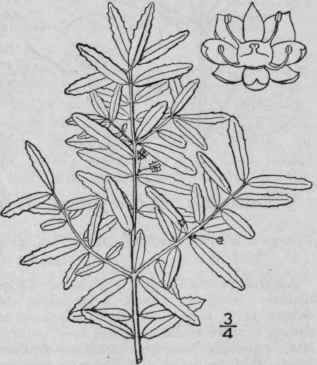
1. Pachystima Cánbyi A. Gray. Canby's Mountain Lover
Fig. 2801
P. Canbyi A. Gray, Proc. Amer. Acad. 8: 623. 1873.
A shrub 4'-12' high, with decumbent rooting branches. Leaves linear-oblong, or slightly obovate, 3"-12" long, 1 1/2"-2" wide, obtuse at each end, very short-petioled, pale green, serrate, the margins revolute; peduncles 1-3-flowered, 2-bracted below the middle; pedicels slender, shorter than the leaves, 2-bracted near the base; calyx-lobes oval, about equalling the petals; capsule oblong, about 4" long and 2" in diameter, dehiscent at maturity.
On dry exposed rocks, mountains of Virginia and West Virginia. Rat-stripper. April-May.
Continue to:


My Books

