


4. Batodéndron Nutt. Trans. Am. Phil. Soc. II. 8: 261. 1843
Description
This section is from the book "An Illustrated Flora Of The Northern United States, Canada And The British Possessions Vol2", by Nathaniel Lord Britton, Addison Brown. Also available from Amazon: An Illustrated Flora of the Northern United States, Canada and the British Possessions. 3 Volume Set..
4. Batodéndron Nutt. Trans. Am. Phil. Soc. II. 8: 261. 1843
Shrubs or small trees, with firm deciduous leaves, and white flowers in leafy-bracted racemes. Calyx 5-toothed. Corolla campanulate, 5-lobed. Stamens 10; anthers not exserted. Ovary inferior, 5-celled; style exserted. Berry black, globose, many-seeded. [Greek, blackberry tree.]
Two or three species of North America, or monotypic, with several races. Type species: Batodendron arboreum (Marsh.) Nutt.
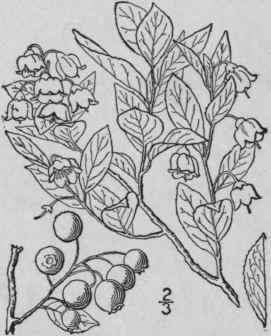
1. Batodendron Arbòreum (Marsh.) Nutt. Farkleberry. Tree-Huckleberry
Fig. 3258
Vaccinium arboreum Marsh. Arb. Amer. 157. 1785. Batodendron arboreum Nutt. loc. cit. 1843.
A divergently branched shrub or small tree, reaching a maximum height of about 300, and trunk diameter of 9', the twigs glabrous or slightly pubescent. Leaves obovate or oval, obtuse or acute and mucronulate at the apex, narrowed at the base, short-petioledi shining and bright green above, duller, and sometimes sparingly pubescent beneath, entire or glandular-denticulate, coriaceous, 1'-2' long, 1/2'-1' wide; flowers pendulous, slender-pedicelled; corolla white, campanulate, 5-lobed; bracts persistent; berry about 3" in diameter, inedible.
In dry sandy soil, North Carolina to Kentucky, Indiana, Illinois, Missouri, Oklahoma, Florida and Texas. Wood hard, reddish brown, weight per cubic foot 47 lbs. Gooseberry. Sparkleberry. May-June.
Batodendron andrachnefòrme Small, of Missouri, differs by its shorter-pedicelled smaller flowers, the corolla globular-campanulate.
Continue to:


My Books

