
![previous page: 102. Senecio [Tourn.] L. Sp. Pl. 866. 1753. Part 2](../../../images/nav/page_prev.gif)

![next page: 102. Senecio [Tourn.] L. Sp. Pl. 866. 1753. Part 4](../../../images/nav/page_next.gif)
102. Senecio [Tourn.] L. Sp. Pl. 866. 1753. Part 3
Description
This section is from the book "An Illustrated Flora Of The Northern United States, Canada And The British Possessions Vol3", by Nathaniel Lord Britton, Addison Brown. Also available from Amazon: An Illustrated Flora of the Northern United States, Canada and the British Possessions. 3 Volume Set..
102. Senecio [Tourn.] L. Sp. Pl. 866. 1753. Part 3
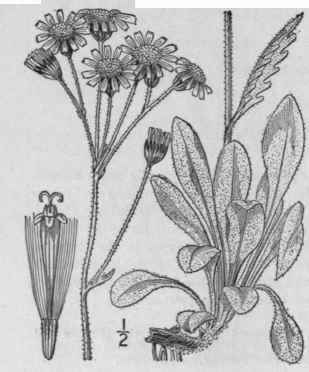
5. Senecio Palustris (L.) Hook. Marsh Fleawort. Pale Ragwort. Marsh Groundsel
Fig. 4614
Cineraria palustris L. Sp. Pl. Ed. 2, 243. 1763.
Senecio palustris Hook. Fl. Bor. Am. 1: 334. 1833.
Annual or biennial, pubescent or glabrate; stem stout, simple, hollow, 6'-24' high. Leaves lanceolate, oblong or spatulate, entire, dentate, or laciniate, acute or obtuse, 2'-7' long, 3"-15" wide, or the upper linear-lanceolate and small, those of the stem sessile and somewhat auriculate-clasping, the basal petioled; heads numerous, 6"-12" broad, mostly short-peduncled in a large, rather dense, terminal corymb; involucre cylindric, becoming campanulate, 3"-4" high, its bracts linear, acute, more or less pubescent, with no shorter outer ones; rays 15-20 or more, pale-yellow; achenes glabrous; pappus white, elongated, at length twice the length of the involucre.
In swamps, Iowa and Wisconsin to Manitoba and arctic America, west to Alaska. Reported from Labrador. Also in Greenland, northern Europe and Asia. June-Aug.
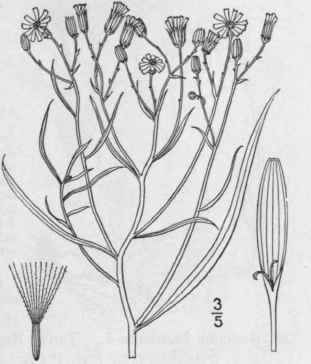
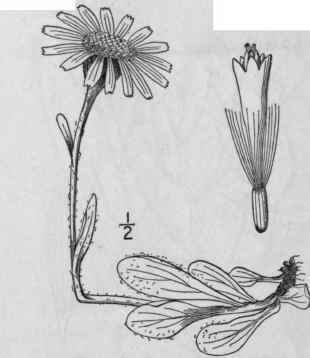
6. Senecio Spartioides T. & G. Broom-Like Senecio
Fig. 4615
Senecio spartioides T. & G. Fl. N. A. 2: 438. 1843.
Woody at the base, usually branched, sometimes shrubby, glabrous or nearly, so, leafy, 1°-6° high. Leaves sessile, or the lowest petioled, 1-3' long, linear, entire, or more or less serrate, not lobed; heads corymbose at the ends of the branches, 1/2'-l' broad, slender-peduncled; involucre cylindric or becoming campanulate, 4"-5" high, its bracts linear, acute or acuminate, usually with some subulate exterior ones; rays 8-15; achenes canescent; pappus bright white.
Plains, in dry soil, Nebraska to Texas, Wyoming and Arizona. June-Sept. This and the following species were included in the description of the far western S. Douglasii DC. in our first edition.
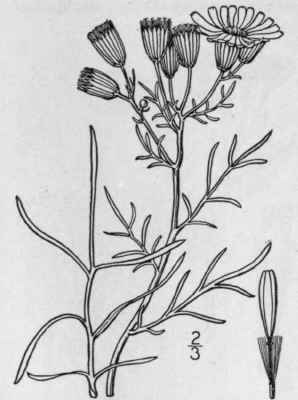
7. Senecio Riddellii T. & G. Riddell's Senecio
Fig. 4616
S. Riddellii T. & G. Fl. N. A. 2: 444. 1843. S. Fremontii (T. & G.) Rydb.; Britton, Manual 1028. 1901. Not S. Fremontii T. & G.
Woody at the base, usually branched, sometimes shrubby, glabrous or nearly so, leafy, 1°-6° high. Leaves sessile, or the lowest petioled, thick, 1 1/2'-3 1/2' long, pinnately parted into 3-0 linear or filiform, entire segments, or the upper entire; heads corymbose at the ends of the branches, 5"-10" broad, slender-peduncled; involucre cylindric or becoming campanulate, 5"-8" high, its bracts linear, acute or acuminate, usually with some subulate exterior ones; rays 8-15; achenes canescent; pappus white.
Plains, in dry soil, Nebraska to Texas and Mexico. June-Sept.
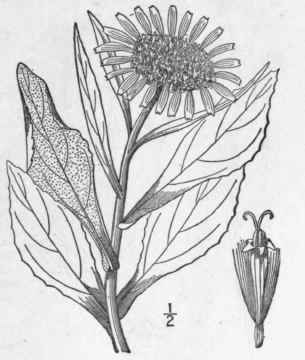
8. Senecio Pseudo-Arnica Less. Sea-Beach Senecio
Fig. 4617
Arnica maritima L. Sp. Pl. 884. 1753. Not S. maritimus L. Senecio Pseudo-Arnica Less. Linnaea 6: 240. 1831.
Perennial, somewhat fleshy; stem stout, mostly simple, very leafy, 6'-3° high. Leaves oblong-obo-vate, lanceolate, or the lower spatulate, acute or obtuse at the apex, 4'-8' long, 1/2-2' wide, densely tomentose beneath, at least when young, repand-dentate or denticulate, narrowed to a sessile and partly clasping base, or the lowest into margined petioles; heads solitary, or several (2-7) and corymbose, stout-peduncled, 1 1/2'-2' broad, 8"-10" high; involucre broadly campanulate, its bracts lanceolate, acuminate, mostly tomentose, commonly with several subulate spreading ones at the base; rays 12-25, linear, 3-toothed, conspicuous; disk-corollas 5-lobed; achenes glabrous; pappus dull.
On sea-beaches and rocks near the sea, Maine, New Brunswick and the lower St. Lawrence to Labrador and the Arctic Sea. Also in Alaska. July-Aug.
Continue to:


My Books

