
![previous page: 102. Senecio [Tourn.] L. Sp. Pl. 866. 1753. Part 3](../../../images/nav/page_prev.gif)

![next page: 102. Senecio [Tourn.] L. Sp. Pl. 866. 1753. Part 5](../../../images/nav/page_next.gif)
102. Senecio [Tourn.] L. Sp. Pl. 866. 1753. Part 4
Description
This section is from the book "An Illustrated Flora Of The Northern United States, Canada And The British Possessions Vol3", by Nathaniel Lord Britton, Addison Brown. Also available from Amazon: An Illustrated Flora of the Northern United States, Canada and the British Possessions. 3 Volume Set..
102. Senecio [Tourn.] L. Sp. Pl. 866. 1753. Part 4
9. Senecio Frigidus Less. Arctic Senecio
Fig. 4618
Senecio frigidus Less. Linnaea 6: 239. 1831.
Perennial, more or less tomentose, or becoming glabrous when old; stem slender, 6'-12' high, bearing a solitary head (rarely 2 or 3) 1/2'-1' broad. Basal and lower leaves spatulate or obovate, l'-2' long, petioled, obtuse, repand-dentate or entire; stem leaves oblong to linear-lanceolate, obtuse or acute, sessile, mostly entire, smaller; involucre broadly campanulate, about 7" high, its bracts lanceolate, acute, with no exterior smaller ones; rays 10-16, 6"-10" long, 3-toothed, linear-oblong, or cuneate at the base; achenes glabrous or sparingly pubescent; pappus white.
Labrador and arctic America to Alaska. Also in northeastern Asia. Summer.
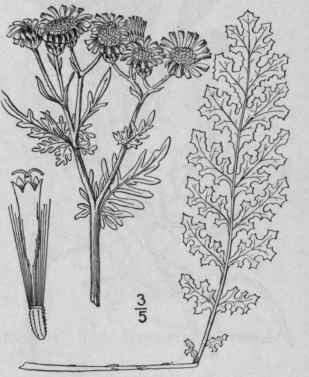
10. Senecio Jacobaea L. Tansy Ragwort. Staggerwort
Fig. 4619
Senecio Jacobaea L. Sp. Pl. 870. 1753.
Perennial by short thick rootstocks, somewhat woolly, or glabrous; stems stout, simple, or branched above, 2°-4° high, very leafy. Stem leaves 2-3-pinnatifid, 2'-8' long, the lower petioled, the upper sessile, the lobes oblong-cuneate, dentate or incised; basal leaves lyrate-pinna-tifid; heads very numerous, 6"-8" broad, short-peduncled in large compact corymbs; involucre narrowly campanulate, about 2 1/2" high, its bracts linear-lanceolate, acute, green, or tipped with black, usually with a few subulate outer ones; rays 12-15; achenes of the disk-flowers pubescent, those of the rays glabrous; pappus white.
In waste places, Newfoundland and Nova Scotia to Maine and Ontario, and in ballast about New York and Philadelphia. Adventive from Europe. Stave-wort. Cankerweed. Kettle-dock. St. James'-wort. Felonweed. Fairies'-horse. Ragweed. Saracen's-com-pass. July-Sept.
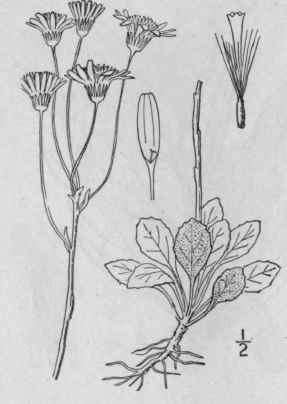
11. Senecio Antennariifolius Britton. Cat's-Paw Ragwort
Fig. 4620
Senecio antennariifolius Britton, in Britt. & Brown, III. Fl. 3: 478. 1898.
Perennial, tufted in mostly large clumps; stems slender, 8'-18' high, loosely white-woolly. Leaves nearly all basal, commonly numerous, oval to spatulate, angulately few-toothed or entire, mostly obtuse, narrowed into a petiole as long as the blade or longer, densely white-tomentose beneath, green and finally glabrous above, 1'-2 1/2' long; stem leaves small, spatulate, laciniate, or the upper narrowly linear and entire; heads several, corymbose, slender-peduncled, rathed less than 1' broad; rays golden-yellow, showy; involucre 3" high, white-woolly; achenes glandular-pubescent.
Stony hillsides, mountains of Virginia and West Virginia. May-June.
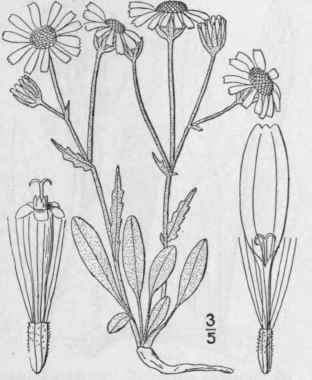
12. Senecio Canus Hook. Silvery Groundsel.
Fig. 4621
S. canus Hook. Fl. Bor. Am. 1: 333. pl. 116. 1833.
S. Purshianus Nutt. Trans. Am. Phil. Soc. (II) 7: 412. 1841.
Perennial, densely and persistently white-tomentose to the inflorescence; stems slender, usually tufted, 6'-18' high. Basal and lower leaves spatulate or oval, entire, or rarely somewhat repand, very obtuse, l'-2' long, narrowed into petioles; upper leaves oblong or spatulate, obtuse or acute, mostly sessile, smaller, entire or dentate; heads several or numerous, 8"-10" broad, usually slender-peduncled; involucre campanulate, or at first short-cylindric, about 5" high, its bracts linear-lanceolate, acute, sparingly tomentose, or glabrate, usually with no exterior smaller ones; rays 8-12; achenes glabrous, at least below; pappus white.
In dry soil, Manitoba to North Dakota, Nebraska, west to British Columbia and California. Recorded from Minnesota. May-Aug.

Continue to:


My Books

