


11. Nicotiana [Tourn.] L. Sp. Pl. 180. 1753
Description
This section is from the book "An Illustrated Flora Of The Northern United States, Canada And The British Possessions Vol3", by Nathaniel Lord Britton, Addison Brown. Also available from Amazon: An Illustrated Flora of the Northern United States, Canada and the British Possessions. 3 Volume Set..
11. Nicotiana [Tourn.] L. Sp. Pl. 180. 1753
Annual or perennial viscid-pubescent acrid narcotic herbs or shrubs, with large alternate entire or slightly undulate leaves, and rather large white yellow greenish or purplish flowers, in terminal, often bracted, racemes or panicles. Calyx tubular-campanulate or ovoid, 5-cleft. Corolla funnelform, salverform, or nearly tubular, the tube usually longer than the limb, 5-lobed, the lobes spreading. Stamens 5, inserted on the tube of the corolla; filaments filiform; anthers ovate or oblong, their sacs longitudinally dehiscent. Ovary 2-celled (rarely 4-celled); style slender; stigma capitate. Capsule 2-valved, or sometimes 4-valved at the summit. Seeds very numerous, small. [Named for John Nicot, French ambassodar to Portugal, who sent some species to Catherine de Medici, about 1560.]
About 50 species, mostly natives of America. Besides the following, some 10 others occur in the southern and western United States. Type species: Nicotiana Tabacum L.
Corolla 1' long, the tube cylindric; calyx-lobes triangular.
1. N. rustica.
Corolla 4-6' long, the' tube very slender; calyx-lobes linear or narrowly lanceolate.
2. N. longiflora.
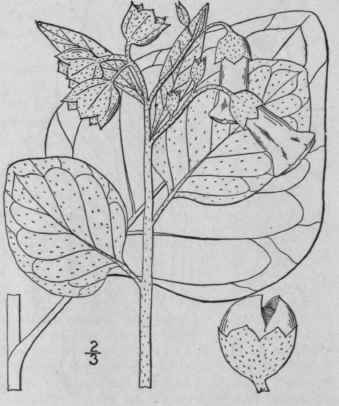
I. Nicotiana Rustica L. Wild Tobacco
Fig. 3731
Nicotiana rustica L. Sp. Pl. 180. 1753.
Annual; stem rather slender, 2°-4° high. Leaves broadly ovate, thin, entire, slender-petioled, 2'-8' long, 1'-6' wide; petioles 1/2'-5 1/2 long; flowers greenish-yellow, about 1' long, panicled; pedicels 3"-6" long, rather stout; calyx-lobes broadly triangular, acute, shorter than the tube; corolla-tube cylindric, somewhat enlarged above, the lobes short, obtuse, slightly spreading; capsule globose, glabrous, about 5" in diameter, 2-valved, longer than the calyx.
In fields and waste places, escaped from gardens, Ontario to Minnesota, south to southern New York and Florida. Cultivated by the Indians, its origin unknown. Leaves greenish when dry. Indian, Syrian or real-tobacco. June-Sept.
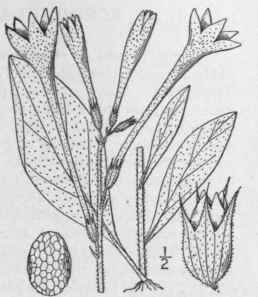
2. Nicotiana Longifldra Cav. Long-Flowered Tobacco
Fig. 3732
Nicotiana longiflora Cav. Descr. Pl. 106. 1802.
Annual, minutely rough-puberulent and viscid; stem erect, slender, branched, 1 1/2°-3° high. Basal leaves ovate-lanceolate or broadly oblanceolate, obtuse, 6'-10' long, 1'-3,' wide, tapering into slender winged petioles; stem-leaves linear or lanceolate, sessile, 2'-4' long; flowers in terminal racemes, short-pedicelled, 4'-6' long; calyx oblong, pubescent, its narrow lobes nearly as long as the tube; corolla white or purplish, viscid, the tube slender, 1"-1 1/2" in diameter, expanding above, the lobes ovate-lanceolate, acute; capsule oblong.
Near Harrisburg and Easton, Pa. Escaped from gardens. Native of South America. Aug.-Oct.
Continue to:


My Books

