


11. Paulownia Sieb. & Zucc. Fl. Jap. 1: 25. Pl. 10. 1835
Description
This section is from the book "An Illustrated Flora Of The Northern United States, Canada And The British Possessions Vol3", by Nathaniel Lord Britton, Addison Brown. Also available from Amazon: An Illustrated Flora of the Northern United States, Canada and the British Possessions. 3 Volume Set..
11. Paulownia Sieb. & Zucc. Fl. Jap. 1: 25. Pl. 10. 1835
A large tree, with the aspect of Catalpa, with broad opposite entire or 3-lobed, petioled pubescent leaves, and large violet flowers in terminal panicles. Calyx deeply 5-cleft, the lobes short. Corolla irregular, the tube elongated, enlarged above, the 5 lobes spreading, somewhat unequal. Stamens 4, didynamous, included; anther-sacs divaricate. Style slender, slightly thickened toward the summit, stigmatic on the inner side. Capsule coriaceous, ovoid, acute, loculicidally dehiscent. Seeds numerous, striate, winged. Flowers expanding before the leaves appear. [Named for Anna Paulowna, daughter of the Czar Paul I.]
A monotypic Japanese genus.
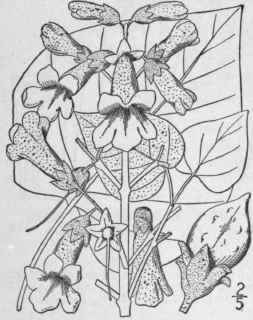
1. Pauiownia Tomentosa (Thunb.) Baill. Pau-Lownia
Fig. 3774
Bignonia tomentosa Thunb. Fl. Jap. 252. 1784. Pauiownia imperialis Sieb. & Zucc. Fl. Jap. 1: 27. 1835. Pauiownia tomentosa Baill. Hist. Pl. 9: 434. 1888.
A tree with thin flaky bark, reaching a maximum height of about 700 and a trunk diameter of 4°, the branches stout, spreading. Leaves broadly ovate, 6'-15' long, 4'-8' wide, long-petioled, canescent on both sides when young, glabrate above when old, the petioles terete; flowers about 2 1/2' long, numerous in large erect terminal panicles; pedicels stout, densely tomentose; calyx 5-lobed, the lobes thick, tomentose; corolla slightly irregular, puberulent without; capsule 2' high, 1' in diameter.
Escaped from cultivation, southern New York and New Jersey to Georgia. May-July.
Continue to:


My Books

