


28. Dasystoma Raf. Journ. Phys. 89: 99. 1819. Continued
Description
This section is from the book "An Illustrated Flora Of The Northern United States, Canada And The British Possessions Vol3", by Nathaniel Lord Britton, Addison Brown. Also available from Amazon: An Illustrated Flora of the Northern United States, Canada and the British Possessions. 3 Volume Set..
28. Dasystoma Raf. Journ. Phys. 89: 99. 1819. Continued
3. Dasystoma Serrata (Benth.) Small. Serrate False Foxglove
Fig. 3814
D. Drummondii serrata Benth, in DC. Prodr. 10: 521. 1846.
G. grandiflora integriuscula A. Gray, Syn. Fl. N. Am. 21: 291. 1871.
Gerardia grandiflora serrata Robinson, in A. Gray, Man. Ed. 7, 730. 1908.
Dasystoma serrata Small, Bull. Torr. Club 28: 451. 1901.
Perennial, grayish puberulent or finely pubescent; stems 1°-3 1/2° tall, often widely branched. Leaf-blades of the lower part of the stem pin-natifid and their segments entire, merely serrate and much smaller above; calyx-tube 2 1/2"-3" broad during anthesis; calyx-lobes linear-lanceolate to lanceolate, entire; corolla 1'- 1 2/3' long; capsules ovoid or globose-ovoid, 5"-7 1/2" long, short-beaked.
In dry soil, Missouri to Louisiana and Texas. July-Sept.


4. Dasystoma Grandiflora (Benth.) Wood. Western False Foxglove
Fig. 3815
Gerardia grandiflora Benth. Comp. Bot. Mag. 1: 206.
1835. D. Drummondii Benth. in DC. Prodr. 10: 520. 1846. D. grandiflora Wood, Bot. & Flor. 231. 1873.
Perennial, cinereous-puberulent and roughish; stem much branched, very leafy to the top, 2°-3° high, the branches ascending or spreading. Leaves short-petioled, thin, ovate or ovate-lanceolate in outline, all pinnatifid or deeply incised, 2'-4' long, the lobes acute or obtuse, serrate, or nearly entire; upper leaves smaller, sessile; pedicels, even in fruit, shorter than the calyx; calyx-lobes oblong or ovate, dentate or entire, about as long as the tube; corolla 1 1/2'-2' long, glabrous without, its tube much expanded above.
In dry woods and thickets, Minnesota and Wisconsin to Tennessee, Kansas and Texas. July-Aug.
5. Dasystoma Laevigata Raf. Entire-Leaved False Foxglove
Fig. 3816
Gerardia laevigata Raf. Ann. Nat. 13. 1820. Dasystoma quercifolia var. integrifolia Benth. in DC. Prodr. 10: 520. 1846. Dasystoma laevigata Raf.; Chapm. Fl. S. States, Ed. 2, 636. 1883.
Perennial, glabrous or very nearly so, not glaucous; stem strict, simple, or sparingly branched, 1°-3° high, the branches ascending. Leaves usually all petioled, lanceolate or ovate-lanceolate, 1 1/2' - 4' long, entire, or the lowest dentate or incised; pedicels shorter than the calyx, or in fruit longer; calyx-lobes ovate-lanceolate, equalling or shorter than the tube; corolla glabrous without, 1' - 1 1/2' long, the limb fully as broad, the tube much expanded above; capsule glabrous, twice as long as the calyx.
In dry thickets, Pennsylvania to Michigan, Georgia and Missouri. July-Aug.
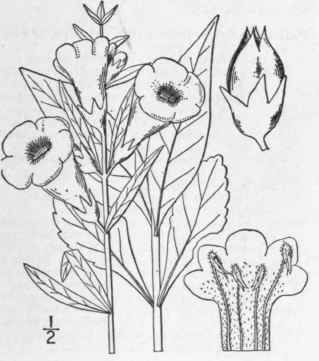
6. Dasystoma Virginica (L.) Britton. Smooth False Foxglove
Fig. 3817
Rhinanthus virginicus L. Sp. Pl. 603. 1753. Gerardia quercifolia Pursh, Fl. Am. Sept. 423. pl. 19.
1814. D. quercifolia Benth, in DC. Prodr. 10: 520. 1846. D. virginica Britton, Mem. Torr. Club 5: 295. 1894
Perennial, glabrous and glaucous; stem strict, rather stout, usually branched, 3°-6° high, the branches ascending. Leaves usually all petioled, ovate or ovate-lanceolate in outline, the lower 1-2-pinnatifid, 4'-6' long, the upper pinnatifid or deeply incised, the lobes lanceolate or oblong, acute, entire, or dentate; fruiting pedicels longer than the calyx; calyx-lobes ovate or ovate-lanceolate, acute, entire, about equalling the tube; corolla 11/2'-2' long, glabrous outside, its tube not widely expanded above; capsule glabrous, twice as long as the calyx.
In dry or moist woods, Maine to Minnesota, south to Florida and Illinois. Golden-oak. July-Sept.
Dasystoma calycosa Mackenzie & Bush has been distinguished from D. virginica by its more finely divided leaves, its elongate spreading branches and its long and narrow calyx-lobes; it occurs in Missouri and Arkansas.

Continue to:


My Books

