


6. Vincetoxicum Walt. Fl. Car. 104. 1788
Description
This section is from the book "An Illustrated Flora Of The Northern United States, Canada And The British Possessions Vol3", by Nathaniel Lord Britton, Addison Brown. Also available from Amazon: An Illustrated Flora of the Northern United States, Canada and the British Possessions. 3 Volume Set..
6. Vincetoxicum Walt. Fl. Car. 104. 1788
Twining or trailing perennial vines, with opposite usually cordate leaves, and rather large purple, brown, white or greenish flowers in axillary cyme-like Umbels or fascicles. Calyx 5-parted or deeply 5-cleft, mostly 5-glandular within. Corolla rotate, very deeply 5-parted, the tube very short, the segments convolute in the bud. Corona (crown) annular or cup-shaped, entire, lobed or divided, adnate to the corolla. Stamens inserted on the base of the corolla, the filaments connate into a tube; anthers not appendaged, merely tipped, borne along or just under the margin of the flat-topped stigma, the sacs more or less transversely dehiscent. Pollen-masses solitary in each sac, horizontal or nearly so. Follicles thick, acuminate, smooth, angled or tuberculate. Seeds comose. [Greek, subduing poison.]
About 75 species, natives of America. Besides the following, some 10 others occur in the southern and southwestern United States. Type species: Vincetoxicum gonocarpos Walt.
Crown annular, 10-crenate; follicles angled, not warty. Corolla about twice as long as the calyx.
1. V. suberosum.
Corolla 3-4 times as long as the calyx.
2. V. gonocarpos.
Crown cup-shaped, about as high as the anthers; follicles warty. Flowers purple to dull yellow.
Corolla-segments oblong, 3"-4" long; crown crenate.
3. V. hirsutum.
Corolla-segments linear or linear-oblong, 5" - 7" long. Crown merely crenate.
4. V. obliquum.
Crown toothed or lobed.
Crown 5-lobed, with a subulate 2-cleft tooth in each sinus.
5. V. carolinense.
Crown 10-toothed, the alternate teeth thinner and longer.
6. V. Shortii.
Flowers white; crown deeply cleft.
7. V. Baldwinianum.
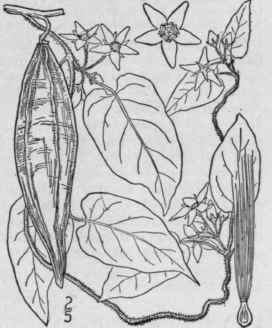
1. Vincetoxicum Suberosum (L.) Britton. Coast Vincetoxicum
Fig. 3416
Cynanchum suberosum L. Sp. Pl. 212. 1753.
G. suberosus R. Br. in Ait. Hort. Kew. Ed. 2: 82. 1811.
V. suberosum Britton, Mem. Torr. Club 5: 266. 1894.
Stem pubescent or glabrous, slender, twining. Leaves thin, 2'-5' long, 1'- 3' wide, ovate or ovate-oval, acute or abruptly acuminate at the apex, cordate at the base; petioles 1/2'-2 long; umbels commonly few-flowered; peduncles 1/4'-1' long; pedicels 1/2'-1' long, fleshy, nearly glabrous; corolla brown-purple, broadly conic in the twisted bud, its segments lanceolate or ovate-lanceolate, acute, pubescent or granulose within, 3'-4" long, about twice as long as the calyx; crown an annular fleshy undulately 10-crenate disk; follicles glabrous, 3-5-angled, when young fleshy, when mature dry and spongy, 4'-6' long, 1' in diameter or more.
In thickets, Virginia to Florida, mainly near the coast.
May-July.

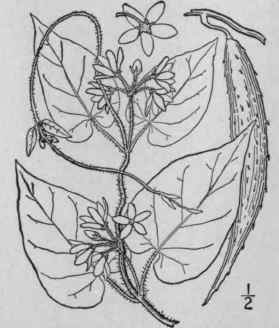
2. Vincetoxicum Gonocarpos Walt. Large-Leaved Angle-Pod
Fig. 3417
Vincetoxicum gonocarpos Walt. Fl. Car. 104. 1788. G. macrophyllus Michx. Fl. Bor. Am. 1: 119. 1803. Gonolobus laevis var. macrophyllus A. Gray, Syn. Fl. 2: Part 1, 103. 1878.
Glabrous or pubescent, stems slender, climbing high. Leaves broadly ovate, thin, 3'-8' long, 2'-6' wide, acuminate at the apex, deeply cordate at the base, the sinus narrow or the rounded auricles overlapping; petioles 1'- 4' long; umbels few-flowered; peduncles 1'-3' long; pedicels rather stout, glabrous or nearly so; corolla conic in the bud, not twisted, its segments lanceolate, glabrous, 4"-5" long, 3-4 times as long as the calyx; crown a low obtusely undulate disk; follicles glabrous, similar to those of the preceding species but usually shorter.
Along rivers and in moist thickets, Virginia to South Carolina, Georgia, Indiana Missouri and Texas.
Continue to:


My Books

