
![previous page: 8. Hypochaeris [Vaill.] L. Sp. Pl 810. 1753](../../../images/nav/page_prev.gif)


9. Apargia Scop. Fl. Cam. Ed. 2, 2: 113. 1772
Description
This section is from the book "An Illustrated Flora Of The Northern United States, Canada And The British Possessions Vol3", by Nathaniel Lord Britton, Addison Brown. Also available from Amazon: An Illustrated Flora of the Northern United States, Canada and the British Possessions. 3 Volume Set..
9. Apargia Scop. Fl. Cam. Ed. 2, 2: 113. 1772
Perennial scapose herbs, with tufted basal, mostly pinnatifid leaves, branched and scaly, or simple and naked scapes, and large heads of yellow flowers, solitary at the end of the scape or of its branches. Involucre ovoid or oblong, its principal bracts in 1 or 2 series, nearly equal, with several series of short outer ones. Receptacle flat, fimbrillate, villous, or somewhat honeycombed. Rays truncate and 5-toothed at the apex. Anthers sagittate at the base. Style-branches slender. Achenes oblong or linear, finely striate, contracted or beaked at the summit. Pappus of 1 or 2 series of plumose persistent brownish bristles, somewhat broadened at the base, or the outer scale-like and simple. [Greek, from the growth of these plants on unused land.]
About 45 species, natives of the Old World. Type species: Apargia incana Scop. Scape scaly-bracted, mostly branched; pappus of plumose bristles only.
1. A. autumnalis.
Scape bractless, monocephalous; pappus of two kinds. Pappus of marginal and inner flowers dissimilar.
2. A. nudicaulis.
Pappus of all flowers alike.
3. A. hispida.
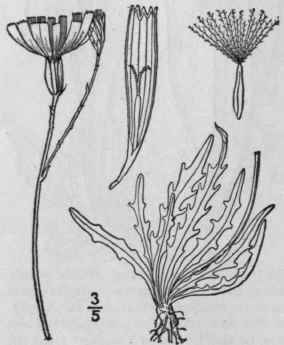
1. Apargia Autumnale (L.) Hoffm. Fall Dandelion. Autumnal Hawkbit. Lion's- Tooth
Fig. 4051
Leontodon autumnale L. Sp. Pl. 798. 1753.
Apargia autumnalis Hoffm. Deutsch. Fl. Ed. 2, 2: 113. 1800.
Plant glabrous or nearly so, or the involucres and ends of peduncles black-pubescent; scape slender, usually branched and scaly, 6'-2° high. Leaves narrowly oblong to linear-lanceolate, pin-natifid into narrow lobes, or some of them coarsely dentate, 3'-8' long, 3"-12" wide, acuminate at the apex, narrowed into rather short petioles; heads several, rarely solitary, about 12"-15" broad; involucre oblong; achenes tapering into a short beak, or the outer ones nearly terete; pappus-bristles all plumose.
In fields and along roadsides, Newfoundland to Ontario, New Jersey, Pennsylvania and Michigan. Naturalized from Europe. Native also of Asia. June-Nov. Dog-dandelion. Arnica-bud.
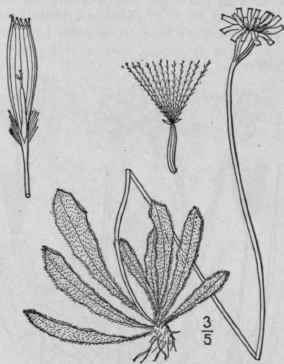
2. Apargia Nudicaulis (L.) Britton. Rough Or Hairy Hawkbit
Fig. 4052
Crepis nudicaulis L. Sp. Pl. 805. 1753. Leontodon hirtum L. Sp. Pl. Ed. 2, 1123. 1763. Leontodon nudicaule Banks; Lowe, Trans. Camb. Phil. Soc. 4: 28. 1831.
Plant more or less hirsute; scape simple, slender, 4'-12' high, minutely scaly, or naked. Leaves linear-oblong to narrowly spatulate, acute or obtuse, not acuminate, nearly entire, coarsely sinuate-dentate or sometimes pinnatifid, 2'-5' long, 3"-8" wide, narrowed into petioles; head solitary at the end of the scape, 5"-10" broad; involucre canescent or pubescent; outer achenes with a pappus of simple narrow scales, the inner ones with a pappus of plumose bristles.
In ballast and waste places, Connecticut to New Jersey and Pennsylvania, and on Vancouver Island. Adventive from Europe. June-Oct.
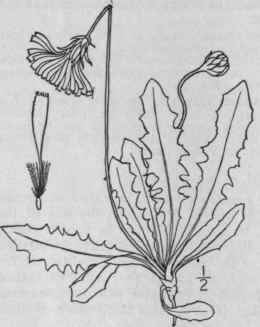
3. Apargia Hispida (L.) Willd. Common Hawkbit
Fig. 4053
Leontodon hispidus L. Sp. Pl. 799. 1753.
Leontodon hostile L. Sp. Pl. Ed. 2, 1123. 1763.
A. hispida Willd. Sp. PI. 3: 1552. 1804.
Glabrous, or bristly-hispid. Scape stout or slender, 4'-25' high, bractless, monocephalous; head nodding before flowering; leaves 2'-6' long, oblong-lanceolate in outline, coarsely and sharply dentate or subpin-natifid; head 1 1/2' broad or less; involucre 6"-7" high; pappus an outer series of short and an inner series of long plumose bristles, alike in all the flowers.
Fields and waste grounds, Rhode Island to Pennsylvania, Ontario and Ohio. July-Sept.
Continue to:


My Books

