
![previous page: 8. Sherardia [Dill.] L. Sp. Pl. 102. 1753](../../../images/nav/page_prev.gif)


9. Asperula L. Sp. Pl. 103. 1753
Description
This section is from the book "An Illustrated Flora Of The Northern United States, Canada And The British Possessions Vol3", by Nathaniel Lord Britton, Addison Brown. Also available from Amazon: An Illustrated Flora of the Northern United States, Canada and the British Possessions. 3 Volume Set..
9. Asperula L. Sp. Pl. 103. 1753
Erect or ascending branching perennial herbs, with 4-angled stems, verticillate leaves, and small white pink or blue flowers in terminal or axillary, mostly cymose clusters. Calyx-tube somewhat didymous, the limb obsolete. Corolla funnelform. 4-lobed. Stamens 4, inserted on the tube or throat of the corolla; anthers linear or oblong. Ovary 2-celled; ovules 1 in each cavity; style 2-cleft. Fruit globose-didymous, the carpels indehiscent. Seed adherent to the pericarp; endosperm fleshy; embryo curved. [Latin diminutive of asper, rough, referring to the leaves.]
About 80 species, natives of the Old World. Type species: Asperula odorata L. Leaves oblong-lanceolate to obovate; fruit hispid.
1. A. odorata.
Leaves linear, 1" wide or less; fruit smooth.
2. A. galioides.
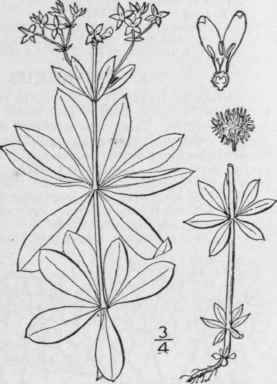
1. Asperula Odorata L. Sweet Woodruff
Fig. 3953
Asperula odorata L. Sp. Pl. 103. 1753.
Stems erect, slender, smooth. Leaves usually in 8's (6's-9's), thin, oblong-lanceolate, acute or obtuse, mucronate, 1-nerved, roughish on the margins, 6"-18" long, the lower smaller, often obo-vate or oblanceolate; peduncles terminal and axillary, slender; cymes several-flowered; flowers white or pinkish, 1 1/2" long; pedicels 1"-2" long; fruit very hispid, about 1" broad.
In waste places, New Brunswick, N. J. Fugitive from Europe. Other English names are hay-plant, mugwet or mugget, rockweed, sweet hairhoof, wood-rip, woodrowel, star-grass, and sweet-grass. May-July.
Asperula arvensis L., another European species, with terminal capitate flowers, and linear obtuse leaves, has been found in waste places on Staten Island.
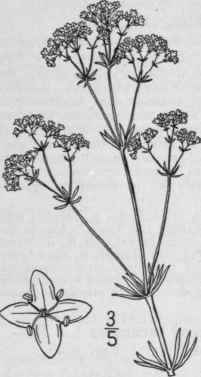
2. Asperula Galioides Bieb. Bedstraw Asperula
Fig. 3954
Asperula galioides Bieb. Fl. Taur. Cauc. 1: 101. 1808.
Glaucous, glabrous, stems erect or ascending, 2 1/2" high or less. Leaves linear, rigid, involute-margined, 1/2'-1 1/2' long, about 1" wide, whorled in 5's-10's (often in 8's), subulate-tipped or mucronate; cymes panicled; flowers white; fruit smooth.
In fields, Connecticut to Michigan. Adventive from Europe. May-July.
Continue to:


My Books

