


Chapter IV. The Key
Description
This section is from the book "The Mushroom Book", by Nina L. Marshall. Also available from Amazon: Mushroom Book.
Chapter IV. The Key
What A Key Is, And Why A Name Is Desirable
A key in the study of botany is a guide by which a student may trace a specimen until he finds a name for it. Having found a name, he may learn from books or from friends what is known of its habits of growth, of its value as a food or drug, whether it is harmful or harmless, whether it is to be protected or whether war is to be waged against it. He may learn whether it has figured in history or the myths, and how the poets and artists viewed it, and may perhaps learn to see it with their eyes. He may watch similar specimens as they grow, and may add the results of his observations to the facts already recorded about his specimen.
How A Key For Fungi Is Made, And Why It Is Desirable
In the first place, only such plants are considered as grow from spores and have no leaf-green. (The spore characteristic is one the amateur must decide upon either by seeing the spores or by inferring their existence from the fact that seeds do not appear.) There are some thirty-five thousand species of fungi known to botanists, so that it would be impossible to find a name for a specimen if one had to read at random until the right description for his specimen was found; but since all of these plants may be put in one or another of three groups, on account of certain points of resemblance which they have in common, and since these three groups may each in turn be divided and subdivided, one may, by selecting groups rather than individual specimens, find a short path to the name desired. The three primary groups, called classes, are made as follows :
The first contains many mould-like fungi which resembl one another in microscopic characters.
The second contains other mould-like fungi and many con spicuous fungi which bear their spores in transparent sacs (see first page of Key).
The third contains all fungi which bear their spores on enlarged cells called basidia (see first page of Key).
To even partially understand the inconspicuous fungi is a task impossible to one who is not familiar with the use of a compound microscope. To acquire a knowledge sufficiently accurate to identify nearly all of the conspicuous fungi is within the power of any intelligent person, for the two groups or classes containing the conspicuous species may be divided, on account of easily distinguished characters, into groups called orders. The orders may be divided into groups called families, and the families into groups called genera (singular genus), and the genera into individual specimens called species; and all these groups may be arranged in such a way that the series of selections may be quickly made. Such an arrangement of groups is called a key.
Key
Fungi
Fungi which are inconspicuous as individuals, and do not bear the spores in sacs (asci), or on sterigmata. Mould-like.
Spores produced in delicate membranous sacs (asci).
Spores free on enlarged basidia.

(Magnified)

(Magnified)
Class I
Phycomycetes. (The Algal-like Fungi.)
Page 9.
II
(The Spore-sac Fungi.) Page 18.
III
Basidiomycetes. Page 22.

Class II
Ascomycetes (Spore-Sac Fungi)

Subterranean. Asci remaining enclosed in a tuber-like body.
Bright coloured. Perithecia imbedded in a fleshy or waxy stroma.
Asci collected in a spherical or near-shaped body.

Outer surface.

Section.

Section of stroma with perithecia (magnified).

Perithecium (highly magnified).
Orders
Tuberales. (Truffles.)
Page 135.
Hypocreales. Page 136.
Fleshy cup-like fungi. Asci collected in a flattened or cup-like body (ascoma). Ascoma closed at first, open at maturity.
Club-shaped (a); or conic, convex, and pitted (b); or with gyrose furrows (c); or saddle-shape (d).
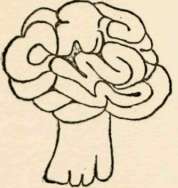
(c)

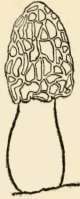
(b)

(a)

(d)
Pezizales (Cup Fungi.)
Page 20.
Helvellales, Page 20.

Class 11 Ascomycetes (Spore-Sac Fungi).

Pezizales.
Helvellales.
Family Helvellaceae
Ascomata smooth, regularly saucer-shaped, or cup-shaped, or circular.

Ascoma with a distinct stalk, campanulate or saddle-shaped, attached to the stipe at the middle.
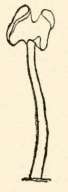
Ascoma conic or pileate.
Ascoma cap-like, irregular or lobed, covered with gyrose wrinkles.
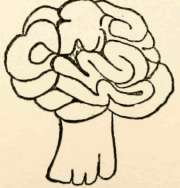
Genera
Peziza. Page 137.
Helvella. Page 142.
Gyromitra. Page 141.
Family Geoglossaceae.
Ascoma clavate or capitate; yellow, green, or black clublike forms.
Ascoma cap-like, ovoid, or conic, covered with deep pits.
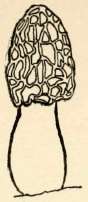
Ascomata flat, running down both sides of the stem.

Ascoma hollow, discoid, usually with free margin, light-coloured, yellowish or light brown, sharply separate from the stem.

Morchella. Page 141.
Spathularia. Page 138.
Mitrula. Page 140.

Class III
Bas1diomycetes (Spores Borne On Basidia)

Fungi taking nourishment from liv-ing plants, parasitic, often deforming the host.
Fungi taking nourish-ment from dead organic matter.

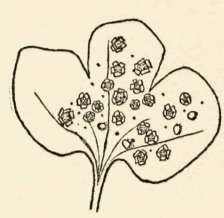
Gelatinous fungi with divided spore clubs.
Fleshy, woody, or leathery.
Spore clubs undivided.
Spore clubs forming a membranous surface, naked at maturity.
1st. Membrane covering the surface of lamellae.

Rusts and Smuts.
Page 14.
Tremellines. (Gelatinous Fungi.)
Hymenomycetes, or Membrane Fungi or
2d. Membrane covering the surface of pores.
3d. Membrane covering the surface of spines.
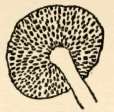

Spore clubs enclosed within a definite case (peridium).
Agaric ales. Page 30.
Gasteromycetes. (Pouch Fungi.) Page 24.

Gasteromycetes (Pouch Fungi).
□
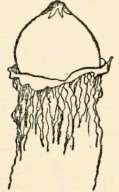
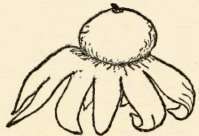
Spores borne in a more or less deliquescent mass, which is at first enclosed in an egg-like sac (peridium), but at maturity is elevated on an elastically expanding receptacle.
□
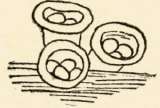
Spores borne in little egg-like cases, persistent, in a cup-shaped peridium.


Phallales (Stinkhorns.)
Page 26.
Nidulariales. (Bird's-nest Fungi.) Page 133.
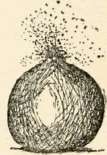
Spores remaining within the peridium until maturity.
Fleshy when young ; at maturity filled with dust-like spore masses, mixed with threads (capilitium).
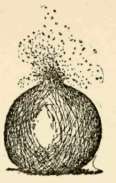
Rough, warty balls, thick skinned.
Lead colour within.
Skin rupturing irregularly at maturity.
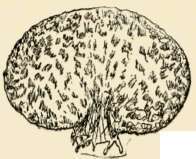

Section.
Lycoperdales. Page 28.
Sclerodermatales. Page 133.

Continue to:


My Books

