


England
Description
This section is from the book "Drinks Of The World", by James Mew. Also available from Amazon: Drinks of the world,.
England
Love of the English for Beer - A National Drink - Private Brewing - A French View of English Society - Sir John Barleycorn-the "Black Jack" and "Leather Bottel" - "Toby Philpot"-burton-on-trent - Bottled Beer - Brewers - The Village Alehouse - Various Beers.
"Back and syde goo bare, goo bare, Both hande and foote goo colde; But, Bellie, God send the good ale inowghe Whether hyt be newe or old."
"Brynge us home good ale, syr, brynge us home good ale, And for our der lady's love, brynge us som good ale. Brynge us home no beff, syr, for that is full of bonys, But brynge us home goode ale y-nough, for that my love alone ys; Brynge us home no wetyn brede, for yt be ful of branne, Nothyr of no ry brede, for yt is of ye same; Brynge us home no porke, syr, for yt is verie fatt, Nothyr no barly brede, for neythir love I that; Brynge us home no muton, for that is tough and lene, Neyther no trypys, for thei be seldyn clene; Brynge us home no veel, syr, that do I not desyr, But brynge us home good ale y-nough to drynke by ye fyer; Brynge us home no syder, nor no pakle l wyne, For, and yu do, thow shalt have Criste's curse and mine."
1 From the old French Pallir, to become vapid, lose spirit. Washy stuff.
The foregoing verses epitomise the praise of good beer. The first is from one of the earliest known drinking songs in the English language - the last is an old Wassail song - the Wassail bowl, which was of hot spiced ale, with roasted apples bobbing therein, - a kindly way of welcome on New Year's Eve, of Saxon derivation as its name "Wes-hal," be of health, or your health, testifies.
That the Anglo-saxon took kindly to his beer, we have already seen; and that that feeling exists at the present day is undoubted, for what says the refrain of a comparatively modern drinking song ?
"I loves a drop of good beer - I does-fse partickler fond of my beer - I is And ------ their eyes,
If ever they tries
To rob a poor man of his beer."
Its popularity has never waned - and it has reached to such a height that the brewing trade seems to be instituted for the propagation of Peers of the realm - a fact which Dr. Johnson even could not have foreseen, although, at the sale of Thrale's brewery, he did say that they had not met together to sell boilers and vats, but "the potentiality of growing rich beyond the dream of avarice."
It was the national drink - for tea and coffee were not introduced into England until the middle of the seventeenth century - and it is only of very modern times that the "free breakfast table " fad of statesmanship has made those beverages so popular, by bringing them within the means of the very poorest.
Beer was, perforce, drank morning, noon and night by those, and they were the vast majority, who could not afford wine - and, as a rule, after the Norman Conquest, when the Anglo-saxons copied the soberer customs of their conquerors, the English were not drunkards as a nation; in fact, although almost all their jests hinge on drinking, there is in most of them an underlying moral, which in print are as telling as this illustration, which, in deference to nasty Mrs. Grundy, has been slightly toned down. Here is very cleverly satirised for reprobation the phases of men under the influence of drink. How it transforms them into beasts, some like lions, others like asses and calves, sensual as hogs, greedy as goats, stupid as gulls.
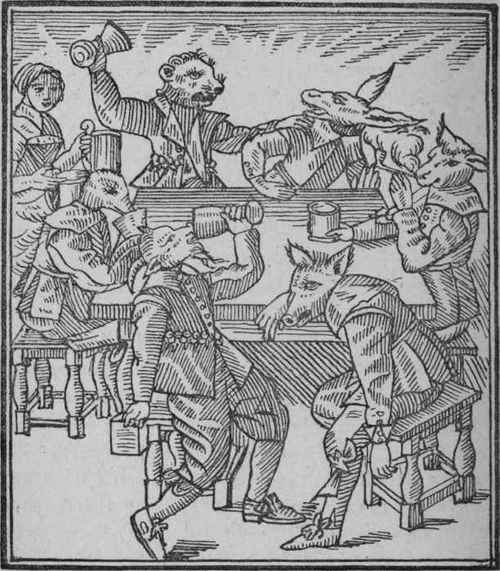
Every man brewed his own beer up to the seventeenth century, when we find Pepys speaking of Cobb's strong ales at Margate; and in the reign of Queen Elizabeth the public brewing had begun at Burton, for an inquiry was made by Walsingham to Sir Ralph Sadler, the governor of Tutbury Castle, as to "What place neere Tutbury, beere may be provided for her Majesty's use ?" and the answer was that it might be obtained at Burton, three miles off. Good Queen Bass would, indeed, have fared badly without her beer, for her breakfast beverages were always beer and wine.
Yet every one was fairly sober. They were weaned on alcoholic liquors, and, consequently, enjoyed them as foods, as they undoubtedly are, if properly used. It is very well to "see our sen as others see us," but it is almost impossible to agree with Estienne Perlin, who published his Description des Royaulmes d'angle-terre et d'escosse, at Paris in 1558, in which he says that the English "sont fort grands yvrongnes." His description is, we feel, as untrustworthy as his English. "Car si un Anglois vous veult traicter, vous dira en son langage, vis dring a quarta rim vim gasquim, vim hespaignol, vim malvoysi, c'est a dire veulx tu venir boire une quarte de vin du gascoigne, une autre d'espaigne, & une autre de malvoisie, en beuvant & en mengeant vous diront plus de cent fois drind iou, c'est a dire je m'en vois boyre a toy, & vous leur responderes en leur langage iplaigiu, qui est a dire, je vous plege. Si vous les remarcies vous leurs dires en leurs langages, god tanque artelay, c'est a dire, je vous remercie de bon coeur. Eulx estans yvres, vous jureront le sang et le mort que vous beures tout ce que vous tenes dedans vostre tace, & vous diront ainsi, bigod sol drind iou agoud oin" It is much to be feared that the worthy Frenchman, if his description is to be at all relied on, mixed with rather a fast lot.
Ale was looked upon as a kindly creature, and our ancestors of the seventeenth century had several ballads in praise of the "little Barleycorn" and the indictment, as well as the "Bloody Murther," of Sir John Barleycorn. From this latter the peasant poet, Burns, plagiarised right royally. There was also a very curious Chap book published in the early part of the eighteenth century, entitled,
"The whole Trial and Indictment of
Sir John Barley-corn - Knt.
A Person of Noble Birth and Extraction, and well known by Rich and Poor throughout the Kingdom of Great Britain: Being accused of several Misdemeanours, by him committed against His Majesty's Liege People; by killing some, wounding others, and bringing Thousands to Beggary, and ruins many a poor Family.
Continue to:


My Books

