


England. Part 2
Description
This section is from the book "Drinks Of The World", by James Mew. Also available from Amazon: Drinks of the world,.
England. Part 2
Here you have the Substance of the Evidence given in against him on his Trial, with the Names of the Judges, Jury, and Witnesses. Also the Comical Defence Sir John makes for himself, and the Character given him by some of his Neighbours, namely, Hewson the Cobbler, an honest friend of Sir John's, who is entomb'd as a Memorandum, at the Two Brewers in East Smithfield.
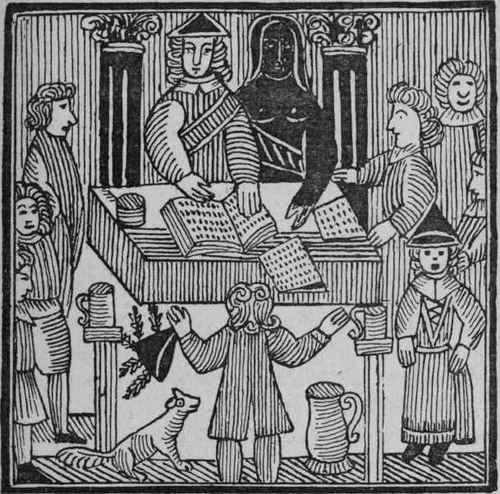
Taken in Short Hand by Thomas Tosspott, Foreman of the Jury."
One of the witnesses, hight Mistress Full-pot, the hostess, called in his defence, thus winds up her evidence,"nay, I beseech you, give me leave to speak to you; if you put him to Death, all England is undone, for there is not such another in the Land that can do as he can do, and hath done; for he can make a Cripple to go, he can make a Coward to fight with a valiant Soldier, nay, he can make a good Soldier feel neither Hunger or Cold. Besides, for Valour in himself, there are few that can encounter with him, for he can pull down the strongest Man in the World, and lay him fast asleep."
Of course, the jury found a verdict of Not Guilty.
Beer has a large literature of its own, principally metrical, but this has pretty well been collected in two books - The Curiosities of Ale and Beer, by John Bickerdyke; and In Praise of Ale, by W. T. Marchant - either of which would be a valuable addition to any one's library. Yet in neither of them have I met with Ned Ward's Dialogue between Claret and Darby Ale" published 1691, in which each of the drinks speak for themselves; and, of course, the arguments of ale are all potent over his antagonist. Space will only allow of a very short extract.
"Darby. - I'm glad to know you, High and Mighty Sir;
Think you your pompous empty Name could stir My Choler ? No, your Title makes me fear As much as if you'd been Six Shilling Beer. Claret. - Thou Son of Earth, thou dull insipid thing, To level me, who am of Liquors King,
With lean Small Beer, but that thou art not worth My Anger, else I'de frown thee into Earth.
Darby. - I neither fear your Frown, nor court your Smile; But, if I'm not mistaken all this while, By other names than Claret you are known Claret. - You do not hear me, Sir, the Fact disown, Some call me Barcelona, some Navar, Some Syracuse, but at the Vintner's Bar My name's Red Port. But call me what they will, Claret I am, and will be Claret still," etc., etc.
Not content with praising the liquor ale, our ancestors fell to eulogising the vessels used for its consumption, and the "Black Jack" and "Leather Bottel" both came in for their meed of praise. I give sketches of a fine example of each, which I have drawn from the national collection in the British Museum.
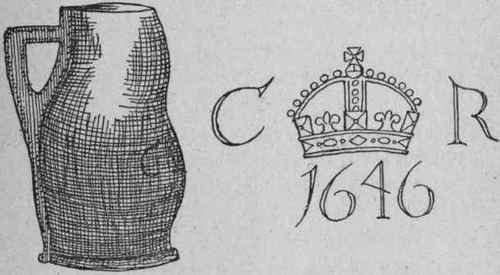
The Black Jack is a jug or pitcher, made of leather, which was sometimes ornamented with a silver rim and a silver plate with the owner's name or coat of arms engraved thereon. Here is a short lyric, "In praise of the Black Jack."1
1 See second part of Westaminster Drollery, 1672.
" Be your liquor small, or as thick as mudd, The cheating bottle cryes, good, good, good, Whereat the master begins to storme, Cause he said more than he could performe.
A nd I wish that his heires may never want Sack, That first devis'd the bonny black Jack.
No Tankerd, Flaggon, Bottle nor Jugg Are half so good, or so well can hold Tugg, For when they are broke, or full of cracks, Then they must fly to the brave black Jacks.
And I wish, etc.
When the Bottle and Jack stands together, O fie on't, The Bottle looks just like a dwarfe to a Gyant; Then had we not reason Jacks to chuse For this'l make Boots, when the Bottle mends shoes.
And I wish, etc.
And as for the bottle you never can fill it Without a Tunnell, but you must spill it, 'tis as hard to get in, as it is to get out, 'tis not so with a Jack, for it runs like a Spout.
And I wish) etc.
And when we have drank out all our store, The Jack goes for Barme to brew us some more; And when our Stomacks with hunger have bled, Then it marches for more to make us some bread.
And I wish, etc.
I now will cease to speak of the Jack, But hope his assistance I never shall lack, And I hope that now every honest man, Instead of Jack will y'clip him John.
And I wish, etc."
But the composer of " A Song in praise of the Leather Bottel" could rise to the magnitude of his subject in a far superior manner than the preceding poet, the refrain of his song being of a higher type.
" And I wish in Heaven his Soul may dwell, That first devised the Leather Bottel"
The uses of the Bottel were so manifest, and its material so superior to any other, that it occupied a higher position. It was better than wood, for it would not run, and was unbreakable. When a man and his wife fell out, as will occasionally happen even in the best matrimonial existence, the bottel could be thrown at each other, without great injury either to human, or the bottel. It held no temptation to steal,as if it were of silver; nor could It be broken, as if it were of glass - because, as the song justly says, "Then what do you say to these Glasses fine? Yes, they shall have no Praise of mine; For when a Company there are sat, For to be merry, as we are met; Then, if you chance to touch the Brim, Down falls your Liquor, and all therein; If your Table Cloath be never so fine, There lies your Beer, your Ale or Wine; It may be for a small Abuse, A young Man may his Service lose; But had it been in a Leather Bottel, And the Stopple in, then all had been well."
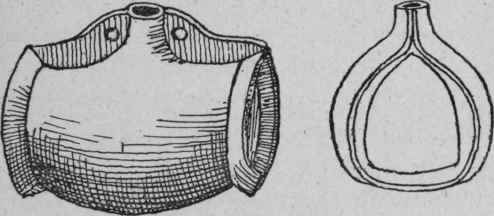
The rhymester recapitulates the gratitude of all classes for this extremely handy and unbreakable convenience, and winds up thus, somewhat sadly "Then when the Bottel doth grow old, And will good Liquor no longer hold, Out of its side you may take a Clout, Will mend your Shooes when they'r worn out; Else take it, and hang it upon a Fin, It will serve to put many Trifles in, As Hinges, Awls, and Candle-ends, For young Beginners must have such things.
Continue to:


My Books

