


England. Part 3
Description
This section is from the book "Drinks Of The World", by James Mew. Also available from Amazon: Drinks of the world,.
England. Part 3
Then I wish, etc."
The next most popular English drinking vessel was the greybeard, or as it was sometimes, but seldom, called the Bellarmine, from the Cardinal of that name so famous for his controversial works. These jugs were imported largely from the Low Countries, where the Cardinal's name was a reproach. These greybeards are of very common occurrence, being frequently found in excavating on the sites of old houses.
Two centuries after the greybeard, came the brown Staffordshire Toby Philpot, an enormously stout old gentleman, whose arms and hands encircle his enormous paunch, and his three-cornered hat forms a most convenient lip, whence the ale can be poured. It owes its origin to a once very popular drinking song, entitled " The Brown Jug," which is an imitation from the Latin of Hieronymus Amaltheus, by Francis Fawkes, M.a., published in 1761, which is the date of the accompanying illustration.
"Dear Tom, this brown jug, which now foams with mild ale. Out of which I now drink to sweet Nan of the Vale,was once Toby Philpot, a thirsty old soul, As e'er cracked a bottle, or fathom'd a bowl; In bousing about, 'twas his pride to excel, And amongst jolly topers he bore off the bell.
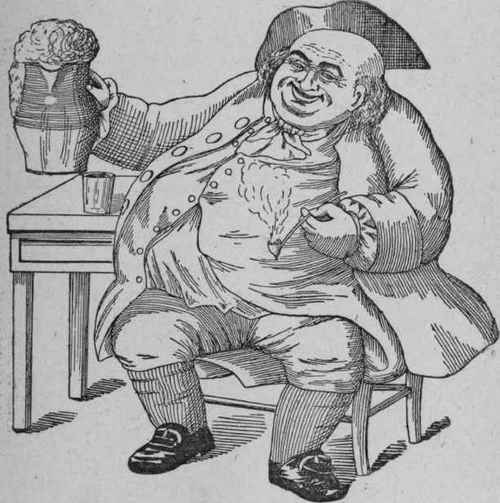
It chanced as in dog-days he sat at his ease, In his flower-woven arbour, as gay as you please, With his friend and a pipe, puffing sorrow away, And with honest Old Stingo sat soaking his clay, His breath-doors of life on a sudden were shut, And he died full big as a Dorchester Butt.
His body, when long in the ground it had lain,
And time into clay had dissolved it again,
A potter found out, in its covert so snug,
And with part of Fat Toby he form'd this brown jug;
Now sacred to friendship, to mirth, and mild ale So here's to my lovely sweet Nan of the Vale."
Burton-on-Trent may be termed the Metropolis of English Beer, and there, veritably, " Beer is King." This pre-eminence is attributed to the quality of the water, which seems peculiarly fitted for brewing purposes, and the fact that the large brewers there located use none but the finest malt and hops procurable. There is an old saying, that wherever an Englishman has trodden, and where has he not? there may be found, an empty beer bottle. And, truly, he does carry the taste for his natural beverage wherever he goes, and the export trade is enormous, every ship wanting freight, filling up with bottled beer, as a safe thing. Fuller, in his Worthies of England (ed. 1662, p. 115), gives his account of the origin of bottled beer. Speaking of Alexander Nowell, who was made Dean of St. Paul's as soon as Queen Elizabeth came to the throne, he mentions his fondness for fishing, and says, "Without offence it may be remembred, that leaving a Bottle of Ale (when fishing) in the Grasse; he found it some dayes after, no Bottle, but a Gun, such the sound at the opening therof. And this is believed (Casualty is Mother of more Inventions than Industry) the original of bottled-ale in England."
The London brewer had to be content, before Sir Hugh Myddleton brought the New River to the Metropolis, with the water obtained from the Thames, for Artesian wells were not, and other well water must, from the crowded state of the City, have been highly charged with organic matter. But their trade was so important that they were incorporated into a Gild, and the Brewer's Company is now in existence, having their Hall in Addle Street, Wood Street. The City still maintains the importance of beer as a beverage by keeping an Ale Conner, whose duty is to taste ales, and see that the price charged is not excessive. Their oath of office may be found in the Liber Aldus, published at the instance of the Government.
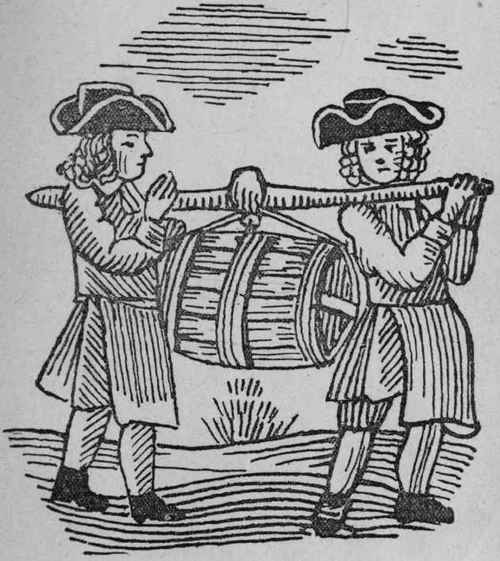
The names of our great English brewers are too well known among the English people to need recapitulation - and space is too scarce to describe their premises. The London draymen have always been noted as a race of tall stalwart men, and brewers generally have taken a pride in getting the largest and strongest horses for their work. These two draymen are of the time of George I., and the weight they are carrying contrasts favourably with the satire of a huge dray horse dragging a four and a half gallon 23f cask. On one notable occasion brewers' draymen have gone beyond their last. When General Haynau visited Barclay's Brewery, they rose in indignation against him and chased him from the place, because it was alleged that the General had caused a lady to be flogged !
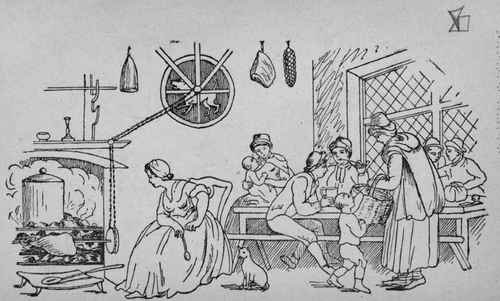
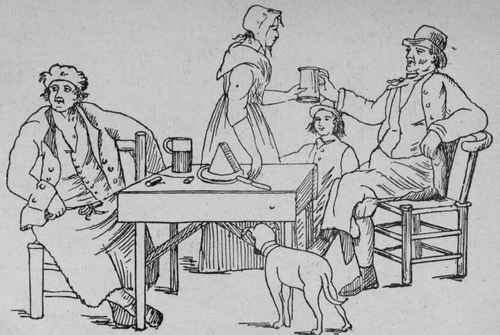
Village Inn
The Village Ale-house is, or was, the village club, and certainly is a welcome place of rest for the wayfarer. They are always clean, and frequently quaint, although now-a-days it would be hard to find, as Rowlandson did, a turnspit dog on duty.

The names of ales are legion; but some are worthy of a passing notice on account of their strength, such as some of the College Ales, those brewed at the birth of an heir - to be drank at his coming of age,
Ten Guinea Ale etc., and there are any quantity of pseudo beers - i.e. those not made from malt and hops, China Ale, Radish Ale, ale made from beet or mangel wurzel, and heather beer, which latter is of so great antiquity that its method of manufacture is said to have been lost with the extirpation of the Picts, although some say it was brewed by the Danes. It is probable that the flowers and tops of the heath were used as a substitute for hops, as, previous to the introduction of the latter plant, broom, wormwood and other bitter herbs were used.
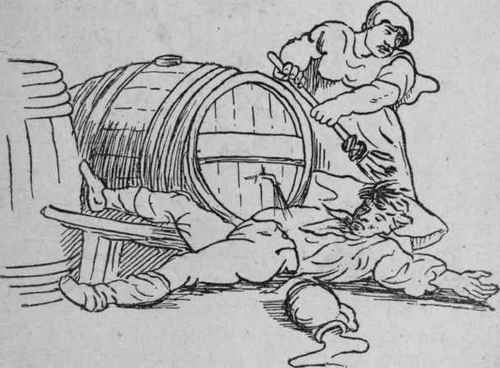
After Rowlandson.
France: Cerevisia; Double Biere;, Adulteration. Germany: Mum; Beer Factories; Faust. India: Pachwai, Piworree. Japan: Saki; Kaernpfer. Russia: Kvas; Vodki; Pivo. Sweden: Spruce. Tartary: Baksoum,
Continue to:


My Books

