


Whiskey. Continued
Description
This section is from the book "Drinks Of The World", by James Mew. Also available from Amazon: Drinks of the world,.
Whiskey. Continued
Perhaps the earliest historical account of Scotch whiskey is the grant, in 1690, to Duncan Forbes of Culloden, in consideration of his services to William III., of the privilege of distilling whiskey, duty free, in the barony of Ferrintosh. Naturally, a number of distilleries were erected there, and Ferrintosh became the generic term for whiskey. In 1785 this grant was annulled on payment of £20,000 to the representatives of Duncan Forbes, a proceeding which Robert Burns thus wrote about, in his " Scotch Drink":
"Thee, Ferrintosh ! O sadly lost! Scotland laments from coast to coast! Now colic-grips an' barkin' hoast
May kill us a'; For loyal Forbes' chartered boast
Is ta'en awa'."
The Highland risings made the Lowlanders more familiar with this spirit; but it was a long time before the drink became general, and a far longer before it was generally introduced into England. "Bonnie Prince Charlie" got too fond of it, and his affection for strong drinks was life-long. George IV., on his visit to Scotland, thought the best way to popularise himself on his arrival was to call for, and drink, a glass of whiskey; and even our good Queen has tasted "Athol-brose."
The manufacture of whiskey was encouraged for several reasons: first, that it gave employment; secondly, that it used up large quantities of grain, to the benefit of the farmer; and thirdly, it was hoped that it would, in many cases, supersede the French brandy, which was most extensively smuggled. But Government imposed so high a duty, that illicit stills sprang up everywhere, and contraband whiskey was universally drank, the smugglers openly bringing their wares down south, and in such force as to defy the Excise, and frequently the military. A wise step was then taken, and in 1823 the excise duty was lowered from 6s. 2d. to 2s. 4 3/4d. per imperial gallon, a proceeding which, in a year, doubled the output of exciseable spirits; but, by degrees, fiscal exigencies have raised it to 10s. per proof gallon. Now, the quantity of homemade spirits on which duty was paid for the year ending 31st March, 1890, is as follows:
England. | Scotland. | Ireland. | ||
Galls. | Galls. | Galls. | ||
12,636,060 | • • • | 9,463,012 | • • • | 7,521,998 |
or in all, 29,621,070 gallons, yielding a revenue of £14,810,522.
It would be invidious to particularize any of the large Scotch distilleries, which mostly owe their fame to the excellence of their malt and the extreme purity of their water, together with the fact that peat is extensively used as fuel, even to the drying of the malt; but "Glenlivet' has a name as world-wide as "Fer-rintosh." Do we not read in the Bon Gualtier Ballads that "Fhairhson had a son
Who married Noah's daughter, And nearly spoiled ta flood,
By trinking up ta water; Which he would have done,
I at least pelieve it, Had ta mixture peen
Only half Glenlivet" ?
It was such a famous place that, according to the Ordnance Gazetteer of Scotland, there were as many as 200 illicit stills there, in brisk work, at the beginning of the present century.
"Small still" whiskey is undoubtedly the best, for only good materials can be used, as the distillation carries over the flavour of the malt. Hear what Dr. Thud'icum says1:
"The product of the patent still derives its name from the fact that it is mere alcohol and water, having no distinctive qualities, telling no tales to nose or palate of the source from which it was obtained, and hence, in the almost poetic spirit of the trade, it is commonly called 'silent spirit.' The owner of a patent still, instead of being confined, like a whiskey distiller, to the use of the best materials, is able to make his spirit from any, even spoiled and waste, materials, and with little reference to any other quality than cheapness. The worst of the spirit thus produced is fit only for methylation, preparatory for being used for trade purposes, exclusive of consumption as a beverage. When intended for a beverage, it must be rectified and flavoured. It thus serves as a basis for the implanting of artificial flavours, which maybe those of sham whiskey, sham brandy, or sham rum.
1 Alcoholic Drinks, 1884, p. 67.
"The presence of grain ethers is the condition of the genuineness of whiskey. Silent spirit, on the other hand, undergoes no change by keeping, and must be flavoured to become drinkable. For that purpose it is either made smoky, to become like Scotch, or it is mixed with Irish pot whiskey, to become like Irish whiskey."
There is yet another and a newer way of altering whiskey, which was shown in the Brewers' Exhibition at Islington, October, 1890, and described in an advertisement in a morning paper as "A Transformation Scene; no Pantomime." This new process of maturing spirits is by subjecting them to the action of compressed air confined in a close chamber. Nothing but atmospheric air is used, which is filtered through pure water before being compressed. The air chamber shown was a cylindrical vessel, which, in practice, would be some twelve feet high or more. It is supplied with a finely perforated floor, at a convenient distance below the top, and it has, besides, one or two lower floors of metallic gauze. The cylinder is charged with the liquor to be treated, and the compressed air is then let into it. The taps having been closed on the completion of this operation, a rotary-pump keeps the liquor in continuous circulation as it passes through the floors in the form of a fine shower. As soon as it reaches the gauze floor it breaks up into spray, and, in this minute state of sub-division, it is acted on by the condensed air. This air, rising through a pipe, collects at the top of the cylinder, and in that way it is prevented from interfering with the steady flow of the shower. A slight circulation of the air is at the same time promoted. On the process being completed, the liquor is run into casks, and the air which remains in the vessel is allowed to escape, the quantity of alcohol in combination with it not being worth saving.
The object of this process is to bring about the oxidation of the essential oils contained in the whiskey or other spirit, and to promote their conversion into ethers. It is claimed that this transformation does take place, and that, the spirit is changed from a new spirit, and has all the character, mellowness, and flavour of that matured by time. This change is said to be effected in twenty-four hours, and that the spirit has, in that period, put on a maturity of ten years.
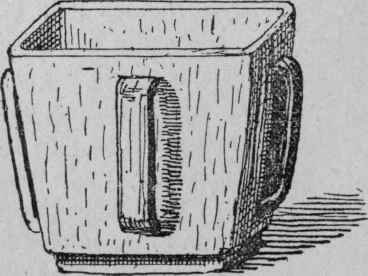
Wooden Cuagh Or Quaigh (Brit. Mus.)
Continue to:


My Books

